


The relation of menarcheal age to obesity in childhood and adulthood: the Bogalusa heart study
- PMID: 12723990
- PMCID: PMC156622
- DOI: 10.1186/1471-2431-3-3
The relation of menarcheal age to obesity in childhood and adulthood: the Bogalusa heart study
Abstract
Background: Several studies have shown that girls who undergo menarche at a relatively young age tend to be more obese as adults. However, because childhood (pre-menarcheal) levels of weight and height are associated with an earlier menarche, the increased prevalence of adult obesity among early maturers may largely reflect the persistence of childhood obesity into adulthood.
Methods: We examined these interrelationships among 1179 girls (65% white, 35% black) who were examined as children (mean age, 9 y), adolescents, and adults (mean age, 26 y) in the Bogalusa Heart Study.
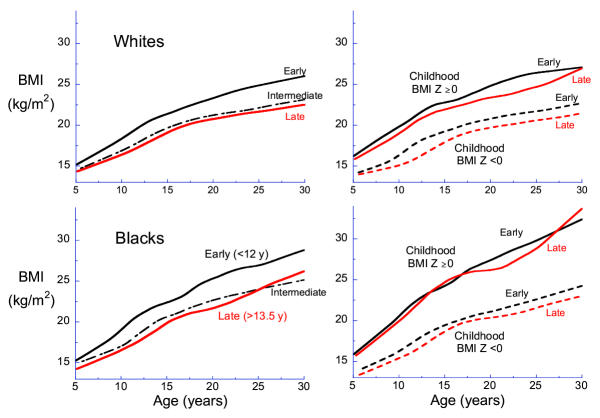
Results: Both white and black women who reported that they underwent menarche before age 12 y had, on average, higher adult levels of weight (+10 kg), body mass index (BMI, +4 kg/m2) and skinfold thicknesses (+6 mm) than did women who underwent menarche after age 13.5 y. However, relatively fat children tended to undergo menarche earlier than did thinner children, with each standard deviation increase in pre-menarcheal BMI increasing the odds of early menarche (<12 y) by approximately 2-fold. Stratified and regression analyses indicated that (1) adult obesity was more strongly associated with childhood obesity than with menarcheal age, and (2) about 60% to 75% of the apparent effect of menarcheal age was due to the influence of childhood obesity on both menarcheal age and adult obesity.
Conclusions: Although additional longitudinal studies are needed, it is likely that the importance of early menarche in adult obesity has been overestimated. Most of apparent influence of menarcheal age on adult obesity is attributable to the association of childhood obesity with both menarcheal age and adult obesity.
Figures
References
-
- Garn SM, LaVelle M, Rosenberg KR, Hawthorne VM. Maturational timing as a factor in female fatness and obesity. Am J Clin Nutr. 1986;43:879–883. - PubMed
-
- Sharma K, Talwar I, Sharma N. Age at menarche in relation to adult body size and physique. Ann Hum Biol. 1988;15:431–434. - PubMed
-
- Wellens R, Malina RM, Roche AF, Chumlea WC, Guo S, Siervogel R. Body size and fatness in young adults in relation to age at menarche. Am J Hum Biol. 1992;4:783–787. - PubMed
-
- St George IM, Williams S, Silva PA. Body size and the menarche: the Dunedin Study. J Adolesc Health. 1994;15:573–576. - PubMed
-
- Helm P, Munster K, Schmidt L. Recalled menarche in relation to infertility and adult weight and height. Acta Obstet Gynecol Scand. 1995;74:718–722. - PubMed
Publication types
MeSH terms
Grants and funding
LinkOut - more resources
Full Text Sources
Medical
