. 2003 May;15(5):1120-30.
doi: 10.1105/tpc.010827.

The Arabidopsis SLEEPY1 gene encodes a putative F-box subunit of an SCF E3 ubiquitin ligase

Affiliations

The Arabidopsis SLEEPY1 gene encodes a putative F-box subunit of an SCF E3 ubiquitin ligase

Karen M McGinnis et al. Plant Cell. 2003 May.

Abstract

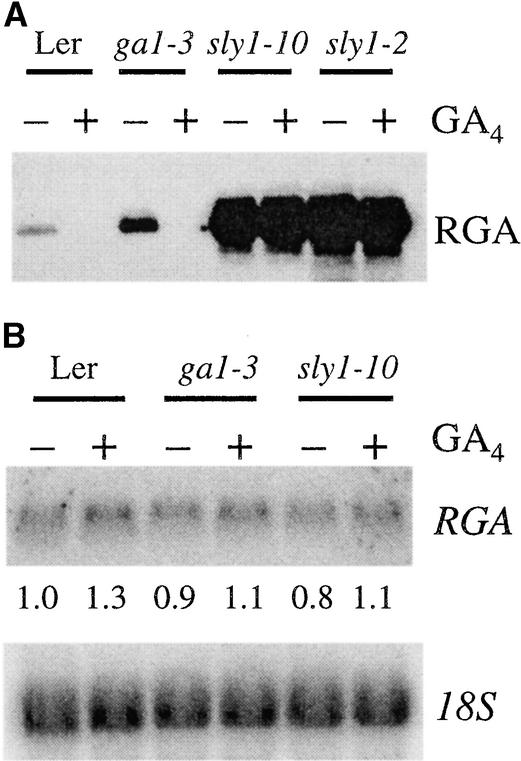
The Arabidopsis SLY1 (SLEEPY1) gene positively regulates gibberellin (GA) signaling. Positional cloning of SLY1 revealed that it encodes a putative F-box protein. This result suggests that SLY1 is the F-box subunit of an SCF E3 ubiquitin ligase that regulates GA responses. The DELLA domain protein RGA (repressor of ga1-3) is a repressor of GA response that appears to undergo GA-stimulated protein degradation. RGA is a potential substrate of SLY1, because sly1 mutations cause a significant increase in RGA protein accumulation even after GA treatment. This result suggests SCF(SLY1)-targeted degradation of RGA through the 26S proteasome pathway. Further support for this model is provided by the observation that an rga null allele partially suppresses the sly1-10 mutant phenotype. The predicted SLY1 amino acid sequence is highly conserved among plants, indicating a key role in GA response.


Figures
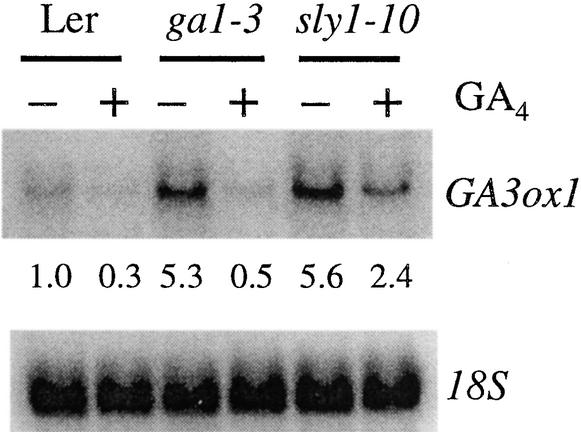
Figure 1.
Figure 1.
Effect of sly1 Mutations on GA3ox1 Transcript. An RNA gel blot, containing 10 μg of total RNA isolated from 8-day-old Ler (wild-type), ga1-3, and sly1-10 seedlings treated with (+) or without (−) 1 μM GA4 for 2 h, was hybridized with a labeled AtGA3ox1 antisense RNA probe. The blot was reprobed with a labeled 18S oligonucleotide probe. Numerals below the blot indicate the relative levels of AtGA3ox1 mRNA after standardization using the 18S RNA as a loading control. The level of AtGA3ox1 mRNA in the water-treated wild type was arbitrarily set to 1.0.
Figure 2.
Figure 2.
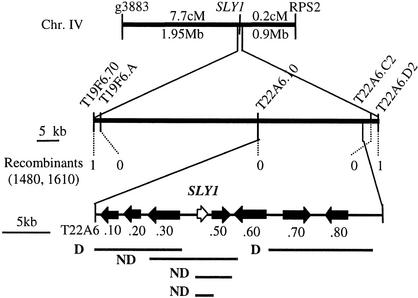
Map-Based Cloning of SLY1. Fine mapping delineated a 70-kb region containing SLY1 between markers T19F6.70 and T22A6.D2. Single recombination events were identified at T22A6.D2 (in 1610 chromosomes) and at T19F6.70 (in 1480 chromosomes). Overlapping BAC clones T22A6 and T19F6 cover this region (Arabidopsis Genome Initiative, 2000). Transformation with subclones of these BACs identified an 11.7-kb complementing subclone, T22A6.2G10. Transformation with T22A6.40 (from −1347 to +666 relative to the ATG) rescued sly1. D, dwarf; ND, nondwarf.
Figure 3.
Figure 3.
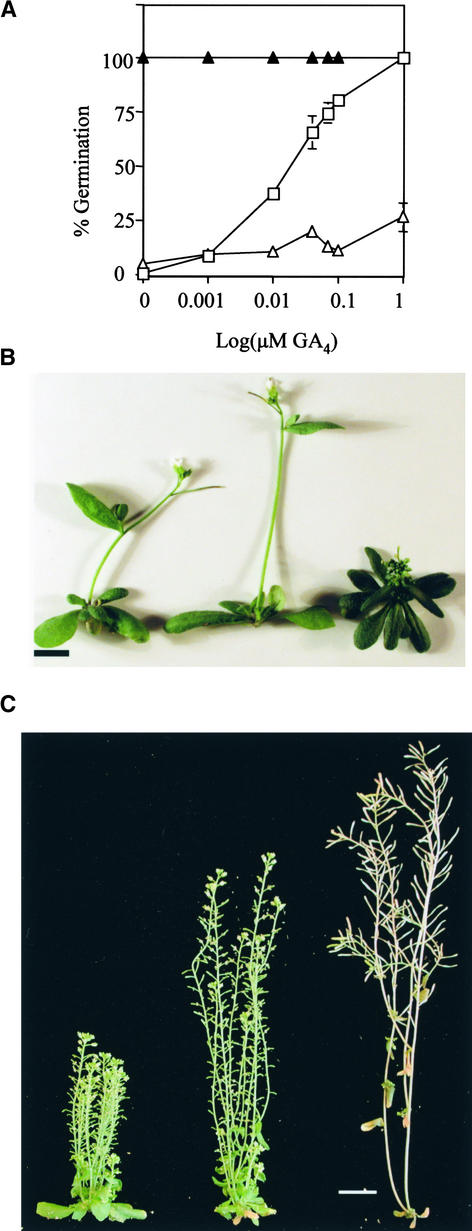
Complementation of sly1 Mutants. (A) GA dose response in germination. Transformation with the T22A6.2G10 subclone rescues the GA-insensitive germination phenotype of sly1-2. Percentage germination of dormant sly1-2 seeds (open triangles), the GA biosynthesis mutant ga1-3 (open squares), and sly1-2 transformed with T22A6.2G10 (closed triangles) is shown. Wild-type Ler germination was identical to that of T22A6.2G10-transformed sly1-2. Error bars represent standard errors for triplicate samples of 50 to 100 seeds. (B) Transformation with T22A6.40 (−1347 to +666) rescues the dwarf phenotype of sly1-2. Wild-type Ler (left), sly1-2+ T22A6.40 (center), and sly1-2 (right) plants are shown. Bar = 1 cm. (C) Suppression of sly1-10 by rga-24. sly1-10 (left), the sly1-10 rga-24 double mutant (center), and wild-type Ler (right) plants are shown. rga-24 partly rescues the dwarf phenotype of sly1-10, but not poor fertility. Ler and homozygous mutant plants were grown on soil for 60 days under a long-day photoperiod. Bar = 15 mm.
Figure 4.
Figure 4.
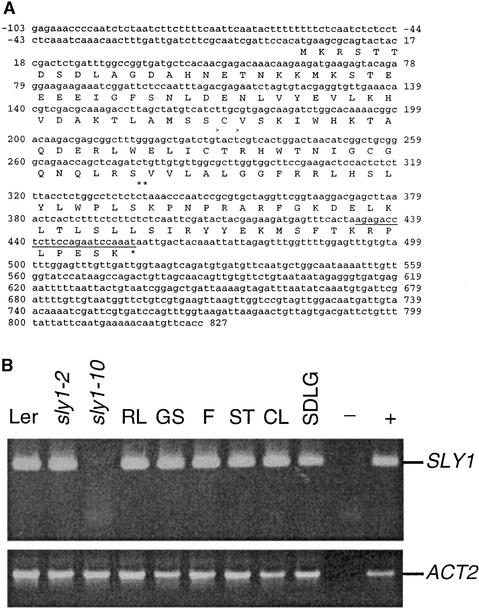
SLY1 mRNA. (A) Sequence of full-length SLY1 cDNA. The SLY1 gene contains no introns and predicts a protein of 151 amino acids. The first ATG (+1) in the transcript is the SLY1 translational start site. sly1-2 contains a 2-bp deletion (double asterisks). sly1-10 contains a 23-bp deletion (underlined) and an 8-kb insertion. (B) RT-PCR analysis of SLY1 mRNA accumulation. An ethidium bromide–stained 2% agarose gel from RT-PCR using 100 ng of total RNA for each sample is shown. SLY1 (250 bp) plus ACT2 (471 bp) accumulation are shown for wild-type Ler, sly1-2, and sly1-10 whole aerial plants and for wild-type Ler rosette leaves (RL), green siliques (GS), flowers (F), stems (ST), cauline leaves (CL), and seedlings (SDLG). For seedlings, tissue was harvested from 4-week-old plants. −, no RNA template; +, genomic DNA.
Figure 5.
Figure 5.
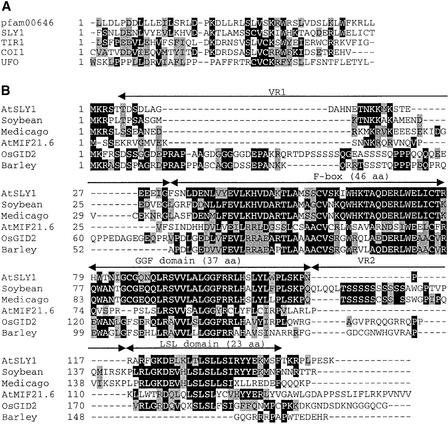
SLY1 Sequence Alignments. (A) Alignment of the SLY1 F-box with National Center for Biotechnology Information consensus Pfam00646 (an F-box protein family) and other Arabidopsis F-box proteins. (B) Alignment of SLY1 with plant homologs from soybean, Medicago truncatula, Arabidopsis MIF21.6, rice OsGID2, and barley. The amino acid sequence predicted from the largest open reading frame in each EST is listed. GGF and LSL refer to conserved residues. aa, amino acids; VR, variable region.
Figure 6.
Figure 6.
RGA Protein Levels, but Not the RGA mRNA, Are Highly Increased in sly1 Mutants. (A) Eight-day-old seedlings were treated with (+) or without (−) 1 μM GA4 for 2 h, and protein extracts were fractionated by 8% SDS-PAGE. The protein blot was probed with an anti-RGA antibody. Ponceau staining was used to confirm equal loading of the blot (data not shown). (B) A duplicate RNA gel blot (described in Figure 1A) was hybridized with a labeled RGA DNA probe. Numerals below the blot indicate the relative levels of RGA mRNA after standardization using 18S as a loading control. The level of RGA mRNA in the water-treated wild type was arbitrarily set to 1.0.
Figure 7.
Figure 7.
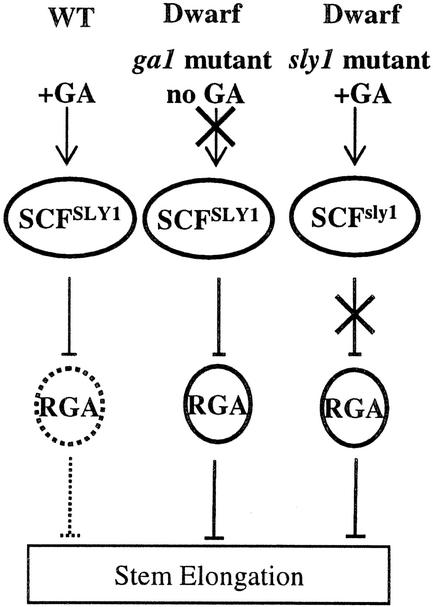
Model for the Role of SLY1 in GA Signaling. The dwarf phenotype of GA biosynthetic mutants results from the accumulation of active RGA protein. In wild-type (WT) plants (+GA), GA stimulates SCFSLY1 (directly or indirectly) to target RGA for degradation, resulting in normal height. The ga1 biosynthetic mutant is a dwarf because there is insufficient GA to stimulate SCFSLY1 to target RGA for proteolysis. The sly1 mutant is a dwarf because a lack of functional SCFSLY1 results in increased accumulation of RGA.

References

    1. Allan, R.E. (1986). Agronomic comparison among wheat lines nearly isogenic for three reduced-height genes. Crop Sci. 26, 707–710.
    1. Altschul, S.F., Gish, W., Miller, W., Myers, E.W., and Lipman, D.J. (1990). Basic local alignment search tool. J. Mol. Biol. 215, 403–410. - PubMed
    1. An, Y.Q., McDowell, J.M., Huang, S., McKinney, E.C., Chambliss, S., and Meagher, R.B. (1996). Strong, constitutive expression of the Arabidopsis ACT2/ACT8 actin subclass in vegetative tissues. Plant J. 10, 107–121. - PubMed
    1. Arabidopsis Genome Initiative (2000). Analysis of the genome sequence of the flowering plant Arabidopsis thaliana. Nature 408, 796–815. - PubMed
    1. Bechtold, N., Ellis, J., and Pelletier, G. (1993). In planta Agrobacterium-mediated gene transfer by infiltration of adult Arabidopsis thaliana plants. C. R. Acad. Sci. Paris 316, 1194–1199.

Publication types

MeSH terms