. 2003 May 1;17(9):1175-87.
doi: 10.1101/gad.260703.

Molecular analysis of the LATERAL SUPPRESSOR gene in Arabidopsis reveals a conserved control mechanism for axillary meristem formation

Affiliations

Molecular analysis of the LATERAL SUPPRESSOR gene in Arabidopsis reveals a conserved control mechanism for axillary meristem formation

Thomas Greb et al. Genes Dev. .

Abstract

In seed plants, shoot branching is initiated by the formation of new meristems in the axils of leaves, which subsequently develop into new axes of growth. This study describes the genetic control of axillary meristem formation by the LATERAL SUPPRESSOR (LAS) gene in Arabidopsis thaliana. las mutants show a novel phenotype that is characterized by the inability to form lateral shoots during vegetative development. The analysis shows that axillary meristem formation is differently regulated during different phases of development. During reproductive development, axillary meristems initiate in close proximity to the shoot apical meristem and do not require LAS function. In contrast, during the vegetative phase, axillary meristems initiate at a distance to the SAM and require LAS function. This control mechanism is conserved between the distantly related species tomato and Arabidopsis. Monitoring the patterns of LAS and SHOOT MERISTEMLESS transcript accumulation allowed us to identify early steps in the development of leaf axil identity, which seem to be a prerequisite for axillary meristem initiation. Other regulators of shoot branching, like REVOLUTA and AUXIN RESISTANT 1, act downstream of LAS. The results are discussed in the context of the "detached meristem" and the "de novo formation" concepts of axillary meristem formation.


Figures
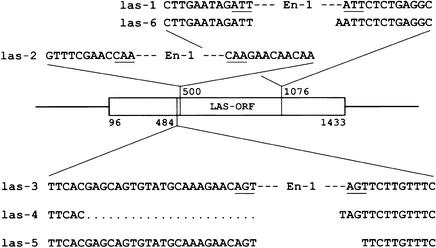
Figure 1
Figure 1
Structure of different LAS alleles. Transcription is from left to right. Numbers are positions in the LAS cDNA. Enhancer-1 (En-1) insertions in independent mutant alleles are indicated at their positions in LAS. The underlined bases represent the target site duplications produced by the insertions of the transposable element En-1.
Figure 2
Figure 2
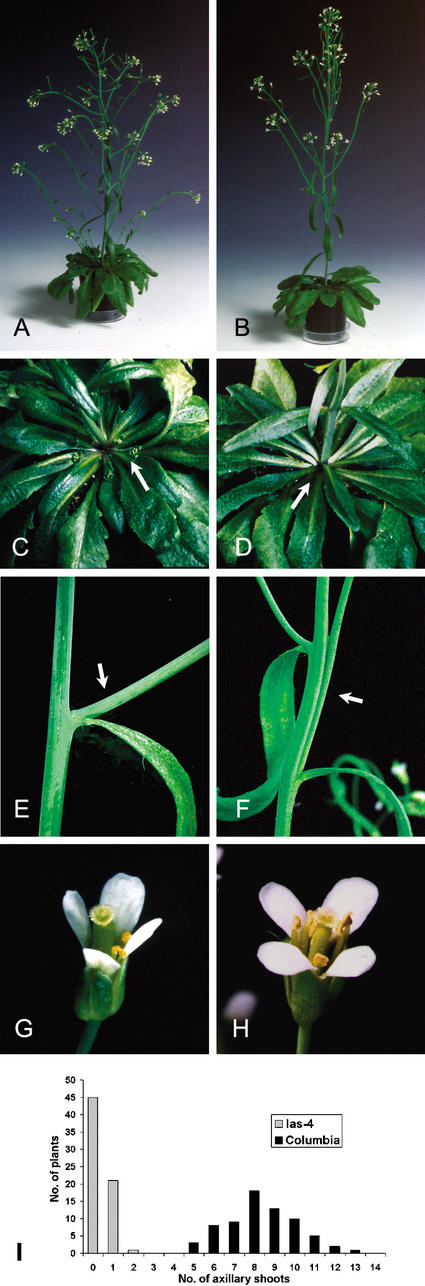
Comparison of wild-type (A,C,E,G) and las-4 (B,D,F,H) plants during vegetative and inflorescence development. In Columbia wild-type plants (A,C) multiple axillary inflorescences have developed from the axils of rosette leaves (C, arrow), whereas axillary shoot development from rosette leaves is blocked in las-4 mutant plants (B,D). Arrows indicate the formation of axillary shoots in Columbia (C) and their absence in las-4 (D) plants, respectively. (EH) Comparisons of cauline leaf axils (E,F) and flowers (G,H) from the wild-type (E,G) and the las-4 mutant (F,H) plants. The arrows in E and F point to the axes of lateral shoots, which are separated from (Columbia) or attached to the primary axis (las-4) of the plant. (I) A comparison of side-shoot development after decapitation. Plants were first grown under short-day conditions for 28 d and then shifted to long days to induce flowering (Col., n = 76; las-4, n = 67). Primary bolts were removed when the plants reached a height of ∼10–15 cm. Side shoots were counted 10 d after the decapitation.
Figure 3
Figure 3
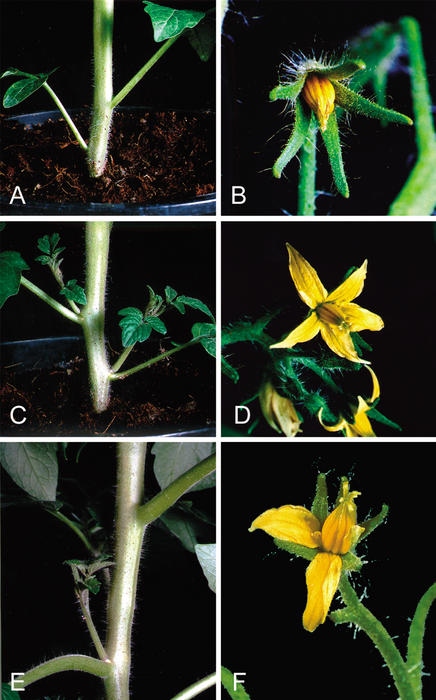
Functional complementation of the tomato ls1 mutant with the Arabidopsis LAS gene. Comparison of phenotypes of Antimold B-ls1 (A,B) and Antimold B-ls1 transformed with construct C28.1 (CF). The pictures show close-ups of leaf axils (A,C,E) and flowers (B,D,F). Note the absence of an axillary shoot in one leaf axil in E and the incomplete whorl of petals in F.
Figure 4
Figure 4
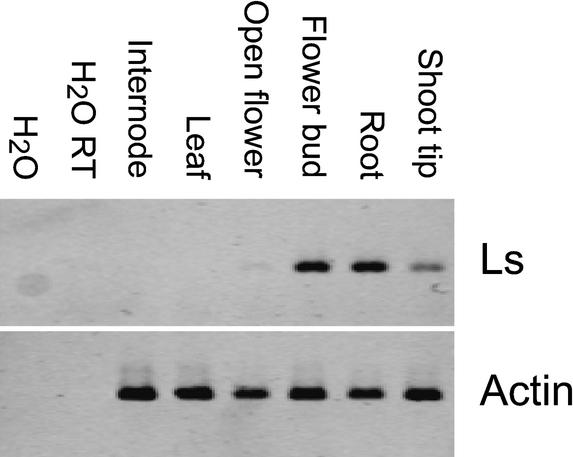
RT–PCR analysis of LAS transcript accumulation. Total RNA from different plant tissues was analyzed by RT–PCR, and the PCR products were hybridized to a probe from the LAS gene. Amplification of actin cDNA was used to ensure that equal amounts of cDNA were added to each PCR reaction.
Figure 5
Figure 5
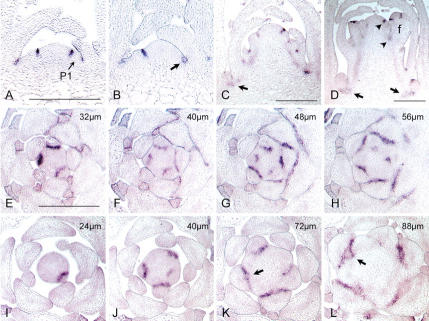
Patterns of LAS mRNA accumulation during vegetative and reproductive development. Longitudinal and transverse sections through shoot tips of Columbia (AH) and Landsberg erecta (IL) plants were hybridized with a probe from the LAS gene. (A) Longitudinal section through the shoot apex of a 28-day-old plant grown under short-day conditions. The arrow points to the P1 primordium. (BD) Longitudinal sections through shoot tips of Columbia plants grown for 28 d in short days and subsequently for 2 d (B), 4 d (C), or 6 d (D) under long-day conditions. The arrows in B, K, and L point to LAS signals that show a down-regulation in their central region. The arrows in C and D indicate residual amounts of LAS transcripts at the base of developing axillary meristems. The arrowheads in D indicate LAS expression domains in the axils of flower primordia. (EL) Successive transverse sections from 28-day-old Columbia (EH) and Landsberg erecta (IL) plants grown in short days. (EL) The approximate distance from the top of the meristem to the middle of the section is given in the upper right corner of the image. As Landsberg erecta plants are more elongated at this time point than Columbia plants, not all serial sections are depicted in this case. Bars: A (for A,B), C,D,E (for EL), 200 μm; f, flower primordium; P1, P1 primordium.
Figure 6
Figure 6
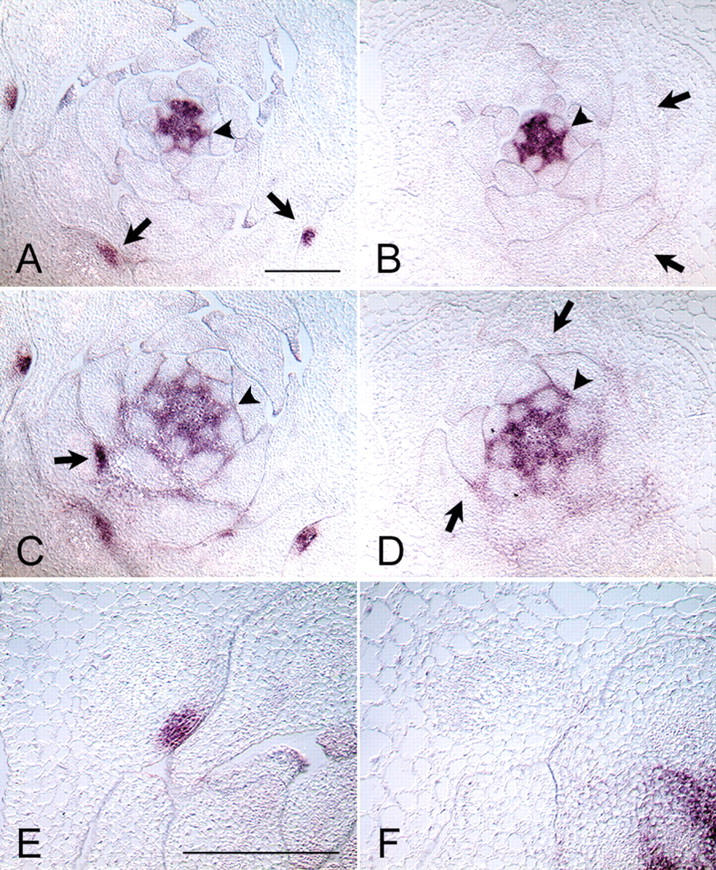
Comparison of STM mRNA accumulation in vegetative shoot apices of wild-type (A,C,E) and las-4 (B,D,F) plants. Consecutive transverse sections through shoot apices of Columbia wild-type (A,C,E) and las-4 (B,D,F) plants were hybridized with an STM antisense probe. Sections were prepared from plants grown under short-day conditions for 28 d before fixation. In wild-type and las-4 plants, STM mRNA is detected in the SAM and in interprimordial regions (AD, arrowheads). In addition, a focused STM expression domain was observed close to the adaxial center of older leaf primordia of the wild type (E; A,C, arrows) but not in the las-4 mutant (F; B,D, arrows). Bars, 200 μm. Same magnifications in AD and E and F.
Figure 7
Figure 7
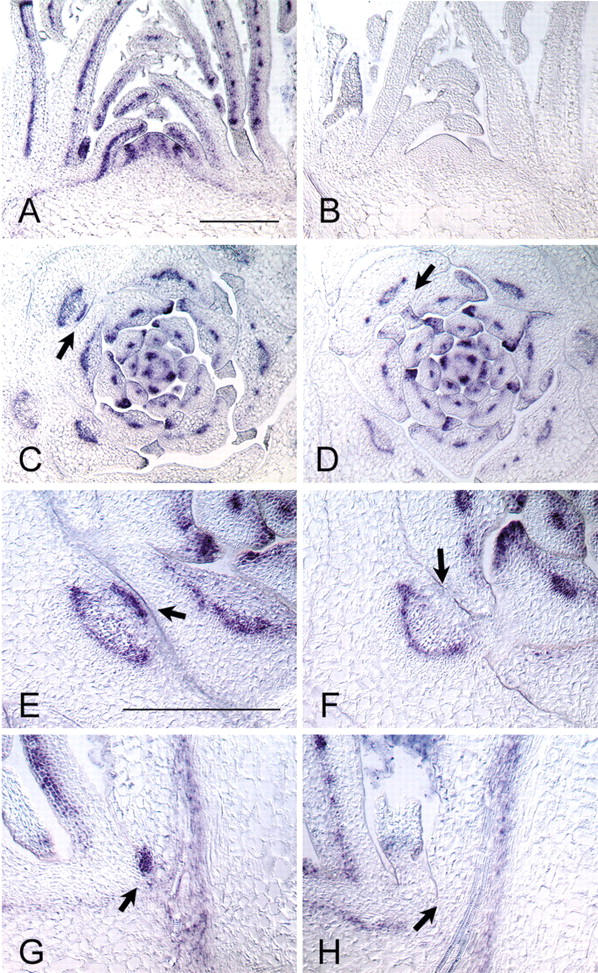
Patterns of REV transcript accumulation in wild-type and las-4 plants. Longitudinal (A,B,G,H) and transverse (CF) sections through shoot tips of Columbia (A,B,C,E,G) and las-4 (D,F,H) plants were hybridized with REV antisense (A,CH) and sense (B) probes, respectively. REV transcripts were detected in vascular bundles and provascular tissues of leaf primordia in Columbia (A,C) and las-4 (D) plants. In addition, REV is expressed in an inverse cup-shaped domain in the SAM (A). In leaf primordia older than P16 of Columbia wild-type plants, REV transcript accumulation was also observed in a cell group close to the adaxial center of the primordium (C,E,G, arrows). This expression domain was not found in las-4 plants (D,F,H, arrows). Hybridization with the sense probe (B) showed that the observed signals were specific for REV mRNA.
Figure 8
Figure 8
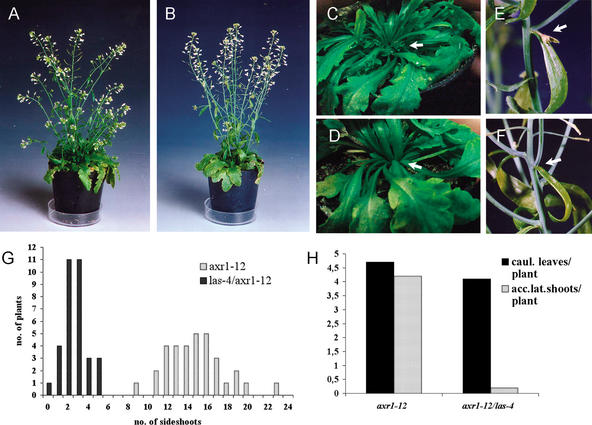
Phenotypic analysis of axr1-12 and axr1-12 las-4 plants. In axr1-12 (n = 33), multiple axillary shoots developed from the axils of rosette leaves (A,C,G), whereas axillary shoot development from rosette leaf axils was strongly reduced in axr1-12 las-4 double mutants (n = 33; B,D,G). The arrows point to the rosette leaf axils of axr1-12 (C) and axr1-12 las-4 (D) plants. In addition, axr1-12 plants developed accessory side shoots in almost every cauline leaf axil (arrow in E,H). This process was found to be blocked in most cauline leaf axils of the axr1-12 las-4 double mutants (arrow in F,H).

References

    1. Abel S, Nguyen MD, Theologis A. The PS-IAA4/5-like family of early auxin-inducible mRNAs in Arabidopsis thaliana. J Mol Biol. 1995;251:533–549. - PubMed
    1. Aida M, Ishida T, Tasaka M. Shoot apical meristem and cotyledon formation during Arabidopsis embryogenesis: Interaction among the CUP-SHAPED COTYLEDON and SHOOT MERISTEMLESS genes. Development. 1999;126:1563–1570. - PubMed
    1. Altschul SF, Gish W, Miller W, Myers EW, Lipman DJ. Basic local alignment search tool. J Mol Biol. 1990;215:403–410. - PubMed
    1. Baumann E, Lewald J, Saedler H, Schulz B, Wisman E. Successful PCR-based reverse genetic screen using an En-1-mutagenised Arabidopsis thaliana population generated via single-seed descent. Theor Appl Genet. 1998;97:729–734.
    1. Becker D, Kemper E, Schell J, Masterson R. New plant binary vectors with selectable markers located proximal to the left T-DNA border. Plant Mol Biol. 1992;20:1195–1197. - PubMed

MeSH terms