Comment
. 2003 May;185(10):2988-98.
doi: 10.1128/JB.185.10.2988-2998.2003.

Discordant phylogenies within the rrn loci of Rhizobia

Affiliations
Comment

Discordant phylogenies within the rrn loci of Rhizobia

Peter van Berkum et al. J Bacteriol. 2003 May.

Abstract

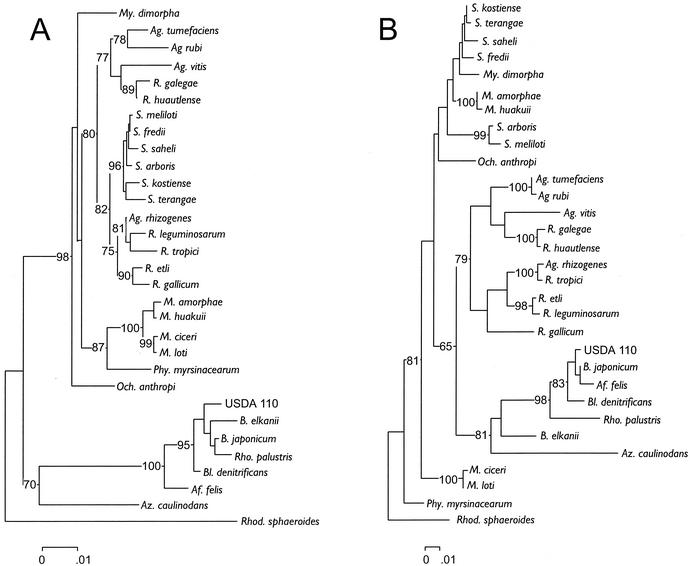
It is evident from complete genome sequencing results that lateral gene transfer and recombination are essential components in the evolutionary process of bacterial genomes. Since this has important implications for bacterial systematics, the primary objective of this study was to compare estimated evolutionary relationships among a representative set of alpha-Proteobacteria by sequencing analysis of three loci within their rrn operons. Tree topologies generated with 16S rRNA gene sequences were significantly different from corresponding trees assembled with 23S rRNA gene and internally transcribed space region sequences. Besides the incongruence in tree topologies, evidence that distinct segments along the 16S rRNA gene sequences of bacteria currently classified within the genera Bradyrhizobium, Mesorhizobium and Sinorhizobium have a reticulate evolutionary history was also obtained. Our data have important implications for bacterial taxonomy, because currently most taxonomic decisions are based on comparative 16S rRNA gene sequence analysis. Since phylogenetic placement based on 16S rRNA gene sequence divergence perhaps is questionable, we suggest that the proposals of bacterial nomenclature or changes in their taxonomy that have been made may not necessarily be warranted. Accordingly, a more conservative approach should be taken in the future, in which taxonomic decisions are based on the analysis of a wider variety of loci and comparative analytical methods are used to estimate phylogenetic relationships among the genomes under consideration.


Figures
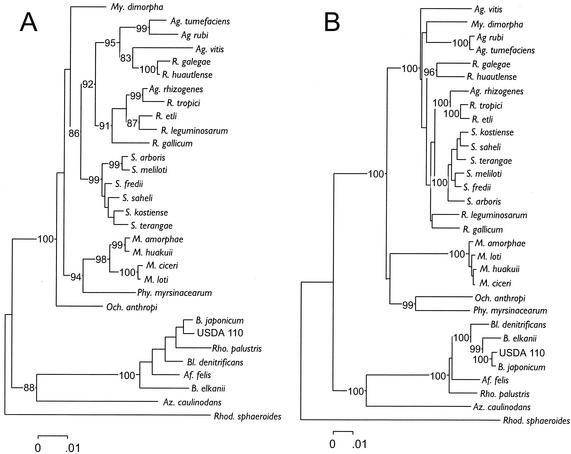
FIG. 1.
FIG. 1.
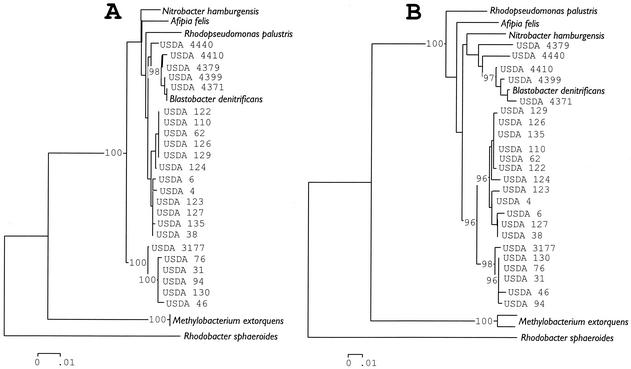
Phylogenetic relationships among a select group of bacteria belonging to the α-subdivision of the Proteobacteria reconstructed from 16S rRNA gene sequence divergence (A) or 23S rRNA gene sequence divergence (B). Sequences were aligned by using PILEUP of the Wisconsin package of the Genetics Computer Group (Madison, Wis.); aligned sequences were checked manually and were edited with Genedoc (see Materials and Methods) before deriving neighbor-joining trees that were constructed from Jukes-Cantor distances by using the MEGA package version 1.01 (29). Trees assembled in a stepwise manner with parsimony analysis by using Paup version 4.0b8a (58) had the same topologies as the distance trees shown. GenBank accession numbers used for the 16S rRNA gene sequences were as follows: A. felis, AF003937; A. rhizogenes, D14501; A. rubi, D14503; A. tumefaciens, D14500; A. vitis, D14502; A. caulinodans, X94200; B. denitrificans, S46917; B. japonicum, U69638; B. japonicum USDA 110, Z35330; B. elkanii, U35000; M. amorphae, AF041442; M. ciceri, U07934; M. huakuii, D13431; M. loti, X67229; M. dimorpha, D12786; O. anthropi, D12794; P. myrsinacearum, D12789; R. etli, U28916; R. galegae, X67226; R. gallicum, U86343; R. leguminosarum, U29386; R. tropici, U89832; Sinorhizobium arboris, Z78204; Sinorhizobium fredii, X67231; Sinorhizobium kostiense, Z78203; S. meliloti, X67222; Sinorhizobium saheli, X68390; Sinorhizobium terangae, X68387; R. sphaeroides, X53855; and R. palustris, D25312. GenBank accession numbers used for the 23S rRNA gene sequences were as follows: B. japonicum USDA 110, Z35330; R. palustris, X71839; and R. sphaeroides, X53855.
FIG. 2.
FIG. 2.
Phylogenetic relationships among a select group of bacteria belonging to the α-subdivision of the Proteobacteria reconstructed from the 16S rRNA gene sequence divergence (A) or the ITS region sequence divergence (B). Sequences were aligned by using PILEUP of the Wisconsin package of the Genetics Computer Group (Madison, Wis.); aligned sequences were checked manually and were edited with Genedoc (see Materials and Methods) before deriving neighbor-joining trees that were constructed from Jukes-Cantor distances using the MEGA package version 1.01 (29). Trees assembled in a stepwise manner with parsimony analysis by using Paup version 4.0b8a (58) had the same topologies as the distance trees shown.
FIG. 3.
FIG. 3.
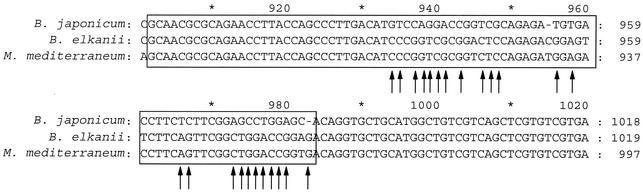
Comparison of the distribution of polymorphic nucleotide positions along 16S rRNA gene genes of B. elkanii (USDA 76); B. japonicum (USDA 6), and M. mediterraneum (Upm-Ca 36) identifying possible gene conversion events between alleles of USDA 76 and Upm-Ca36 from evidence gathered with Genconv version 1.02 (52). The arrows indicate base pair matches between B. elkanii and M. mediterraneum for which there was a corresponding mismatch with B. japonicum.
FIG. 4.
FIG. 4.
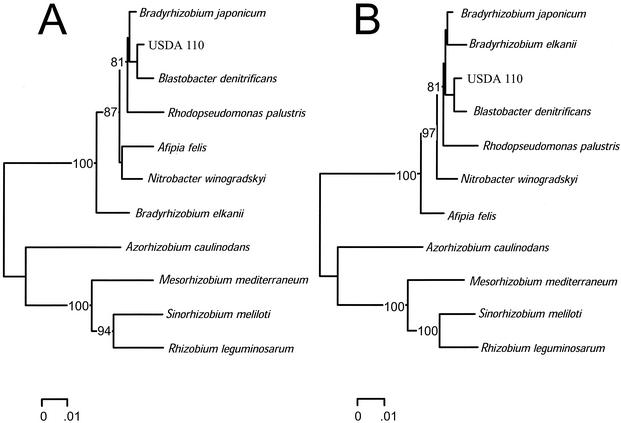
Changes in 16S rRNA gene tree topology following removal of a region identified as a possible gene conversion event between alleles of B. elkanii and M. mediterraneum. Distance control trees (A) were reconstructed from aligned 16S rRNA gene sequence of B. japonicum (U69638), B. elkanii (U35000), R. palustris (D25312), B. denitrificans (S46917), A. felis (AF003937), N. winogradskyi (L35506), A. caulinodans (X94200), M. mediterraneum (L38825), S. meliloti (X67222), and R. leguminosarum (U29386) as described for the legend to Fig. 1 and were compared with a similar tree by using the aligned sequences from which the small region had been removed (B). Trees assembled in a stepwise manner with parsimony analysis using Paup version 4.0b8a (58) had the same topologies as the distance trees shown.
FIG. 5.
FIG. 5.
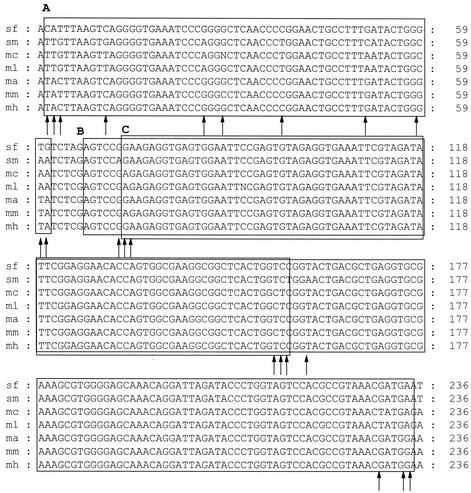
Comparison of the distribution of polymorphic nucleotide positions along 16S rRNA genes of S. fredii (USDA 205), S. meliloti (USDA 1002), M. ciceri (UPM-Ca7), M. loti (NZP 2213), M. amorphae (ACCC 19665), M. mediterraneum (Upm-Ca36), and M. huakuii (CCBAU2609) identifying possible gene conversion events between alleles from evidence gathered with Genconv version 1.02 (52). The arrows indicate base pair mismatches between S. fredii and S. meliloti for which there was a corresponding match between Mesorhizobium and Sinorhizobium.
FIG. 6.
FIG. 6.
Changes in 16S rRNA gene tree topology following removal of two regions identified as a possible gene conversion event between alleles of two species of Sinorhizobium and four species of Mesorhizobium. The distance control tree is presented in Fig. 1A, which is compared with the distance tree after removal of the 317-bp fragment (A). Also shown is the tree topology obtained using the combined region that was deleted from the alignment (B). Trees assembled in a stepwise manner with parsimony analysis by using Paup version 4.0b8a (58) had the same topologies as the distance trees shown.

Comment on

References

    1. Amabile-Cuevas, C. F., M. Cardenas-Garcia, and M. Ludgar. 1995. Antibiotic resistance. Am. Sci. 83:320-329.
    1. Amann, G., K. O. Stetter, E. Llobet-Brossa, R. Amann, and J. Anton. 2000. Direct proof for the presence and expression of two 5% different 16S rRNA genes in individual cells of Haloarcula marismortui. Extremophiles 4:373-376. - PubMed
    1. Blattner, F. R., G. I. Plunketti, C. A. Bloch, N. T. Perna, V. Burland, M. Riley, V. J. Collado, J. D. Glasner, C. K. Rode, G. F. Mayhew, J. Gregor, N. W. Davis, H. A. Kirkpatrick, M. A. Goeden, D. J. Rose, B. Mau, and Y. Shao. 1997. The complete genome sequence of Escherichia coli K-12. Science (Washington, D.C.) 277:1453-1462. - PubMed
    1. Bolotin, A., P. Wincker, S. Mauger, O. Jaillon, K. Malarme, J. Weissenbach, S. D. Ehrlich, and A. Sorokin. 2001. The complete genome sequence of the lactic acid bacterium Lactococcus lactis ssp. lactis IL1403. Genome Res. 11:731-753. - PMC - PubMed
    1. Bourgoin, F., G. Guedon, M. Pebay, Y. Roussel, C. Panis, and B. Decaris. 1996. Characterization of a mosaic ISS1 element and evidence for the recent horizontal transfer of two different types of ISS1 between Streptococcus thermophilus and Lactococcus lactis. Gene 178:15-23. - PubMed

LinkOut - more resources