. 2003 May 13;100(10):5968-73.
doi: 10.1073/pnas.1037651100. Epub 2003 May 1.

Substoichiometric shifting in the plant mitochondrial genome is influenced by a gene homologous to MutS

Affiliations

Substoichiometric shifting in the plant mitochondrial genome is influenced by a gene homologous to MutS

Ricardo V Abdelnoor et al. Proc Natl Acad Sci U S A. .

Abstract

The plant mitochondrial genome is retained in a multipartite structure that arises by a process of repeat-mediated homologous recombination. Low-frequency ectopic recombination also occurs, often producing sequence chimeras, aberrant ORFs, and novel subgenomic DNA molecules. This genomic plasticity may distinguish the plant mitochondrion from mammalian and fungal types. In plants, relative copy number of recombination-derived subgenomic DNA molecules within mitochondria is controlled by nuclear genes, and a genomic shifting process can result in their differential copy number suppression to nearly undetectable levels. We have cloned a nuclear gene that regulates mitochondrial substoichiometric shifting in Arabidopsis. The CHM gene was shown to encode a protein related to the MutS protein of Escherichia coli that is involved in mismatch repair and DNA recombination. We postulate that the process of substoichiometric shifting in plants may be a consequence of ectopic recombination suppression or replication stalling at ectopic recombination sites to effect molecule-specific copy number modulation.


Figures
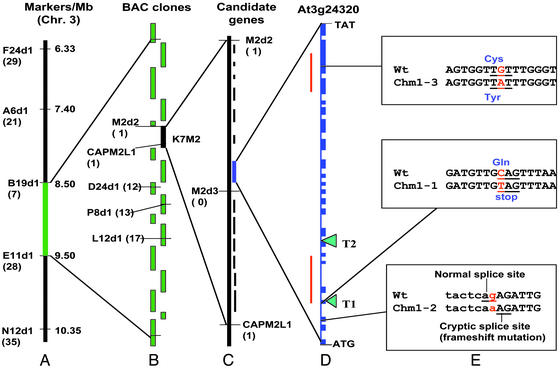
Figure 1
Figure 1
Positional cloning of the CHM candidate locus. The use of molecular markers permitted the establishment of a genetic map (A) and identification of the intervening overlapping bacterial artificial chromosome clones for physical mapping (B). All physical mapping information was derived from the Arabidopsis Genome Initiative (50). High-resolution mapping with three markers permitted delimitation of the locus to an 80-kb interval contained within a single bacterial artificial chromosome clone (C). A gene candidate was identified within the interval based on predicted mitochondrial targeting features. The candidate CHM locus contains 22 exons (D) with two MutS-like conserved intervals denoted by red lines. Analysis of two ethyl methanesulfonate-derived mutants (chm1-1 and chm1-2) and one tissue culture-derived mutant (chm1-3), as well as two T-DNA insertion mutations (T1 and T2), provided definitive evidence of CHM identity (E). The numbers in parentheses in A correspond to the number of recombinants identified between the marker and the gene.
Figure 2
Figure 2
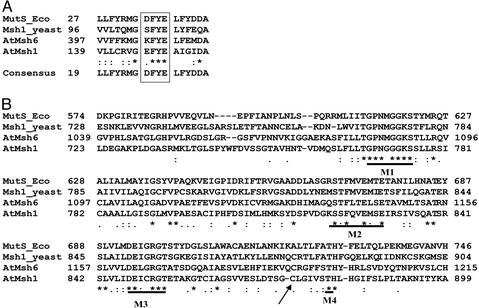
Alignment of AtMSH1 with MutS and MutS homologs. The amino acid sequence alignment was performed by using CLUSTALW software and includes the MutS sequence from E. coli, MSH1 from Saccharomyces cerevisiae, and AtMSH6 and CHM (AtMSH1) from Arabidopsis. (A) Alignment of the region of the DNA binding domain that encompasses the conserved motif for mismatch recognition and DNA binding. (B) Alignment of a portion of the ATPase domain. The characteristic motifs for this domain are indicated by bold lines. M1, Walker motif; M2, ST motif; M3, DE motif (Walker B motif); M4, TH motif (31, 32). The asterisks indicate residues that are identical, and the arrow indicates the site of amino acid substitution in mutant chm1-3.
Figure 3
Figure 3
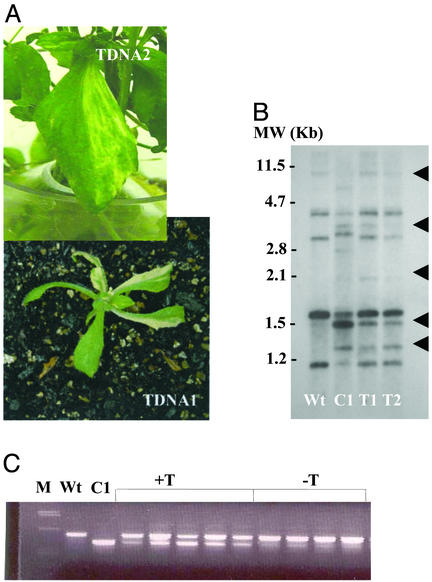
The T-DNA insertion mutation phenotype. (A) Green-white variegation phenotype observed in two independent mutants derived by T-DNA insertion within the candidate CHM locus. T-DNA 1, SALK041951; T-DNA 2, SALK046763. (B) DNA gel blot hybridization analysis of mitochondrial genome configuration using the mitochondrial atp9-rpl16 junction sequence associated with substoichiometric shifting (16) as probe. Total genomic DNA was digested with BamHI, subjected to gel electrophoresis, blotted, and probed. Lane Wt designates wild-type ecotype Col-0, lane C1 designates mutant chm1-1, and lanes T1 and T2 designate two sister lines containing the T-DNA 1 insertion mutation. Arrowheads indicate DNA band pattern changes associated with substoichiometric shifting (24). (C) Cosegregation analysis of mitochondrial substoichiometric shifting with the T-DNA 1 insertion mutation. A three-primer PCR-based assay to detect substoichiometric shifting (16) was used to assay wild-type Col-0 (Wt), mutant chm1-1 (C1), and individual plants segregating for presence of the T-DNA insertion within the candidate CHM locus. All lanes labeled +T represent individual population segregants that are homozygous for the T-DNA insertion, whereas lanes labeled −T include two segregants that are hemizygous for the T-DNA insertion and two segregants that do not contain the T-DNA insertion. M designates the molecular weight marker lane.
Figure 4
Figure 4
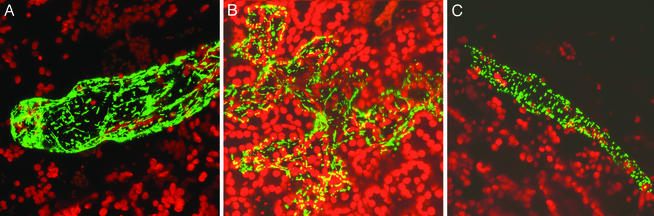
Evidence for mitochondrial targeting capacity by the AtMSH1 protein. Particle bombardment experiments involved delivery of the AtMSH1 targeting presequence fused with enhanced gfp in association with the cauliflower mosaic virus 35S promoter. A and B show gfp localization as green within transformed epidermal cells. Mitochondria were identified by their characteristic movement and rapid interconversions from small, round to highly elongated shapes (A). Plastids located in the cells beneath emit red autofluorescence. Positive controls for mitochondrial (F1-ATPase γ-subunit provided by D. Stern, Boyce Thompson Institute, Ithaca, NY) (C) and chloroplast (Rubisco Pea/SSU/TPSS, provided by L. Alison, University of Nebraska) (data not shown) targeting were included with each experiment.

References

    1. Golden T R, Melov S. Mech Aging Dev. 2001;122:1577–1589. - PubMed
    1. Naviaux R K. Eur J Pediatr. 2000;159:S219–S226. - PubMed
    1. Ravagnan L, Roumier T, Kroemer G. J Cell Physiol. 2002;192:131–137. - PubMed
    1. Epstein C B, Waddle J A, Hale W, Dave V, Thornton J, Macatee T L, Garner H R, Butow R A. Mol Biol Cell. 2001;12:297–308. - PMC - PubMed
    1. Small I, Wintz H, Akashi K, Mireau H. Plant Mol Biol. 1998;38:265–277. - PubMed

Publication types

MeSH terms

Associated data