. 2003 May;69(5):2684-91.
doi: 10.1128/AEM.69.5.2684-2691.2003.

A census of rRNA genes and linked genomic sequences within a soil metagenomic library

Affiliations

A census of rRNA genes and linked genomic sequences within a soil metagenomic library

Mark R Liles et al. Appl Environ Microbiol. 2003 May.

Abstract

We have analyzed the diversity of microbial genomes represented in a library of metagenomic DNA from soil. A total of 24,400 bacterial artificial chromosome (BAC) clones were screened for 16S rRNA genes. The sequences obtained from BAC clones were compared with a collection generated by direct PCR amplification and cloning of 16S rRNA genes from the same soil. The results indicated that the BAC library had substantially lower representation of bacteria among the Bacillus, alpha-Proteobacteria, and CFB groups; greater representation among the beta- and gamma-Proteobacteria, and OP10 divisions; and no rRNA genes from the domains Eukaryota and Archaea. In addition to rRNA genes recovered from the bacterial divisions Proteobacteria, Verrucomicrobia, Firmicutes, Cytophagales, and OP11, we identified many rRNA genes from the BAC library affiliated with the bacterial division Acidobacterium; all of these sequences were affiliated with subdivisions that lack cultured representatives. The complete sequence of one BAC clone derived from a member of the Acidobacterium division revealed a complete rRNA operon and 20 other open reading frames, including predicted gene products involved in cell division, cell cycling, folic acid biosynthesis, substrate metabolism, amino acid uptake, DNA repair, and transcriptional regulation. This study is the first step in using genomics to reveal the physiology of as-yet-uncultured members of the Acidobacterium division.


Figures
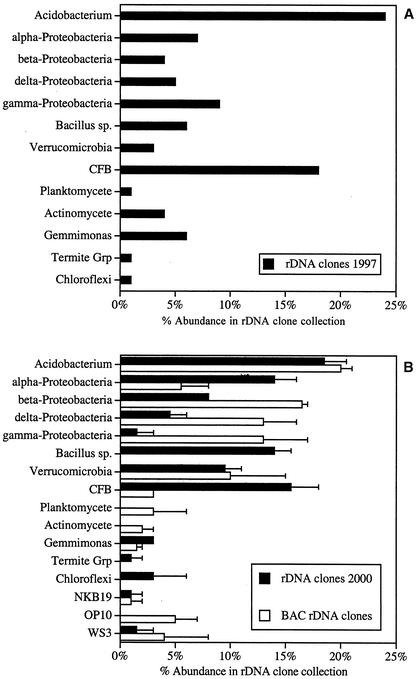
FIG. 1.
FIG. 1.
Phylogenetic distribution of 16S rRNA genes amplified from DNA recovered from soil and a soil metagenomic library. Shown are phylogenetic distributions for rDNA clones derived from soil isolated at the WMARS in the year 1997 (n = 124) (A) or in the year 2000 (n = 130) (B). Panel B also shows the phylogenetic distribution of rRNA genes amplified from the BAC SL2 (n = 132), which was constructed from the same soil sample used for the rDNA clone library in the year 2000. Each rRNA gene sequence was aligned with a large data set of 16S rRNA gene sequences, and maximum-parsimony analysis indicated a phylogenetic affiliation. The percentage of rDNA clones within each phylogenetic group is indicated. Groups that lack a bar (e.g., the Bacillus group in panel B) indicate the absence of clones affiliated with a particular phylogenetic group. Error bars represent the standard errors for the average percentages of abundance of each phylogenetic group within replicate rDNA clone libraries, each prepared from the same DNA template.
FIG. 2.
FIG. 2.
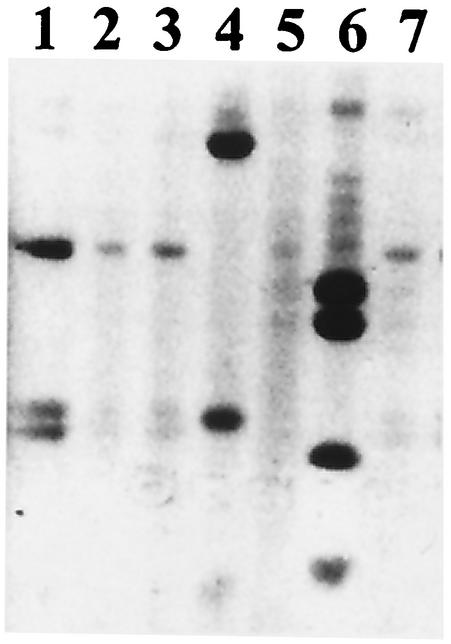
RFLP analysis of rRNA PCR products from metagenomic library clones. Depicted is an RF pattern for the E. coli negative control (lane 1) and 6 different BAC pools, each of which contains a DNA template from 12 different BAC clones. Lanes 4 and 6 reveal BACs containing rRNA genes, whereas lanes 2, 3, 5, and 7 reveal only a faint RF pattern presumably derived from E. coli 16S rRNA genes.
FIG. 3.
FIG. 3.
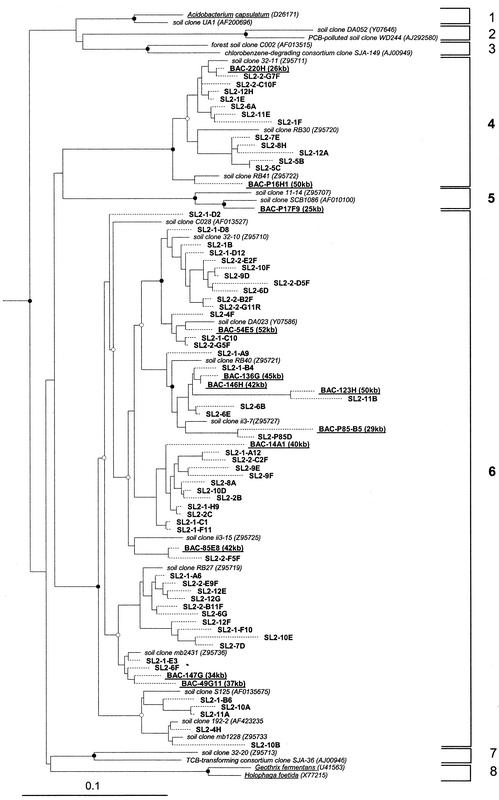
Phylogenetic dendrogram representing the analysis of recovered rRNA sequences affiliated with the Acidobacterium division. 16S rRNA sequences published in GenBank affiliated with the Acidobacterium division (4, 15, 24) were used to analyze all 16S rRNA gene sequences recovered from SL2 as described in the text. Published sequences are designated in italics; clones sequenced in this particular study are in boldface. Underlined sequences in bold indicate that a BAC clone has been identified that contains the respective rRNA gene, and the number in parentheses represents the approximate insert size. Published Acidobacterium subdivisions are bracketed on the right (15). Partial length sequences (<1,400 nt) are indicated by dashed lines. Branch points supported (bootstrap values of >75%) by parsimony analyses are indicated by solid circles; open circles represent those marginally supported (bootstrap values of 50 to 75%) by parsimony. Branch points without circles are unresolved (bootstrap values of <50%) by different analyses. Bacterial out-groups (data not shown) used for the analyses were E. coli (J01695) and Agrobacterium tumerfaciens (M11223). The bar represents 0.1 changes per nucleotide.
FIG. 4.
FIG. 4.
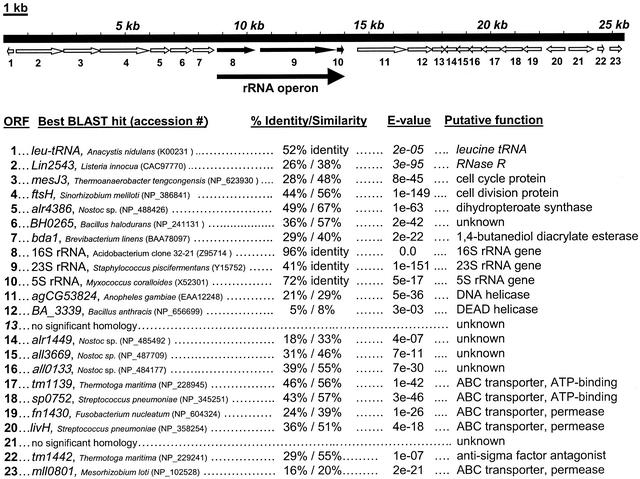
Annotated sequence for the BAC clone P17F9. The 25.4-kb insert from P17F9 was shotgun subcloned, and sequences recovered from subclones were assembled into a contiguous sequence at 3.3× coverage. The Glimmer program was employed to search for ORFs, and each identified ORF was compared to the GenBank database of nonredundant sequences by using BLAST algorithms. For each ORF, the percent identity or similarity of the gene or gene product to its nearest relative in the GenBank database is listed along with the E value and putative function of the gene product.

References

    1. Altschul, S. F., W. Gish, W. Miller, E. W. Myers, and D. J. Lipman. 1990. Basic local alignment search tool. J. Mol. Biol. 215:403-410. - PubMed
    1. Amann, R. I., W. Ludwig, and K. H. Schleifer. 1995. Phylogenetic identification and in situ detection of individual microbial cells without cultivation. Microbiol. Rev. 59:143-169. - PMC - PubMed
    1. Barns, S. M., R. E. Fundyga, M. W. Jeffries, and N. R. Pace. 1994. Remarkable Archaeal diversity detected in a Yellowstone National Park hot spring environment. Proc. Natl. Acad. Sci. USA 91:1609-1613. - PMC - PubMed
    1. Barns, S. M., S. L. Takala, and C. R. Kuske. 1999. Wide distribution and diversity of members of the bacterial kingdom Acidobacterium in the environment. Appl. Environ. Microbiol. 65:1731-1737. - PMC - PubMed
    1. Beja, O., L. Aravind, E. V. Koonin, M. T. Suzuki, A. Hadd, L. P. Nguyen, S. B. Jovanovich, C. M. Gates, R. A. Feldman, J. L. Spudich, E. N. Spudich, and E. F. DeLong. 2000. Bacterial rhodopsin: evidence for a new type of phototrophy in the sea. Science 289:1902-1906. - PubMed

Publication types

Associated data

LinkOut - more resources