. 2003 May;69(5):2712-8.
doi: 10.1128/AEM.69.5.2712-2718.2003.

Characterization of Fe(III) reduction by chlororespiring Anaeromyxobacter dehalogenans

Affiliations

Characterization of Fe(III) reduction by chlororespiring Anaeromyxobacter dehalogenans

Qiang He et al. Appl Environ Microbiol. 2003 May.

Abstract

Anaeromyxobacter dehalogenans strain 2CP-C has been shown to grow by coupling the oxidation of acetate to the reduction of ortho-substituted halophenols, oxygen, nitrate, nitrite, or fumarate. In this study, strain 2CP-C was also found to grow by coupling Fe(III) reduction to the oxidation of acetate, making it one of the few isolates capable of growth by both metal reduction and chlororespiration. Doubling times for growth of 9.2 and 10.2 h were determined for Fe(III) and 2-chlorophenol reduction, respectively. These were determined by using the rate of [(14)C]acetate uptake into biomass. Fe(III) compounds used by strain 2CP-C include ferric citrate, ferric pyrophosphate, and amorphous ferric oxyhydroxide. The addition of the humic acid analog anthraquinone 2,6-disulfonate (AQDS) increased the reduction rate of amorphous ferric iron oxide, suggesting AQDS was used as an electron shuttle by strain 2CP-C. The addition of chloramphenicol to fumarate-grown cells did not inhibit Fe(III) reduction, indicating that the latter activity is constitutive. In contrast, the addition of chloramphenicol inhibited dechlorination activity, indicating that chlororespiration is inducible. The presence of insoluble Fe(III) oxyhydroxide did not significantly affect dechlorination, whereas the presence of soluble ferric pyrophosphate inhibited dechlorination. With its ability to respire chlorinated organic compounds and metals such as Fe(III), strain 2CP-C is a promising model organism for the study of the interaction of these potentially competing processes in contaminated environments.


Figures
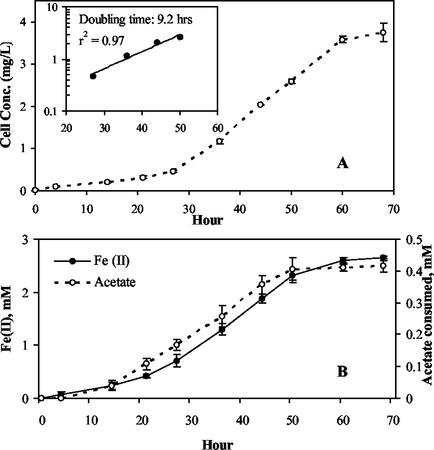
FIG. 1.
FIG. 1.
Coupling of growth of strain 2CP-C to Fe(III) reduction. (A) Increase in biomass concentration derived from [14C]acetate incorporated into new cells. (B) Coincidental reduction of Fe(III) citrate and acetate oxidation during growth. Data are averaged from duplicate cultures, with error bars showing the standard deviation. The inset plot shows the doubling time of cells during exponential growth.
FIG. 2.
FIG. 2.
Coupling of cell growth to 2-CP dechlorination and coincidental appearance of phenol. Cell concentration is derived from [14C]acetate incorporated into biomass. Data are averaged from duplicate cultures, with error bars showing the standard deviation. The inset plot shows doubling time of cells during exponential growth.
FIG. 3.
FIG. 3.
Graphical determination of fe and fs for strain 2CP-C in Fe(III) citrate-reducing culture (A) and 2-CP respiring cells (B), as indicated by the slope of the regression line. Reducing equivalents from acetate are plotted as electron equivalents ([H]) generated in the complete oxidation to CO2. Reducing equivalents for energy formation are plotted as [H] consumed in the reduction of Fe(III) to Fe(II) or 2-CP to phenol. Reducing equivalents for biosynthesis are also plotted as [H] incorporated into biomass. The data are averaged from duplicate cultures, with error bars showing the standard deviation.
FIG. 4.
FIG. 4.
Reduction of ferric iron by strain 2-CPC in the presence or absence of AQDS. The reduction of amorphous Fe(III) oxyhydroxide (4 mM) (A) and the reduction of ferric citrate (B) are indicated by the increase in ferric iron concentration. The results are averages of duplicate cultures, with error bars showing the standard deviation. The absence of a bar indicates that the standard deviation was smaller than the symbol. Control A contained iron, acetate, and AQDS, but not biomass; control B contained iron, AQDS, and biomass, but no acetate.
FIG. 5.
FIG. 5.
Dechlorination of 2-CP in the presence of ferric pyrophosphate (A) and amorphous Fe(III) oxyhydroxide (B). The results are the averages of duplicate cultures, with error bars indicating the standard deviation.
FIG. 6.
FIG. 6.
Influence of 2-CP on Fe(III) reduction, as shown by increase in ferrous iron, Fe(II) (A), and influence of Fe(III) on 2-CP dechlorination, as indicated by the disappearance of 2-CP (B). Ferric compounds tested are Fe(III) pyrophosphate or amorphous Fe(III) oxihydroxide. The data are averages of duplicate cultures.
FIG. 7.
FIG. 7.
Effect of chloramphenicol on the reduction of 2,6-DCP (A) and Fe(III) pyrophosphate (B). Reductive dechlorination was monitored as the depletion of 2,6-DCP, and reduction of Fe(III) was indicated by the increase in Fe(II) concentration. Noninduced resting cells were obtained by growing strain 2CP-C on fumarate and acetate. Cultures were fed 150 μM 2,6-DCP or 0.5 mM Fe(III) pyrophosphate to test or induce activity. In addition, inhibited cultures were amended with 300 μM chloramphenicol. The data are averaged from triplicate cultures, with error bars showing the standard deviation.

References

    1. Arnold, R. G., T. J. DiChristina, and M. R. Hoffmann. 1986. Inhibitor studies of dissimilative Fe(III) reduction by Pseudomonas sp. strain 200 (“Pseudomonas ferrireductans”). Appl. Environ. Microbiol. 52:282-289. - PMC - PubMed
    1. Champine, J. E., B. Underhill, J. M. Johnston, W. W. Lilly, and S. Goodwin. 2000. Electron transfer in the dissimilatory iron-reducing bacterium Geobacter metallireducens. Anaerobe 6:187-196.
    1. Cole, J. R., A. L. Cascarelli, W. W. Mohn, and J. M. Tiedje. 1994. Isolation and characterization of a novel bacterium growing via reductive dechlorination of 2-chlorophenol. Appl. Environ. Microbiol. 60:3536-3542. - PMC - PubMed
    1. Cornell, R. M., and U. Schwertmann. 1996. The iron oxides—structure, properties, reactions, occurrence, and uses. VCH, Weinheim, Germany.
    1. Criddle, C. S., L. M. Alvarez, and P. L. McCarty. 1991. Microbial processes in porous media, p. 641-691. In J. Bear and M. Y. Corapcioglu (ed.), Transport processes in porous media. Kluwer Academic Publishers, Dordrecht, The Netherlands.
