


Comparison of the pathogenesis of two genetically different H3N2 influenza A viruses in pigs
- PMID: 12734230
- PMCID: PMC154671
- DOI: 10.1128/JCM.41.5.1936-1941.2003
Comparison of the pathogenesis of two genetically different H3N2 influenza A viruses in pigs
Abstract
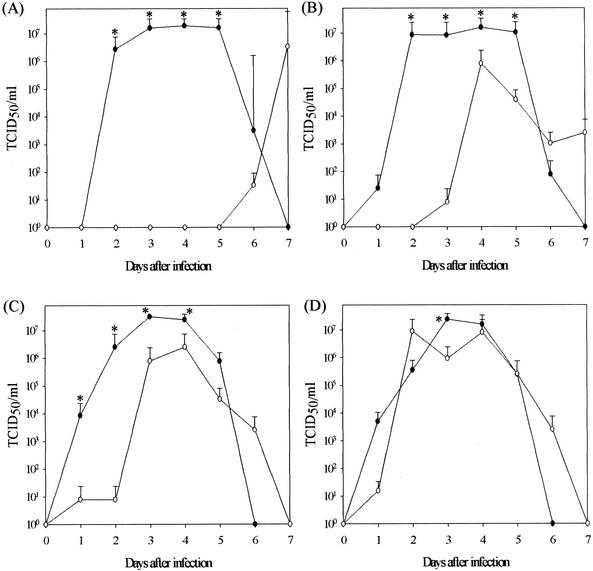
In 1997 and 1998, H3N2 influenza A viruses emerged among pigs in North America. Genetic analyses of the H3N2 isolates demonstrated that they had distinctly different genotypes. The most commonly isolated viruses in the United States have a triple-reassortant genotype, with the hemagglutinin, neuraminidase, and PB1 polymerase genes being of human influenza virus origin, the nucleoprotein, matrix, and nonstructural genes being of classical swine influenza virus origin, and the PA and PB2 polymerase genes being of avian influenza virus origin. In contrast, a wholly human H3N2 virus was isolated from a single baby pig in Ontario, Canada, in 1997, but it did not spread within the swine population. Genetic differences between this wholly human virus and the triple-reassortant viruses may affect their replication efficiencies in pigs. In the present study we compared the pathogenicities and replication kinetics of the wholly human virus and a triple-reassortant virus in 7-week-old pigs that were infected intranasally with 2 x 10(3) to 2 x 10(6) 50% tissue culture infective doses of virus. Our results demonstrate that the wholly human virus replicated to significantly lower titers and that the onset of virus shedding was delayed compared to the replication titers and the time of onset of virus shedding in triple-reassortant viruses. In addition, infection with the triple-reassortant virus was associated with moderate to severe gross pathological and histological pulmonary lesions, while infection with the wholly human virus induced only mild pulmonary changes.
Figures
References
-
- Beare, A. S., and R. G. Webster. 1991. Replication of avian influenza viruses in humans. Arch. Virol. 119:37-42. - PubMed
-
- Bikour, M. H., E. H. Frost, S. Deslandes, B. Talbot, J. M. Weber, and Y. Elazhary. 1995. Recent H3N2 swine influenza virus with haemagglutinin and nucleoprotein genes similar to 1975 human strains. J. Gen. Virol. 76:697-703. - PubMed
-
- Chambers, T. M., V. S. Hinshaw, Y. Kawaoka, B. C. Easterday, and R. G. Webster. 1991. Influenza viral infection of swine in the United States 1988-1989. Arch. Virol. 116:261-265. - PubMed
-
- Couceiro, J. N. S. S., J. C. Paulson, and L. G. Baum. 1993. Influenza virus strains selectively recognize sialyloligosaccharides on human respiratory epithelium: the role of the host cell in selection of hemagglutinin receptor specificity. Virus Res. 29:155-165. - PubMed
-
- Easterday, B. C., and V. S. Hinshaw. 1992. Swine influenza, p. 349-357. In A. D. Leman, B. E. Straw, W. L. Mengeling, S. D. D'Allaire, and D. J. Taylor (ed.), Diseases of swine. Iowa State University Press, Ames.
Publication types
MeSH terms
LinkOut - more resources
Full Text Sources
Other Literature Sources
Medical
Miscellaneous
