. 2003 May 15;31(10):2495-507.
doi: 10.1093/nar/gkg361.

RNomics in Drosophila melanogaster: identification of 66 candidates for novel non-messenger RNAs

Affiliations

RNomics in Drosophila melanogaster: identification of 66 candidates for novel non-messenger RNAs

Guozhong Yuan et al. Nucleic Acids Res. .

Erratum in

  • Nucleic Acids Res. 2013 Apr;41(8):4740

Abstract

By generating a specialised cDNA library from four different developmental stages of Drosophila melanogaster, we have identified 66 candidates for small non-messenger RNAs (snmRNAs) and have confirmed their expression by northern blot analysis. Thirteen of them were expressed at certain stages of D.melanogaster development, only. Thirty-five species belong to the class of small nucleolar RNAs (snoRNAs), divided into 15 members from the C/D subclass and 20 members from the H/ACA subclass, which mostly guide 2'-O-methylation and pseudouridylation, respectively, of rRNA and snRNAs. These also include two outstanding C/D snoRNAs, U3 and U14, both functioning as pre-rRNA chaperones. Surprisingly, the sequence of the Drosophila U14 snoRNA reflects a major change of function of this snoRNA in Diptera relative to yeast and vertebrates. Among the 22 snmRNAs lacking known sequence and structure motifs, five were located in intergenic regions, two in introns, five in untranslated regions of mRNAs, eight were derived from open reading frames, and two were transcribed opposite to an intron. Interestingly, detection of two RNA species from this group implies that certain snmRNA species are processed from alternatively spliced pre-mRNAs. Surprisingly, a few snmRNA sequences could not be found on the published D.melanogaster genome, which might suggest that more snmRNA genes (as well as mRNAs) are hidden in unsequenced regions of the genome.


Figures
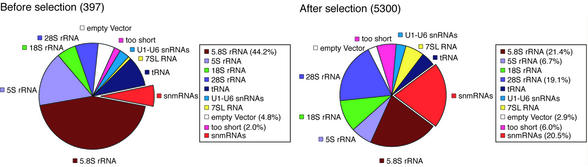
Figure 1
Figure 1
Sequence analysis of cDNA clones from the D.melanogaster cDNA library before (left) and after (right) selective hybridisation, amounting to 397 and 5300 randomly chosen cDNA clones, respectively. cDNA clones representing different RNA species or categories are shown as a percentage of total clones. The sector denoted snmRNAs identifies candidates for novel snmRNAs. ‘Too short’ refers to cDNA clones with an insert length below 12 nt which precluded analysis by BLASTN database search.
Figure 2
Figure 2
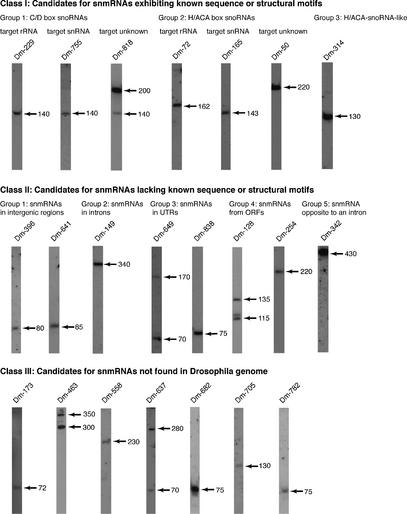
A selection of expressed candidates for novel snmRNAs in D.melanogaster, as deduced by northern blot analysis (designated as Class I, II and III snmRNAs). Clone names for each snmRNA are indicated above each lane; sizes of RNAs, as estimated by comparison with an internal RNA marker, are indicated by arrows on the right.
Figure 3
Figure 3
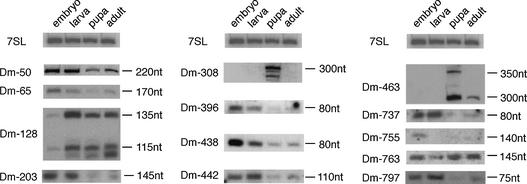
Northern blot analysis showing developmentally regulated expression of Class I, II or III snmRNA candidates; the clone designation is indicated on the left of each panel, the estimated size of the snmRNA is indicated on the right; the four selected developmental stages are: embryo, larva, pupa and adult. As an internal control, ubiquitous expression of 7SL RNA is shown at the top.
Figure 4
Figure 4
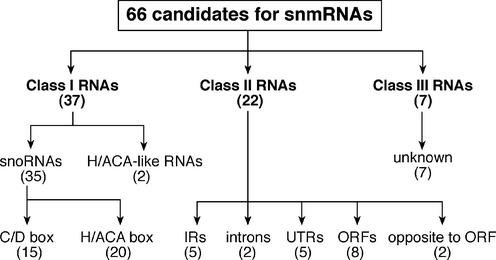
Schematic overview and classification of 66 candidates for snmRNAs in D.melanogaster.
Figure 5
Figure 5
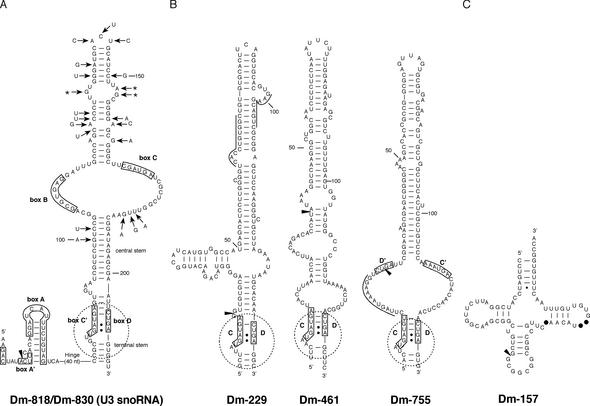
Secondary structure predictions of selected snmRNA candidates from D.melanogaster. The 5′ end of cDNA clones encoding respective snmRNAs is indicated by an arrowhead. (A) Structure of Drosophila C/D snoRNA U3: box motifs are shown as previously delineated for yeast S.cerevisiae and amphibian X.laevis U3 snoRNAs (25). The sequence shown is for Dm-830 (differences in the Dm-818 isoform are denoted by arrows). (B) Additional C/D snoRNAs with long hairpins: the C and D motifs are boxed, and the K-turn structural motifs are delineated by a broken circle. For Dm-229 and Dm-755, antisense elements to 18S rRNA and U5 snRNA, respectively, are overlined. (C) Dm-157, an intron-encoded tRNA-like snmRNA; canonical tRNA nucleotides missing in Dm-157 are indicated by filled circles.
Figure 6
Figure 6
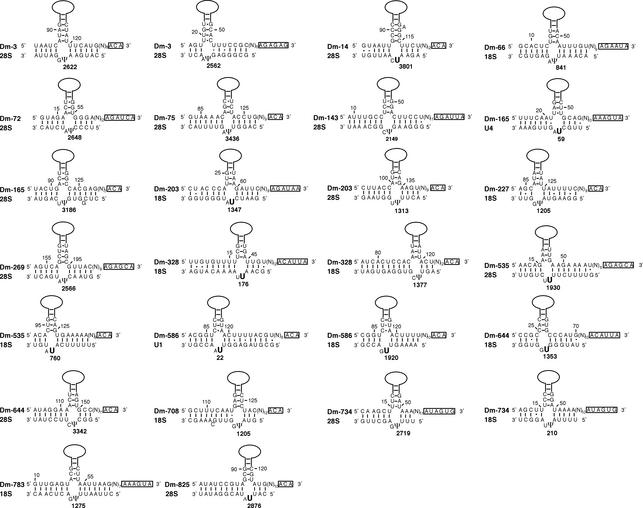
Potential base pairing interactions between novel H/ACA snoRNAs from D.melanogaster and rRNAs or snRNAs. The snoRNA sequences in a 5′ to 3′ orientation are shown in the upper strands, with the two H and ACA motifs boxed and the apical part of the snoRNA 5′ or 3′ hairpin domains schematised by a solid line. The two complementarities to the RNA target are always found within the large internal loop of one (or both) of their hairpin domains, invariably abutting its apex-proximal stem. The positions of pseudouridines are indicated by numbers. Known pseudouridines in D.melanogaster and other species, predicted to be directed by the respective snoRNA, are denoted by Ψ. U indicates a uridine at the expected target position in the canonical, bipartite guide RNA duplex that has not been previously reported to be pseudouridylated.
Figure 7
Figure 7
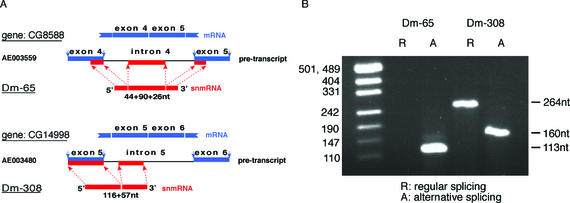
Processing of Dm-65 (top) or Dm-308 snmRNA candidates from pre-mRNAs by alternative splicing. (A) Exons of predicted ORFs (1) are indicated by blue bars; sequences of snmRNA candidates are indicated by red bars. The length of the bi- or tri-partite snmRNA sequences (in nt) is indicated below each snmRNA. (B) RT–PCR amplification of the predicted (R) and alternatively spliced (A) mRNAs for Dm-65 and Dm-308 snmRNAs. Sizes of expected DNA fragments are indicated on the right; on the left, a DNA size marker is shown.

References

    1. Adams M.D., Celniker,S.E., Holt,R.A., Evans,C.A., Gocayne,J.D., Amanatides,P.G., Scherer,S.E., Li,P.W., Hoskins,R.A., Galle,R.F. et al. (2000) The genome sequence of Drosophila melanogaster. Science, 287, 2185–2195. - PubMed
    1. Celniker S.E., Wheeler,D.A., Kronmiller,B., Carlson,J.W., Halpern,A., Patel,S. Adams,M., Champe,M., Dugan,S.P., Frise,E. et al. (2002) Finishing a whole-genome shotgun: release 3 of the Drosophila melanogaster euchromatic genome sequence. Genome Biol., 3, RESEARCH0079-9. - PMC - PubMed
    1. Hoskins R.A., Smith,C.D., Carlson,J.W., Carvalho,A.B., Halpern,A., Kaminker,J.S. Kennedy,C., Mungall,C.J., Sullivan,B.A., Sutton,G.G. et al. (2002) Heterochromatic sequences in a Drosophila whole-genome shotgun assembly. Genome Biol., 3, RESEARCH0085-5. - PMC - PubMed
    1. Stapleton M., Liao,G., Brokstein,P., Hong,L., Carninci,P., Shiraki,T., Hayashizaki,Y., Champe,M., Pacleb,J., Wan,K. et al. (2002) The Drosophila gene collection: identification of putative full-length cDNAs for 70% of D.melanogaster genes. Genome Res., 12, 1294–1300. - PMC - PubMed
    1. Mattick J.S. (2001) Non-coding RNAs: the architects of eukaryotic complexity. EMBO Rep., 2, 986–991. - PMC - PubMed

Publication types

MeSH terms