


Endemic, notifiable bioterrorism-related diseases, United States, 1992-1999
- PMID: 12737739
- PMCID: PMC2972758
- DOI: 10.3201/eid0905.020477
Endemic, notifiable bioterrorism-related diseases, United States, 1992-1999
Abstract
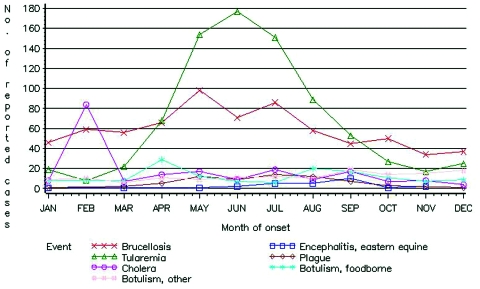
Little information is available in the United States regarding the incidence and distribution of diseases caused by critical microbiologic agents with the potential for use in acts of terrorism. We describe disease-specific, demographic, geographic, and seasonal distribution of selected bioterrorism-related conditions (anthrax, botulism, brucellosis, cholera, plague, tularemia, and viral encephalitides) reported to the National Notifiable Diseases Surveillance System in 1992 to 1999. Tularemia and brucellosis were the most frequently reported diseases. Anthrax, plague, western equine encephalitis, and eastern equine encephalitis were rare. Higher incidence rates for cholera and plague were noted in the western United States and for tularemia in the central United States. Overall, the incidence of conditions caused by these critical agents in the United States is low. Individual case reports should be considered sentinel events. For potential bioterrorism-related conditions that are endemic and have low incidence, the use of nontraditional surveillance methods and complementary data sources may enhance our ability to rapidly detect changes in disease incidence.
Figures
References
-
- Centers for Disease Control and Prevention. Update: investigation of bioterrorism-related anthrax and interim guidelines for clinical evaluation of persons with possible anthrax. MMWR Morb Mortal Wkly Rep. 2001;50:941–8. - PubMed
-
- Centers for Disease Control and Prevention. Bioterrorism alleging use of anthrax and interim guidelines for management—United States, 1998. MMWR Morb Mortal Wkly Rep. 1998;48:69–74. - PubMed
Publication types
MeSH terms
LinkOut - more resources
Full Text Sources
Other Literature Sources
Medical