. 2003 Jun;52(6):854-60.
doi: 10.1136/gut.52.6.854.

Non-genomic regulation of intermediate conductance potassium channels by aldosterone in human colonic crypt cells

Affiliations

Non-genomic regulation of intermediate conductance potassium channels by aldosterone in human colonic crypt cells

K A Bowley et al. Gut. 2003 Jun.

Abstract

Background: Aldosterone has a rapid, non-genomic, inhibitory effect on macroscopic basolateral K(+) conductance in the human colon, reducing its capacity for Cl(-) secretion. The molecular identity of the K(+) channels constituting this aldosterone inhibitable K(+) conductance is unclear.

Aim: To characterise the K(+) channel inhibited by aldosterone present in the basolateral membrane of human colonic crypt cells.

Methods: Crypts were isolated from biopsies of healthy sigmoid colon obtained during colonoscopy. The effect of aldosterone on basolateral K(+) channels, and the possible involvement of Na(+):H(+) exchange, were studied by patch clamp techniques. Total RNA from isolated crypts was subjected to reverse transcriptase-polymerase chain reaction (RT-PCR) using primers specific to intermediate conductance K(+) channels (KCNN4) previously identified in other human tissues.

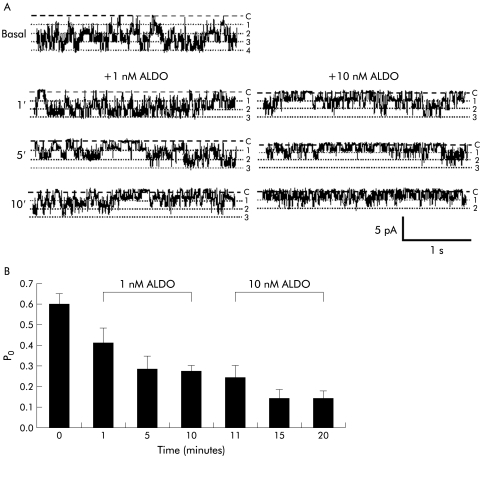
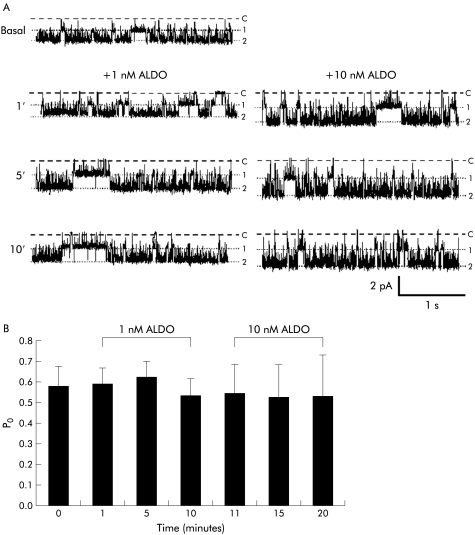
Results: In cell attached patches, 1 nmol/l aldosterone significantly decreased the activity of intermediate conductance (27 pS) K(+) channels by 31%, 53%, and 54% after 1, 5 and 10, minutes, respectively. Increasing aldosterone concentration to 10 nmol/l produced a further 56% decrease in channel activity after five minutes. Aldosterone 1-10 nmol/l had no effect on channel activity in the presence of 20 micro mol/l ethylisopropylamiloride, an inhibitor of Na(+):H(+) exchange. RT-PCR identified KCNN4 mRNA, which is likely to encode the 27 pS K(+) channel inhibited by aldosterone.

Conclusion: Intermediate conductance K(+) channels (KCNN4) present in the basolateral membranes of human colonic crypt cells are a target for the non-genomic inhibitory effect of aldosterone, which involves stimulation of Na(+):H(+) exchange, thereby reducing the capacity of the colon for Cl(-) secretion.


Figures
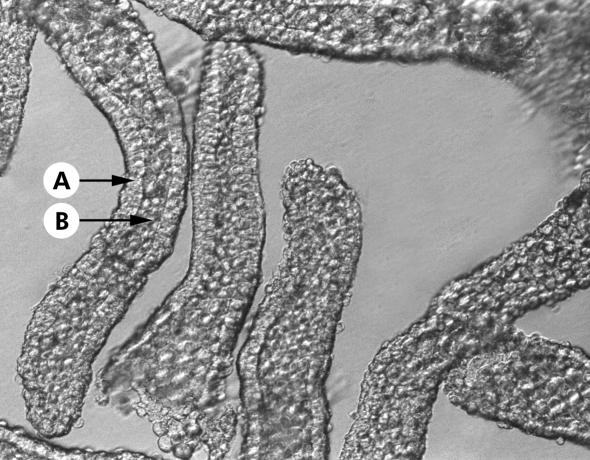
Figure 1
Figure 1
Photomicrograph of intact colonic crypts isolated by Ca2+ chelation and visualised using Hoffman modulated optics (×400). Note that the crypts were isolated devoid of non-epithelial cells originating from the lamina propria. The lumenal opening and base of each crypt can be clearly distinguished. Arrows indicate the continuous layer of crypt epithelial cells (A) and the crypt lumen (B).
Figure 2
Figure 2
Non-genomic inhibition of intermediate conductance basolateral K+ channels by aldosterone (ALDO). (A) Representative recordings from a cell attached patch containing multiple channels (holding voltage −40 mV, referenced to pipette interior; 140 mmol/l Na+ in bath, 145 mmol/l K+ in pipette), showing rapid onset of inhibition of K+ channel activity by 1 nmol/l aldosterone, with further inhibition after increasing the aldosterone concentration to 10 nmol/l. Dashed lines indicate zero current levels (C) and dotted lines open channel levels (1–4). (B) Summary of data from 7–11 cell attached patches.
Figure 3
Figure 3
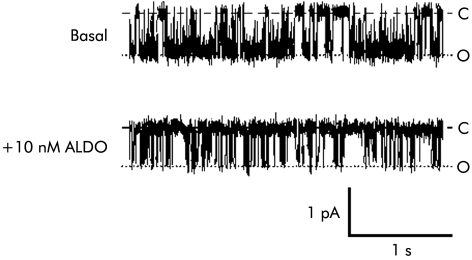
Non-genomic inhibition of intermediate conductance basolateral K+ channels by aldosterone (ALDO). Representative recordings from a cell attached patch containing a single channel (holding voltage −40 mV, referenced to pipette interior; 140 mmol/l Na+ in bath, 145 mmol/l K+ in pipette) showing inhibition of K+ channel activity 10 minutes after addition of 10 nmol/l aldosterone. Dashed lines indicate zero current levels (C) and dotted lines open channel levels (O). The presence of a low residual level of channel activity post aldosterone suggests that channels are regulated in situ within the basolateral membrane rather than being endocytosed.
Figure 4
Figure 4
Ethylisopropylamiloride (EIPA) prevented non-genomic inhibition of intermediate conductance basolateral K+ channels by aldosterone (ALDO). (A) Representative recordings from a cell attached patch containing multiple channels (holding voltage −40 mV, referenced to pipette interior; 140 mmol/l Na+ in bath, 145 mmol/l K+ in pipette) showing failure of 1–10 nmol/l aldosterone to inhibit K+ channel activity in the presence of 20 μmol/l EIPA, a specific Na+:H+ exchange inhibitor. Dashed lines indicate zero current levels (C) and dotted lines open channel levels (1, 2). (B) Summary of data from six cell attached patches.
Figure 5
Figure 5
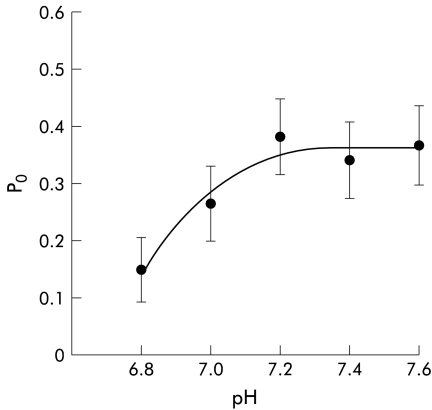
pH sensitivity of intermediate conductance basolateral K+ channels. Summary of data from eight excised inside out basolateral membrane patches, showing the pattern of channel activity when the pH of the bath solution was varied between 6.8 and 7.6 (holding voltage −40 mV, referenced to pipette interior; 145 mmol/l K+ in bath and pipette).
Figure 6
Figure 6
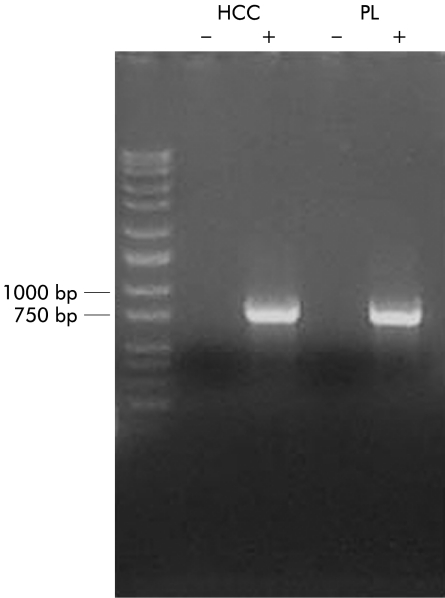
KCNN4 mRNA is present in human colonic epithelial cells. Reverse transcription of total RNA from colonic crypts (HCC) performed in the presence (+) and absence (−) of Superscript and amplified using specific primers for human KCNN4. A human placental cDNA library (PL) amplified with KCNN4 primers acted as a positive control. DNA molecular weight ladder is shown on the far left of the gel.

References

    1. Binder HJ, Sandle GI. Electrolyte transport in the mammalian colon. In: Johnson LR, ed. Physiology of the Gastrointestinal Tract, vol 2, 3rd edn. New York: Raven, 1994:2133–71.
    1. Dharmsathaphorn K, Pandol SJ. Mechanism of chloride secretion induced by carbachol in a colonic epithelial cell line. J Clin Invest 1986;77:348–54. - PMC - PubMed
    1. Mandel KG, McRoberts JA, Beuerlein G, et al. Ba2+ inhibition of VIP-stimulated and A23187-stimulated Cl secretion by T84 cell monolayers. Am J Physiol 1986;250:C486–94. - PubMed
    1. Devor DC, Singh AK, Gerlach AC, et al. Inhibition of intestinal Cl secretion by clotrimazole: direct effect on basolateral membrane K+ channels. Am J Physiol 1997;273:C531–40. - PubMed
    1. Schroeder BC, Waldegger S, Fehr S, et al. A constitutively open potassium channel formed by KCNQ1 and KCNE3. Nature 2000;403:196–9. - PubMed

Publication types

MeSH terms