


Excretion of wild-type and vaccine-derived poliovirus in the feces of poliovirus receptor-transgenic mice
- PMID: 12743311
- PMCID: PMC155012
- DOI: 10.1128/jvi.77.11.6541-6545.2003
Excretion of wild-type and vaccine-derived poliovirus in the feces of poliovirus receptor-transgenic mice
Abstract
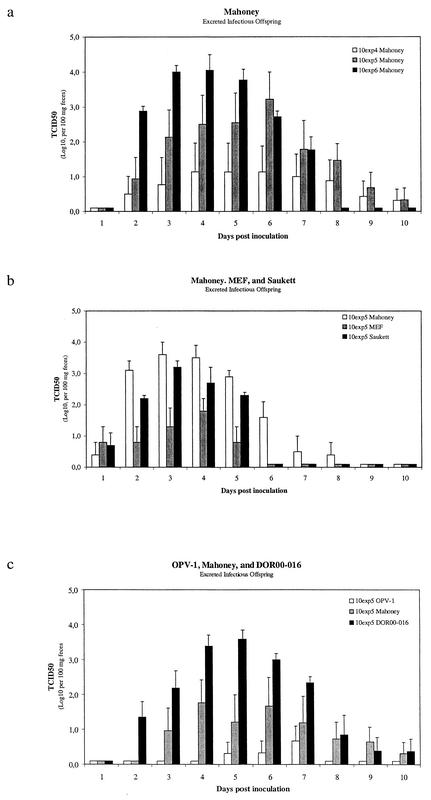
The emergence of circulating vaccine-derived poliovirus (cVDPV) strains in suboptimally vaccinated populations is a serious threat to the global poliovirus eradication. The genetic determinants for the transmissibility phenotype of polioviruses, and in particularly of cVDPV strains, are currently unknown. Here we describe the fecal excretion of wild-type poliovirus, oral polio vaccine, and cVDPV (Hispaniola) strains after intraperitoneal injection in poliovirus receptor-transgenic mice. Both the pattern and the level of fecal excretion of the cVDPV strains resemble those of wild-type poliovirus type 1. In contrast, very little poliovirus was present in the feces after oral polio vaccine administration. This mouse model will be helpful in elucidating the genetic determinants for the high fecal-oral transmission phenotype of cVDPV strains.
Figures
References
-
- Buisman, A. M., J. A. Sonsma, T. G. Kimman, and M. P. Koopmans. 2000. Mucosal and systemic immunity against poliovirus in mice transgenic for the poliovirus receptor: the poliovirus receptor is necessary for a virus-specific mucosal IgA response. J. Infect. Dis. 181:815-823. - PubMed
-
- Centers for Disease Control and Prevention. 2000. Outbreak of poliomyelitis-Dominican Republic and Haiti, 2000. Morb. Mortal. Wkly. Rep. 49:1094-1103. - PubMed
-
- Centers for Disease Control and Prevention. 2001. Acute flaccid paralysis associated with circulating vaccine-derived poliovirus-Philippines, 2001. Morb. Mortal. Wkly. Rep. 50:874-875. - PubMed
-
- Centers for Disease Control and Prevention. 2001. Circulation of a type 2 vaccine-derived poliovirus-Egypt, 1982-1993. Morb. Mortal. Wkly. Rep. 50:41-42. - PubMed
-
- Centers for Disease Control and Prevention. 2002. Poliomyelitis-Madagascar, 2002. Morb. Mortal. Wkly. Rep. 51:662.
Publication types
MeSH terms
Substances
LinkOut - more resources
Full Text Sources
Medical
Research Materials
