. 2003 May 27;100(11):6741-6.
doi: 10.1073/pnas.1031753100. Epub 2003 May 13.

Asialoerythropoietin is a nonerythropoietic cytokine with broad neuroprotective activity in vivo

Affiliations

Asialoerythropoietin is a nonerythropoietic cytokine with broad neuroprotective activity in vivo

Serhat Erbayraktar et al. Proc Natl Acad Sci U S A. .

Erratum in

  • Proc Natl Acad Sci U S A. 2003 Jul 22;100(15):9102

Abstract

Erythropoietin (EPO) is a tissue-protective cytokine preventing vascular spasm, apoptosis, and inflammatory responses. Although best known for its role in hematopoietic lineages, EPO also affects other tissues, including those of the nervous system. Enthusiasm for recombinant human erythropoietin (rhEPO) as a potential neuroprotective therapeutic must be tempered, however, by the knowledge it also enlarges circulating red cell mass and increases platelet aggregability. Here we examined whether erythropoietic and tissue-protective activities of rhEPO might be dissociated by a variation of the molecule. We demonstrate that asialoerythropoietin (asialoEPO), generated by total enzymatic desialylation of rhEPO, possesses a very short plasma half-life and is fully neuroprotective. In marked contrast with rhEPO, this molecule at doses and frequencies at which rhEPO exhibited erythropoiesis, did not increase the hematocrit of mice or rats. AsialoEPO appeared promptly within the cerebrospinal fluid after i.v. administration; intravenously administered radioiodine-labeled asialoEPO bound to neurons within the hippocampus and cortex in a pattern corresponding to the distribution of the EPO receptor. Most importantly, asialoEPO exhibits a broad spectrum of neuroprotective activities, as demonstrated in models of cerebral ischemia, spinal cord compression, and sciatic nerve crush. These data suggest that nonerythropoietic variants of rhEPO can cross the blood-brain barrier and provide neuroprotection.


Figures
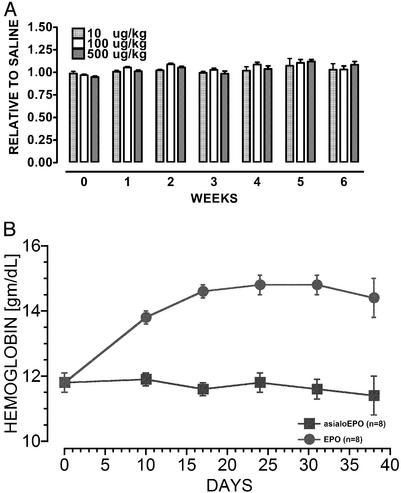
Fig. 1.
Fig. 1.
(A) Biweekly i.v. injections of asialoEPO over a wide dosage range do not change hemoglobin concentration in mice (n = 8 for each group; 50 μg/kg of bw and 200 μg/kg of bw omitted for clarity). (B) Biweekly i.p. administration of asialoEPO at a neuroprotective dose (100 μg/kg of bw) does not change the hemoglobin concentration. In contrast, an equal dose of rhEPO raises the hemoglobin concentration.
Fig. 2.
Fig. 2.
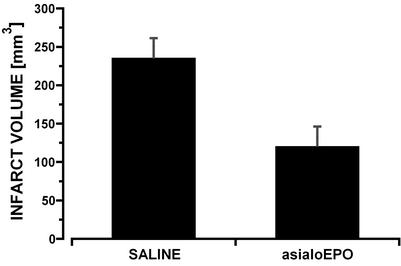
AsialoEPO administered i.v. versus saline reduces infarct size in a rat reperfusion model of focal stroke (n = 6 for each group; P < 0.01).
Fig. 3.
Fig. 3.
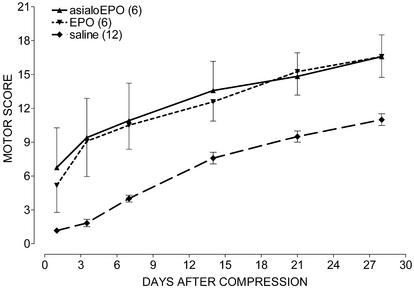
AsialoEPO is as effective as rhEPO in restoring motor function after spinal cord compression. Agents were administered i.v. (10 μg/kg of bw) once daily for 3 days after compression and biweekly thereafter.
Fig. 4.
Fig. 4.
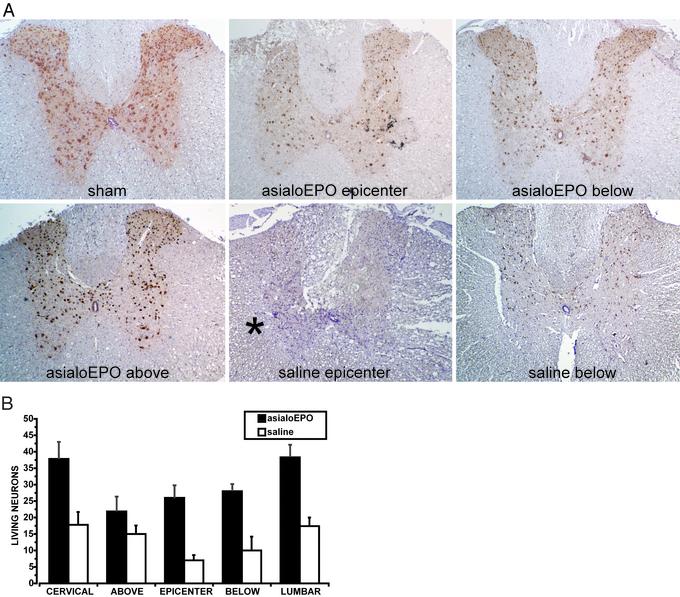
(A) Spinal cord histology 3 days after a 2-min compressive injury. NeuN immunohistochemistry identifies living neurons after asialoEPO (10 μg/kg i.v.) or saline administration immediately after injury. Sections were obtained at the lesion epicenter, 1 cm above, and 1 cm below. Note the extensive disruption of the central gray in the saline-treated cord (Lower Center). White matter (*) is also disrupted and edematous compared with animals receving asialoEPO. Shown are representative sections obtained from five animals in each group. (B) Summary of the mean living neurons number in the five levels investigated after asialoEPO, or saline treatment. Animals treated with asialoEPO presented with a significantly high number of living neurons compared with the saline group (P < 0.05 at all levels).
Fig. 5.
Fig. 5.
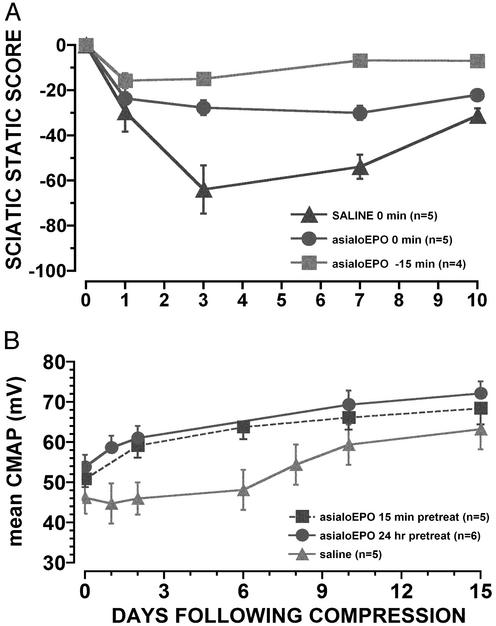
(A) Motor function after compressive injury of the sciatic nerve in the rat. AsialoEPO (50 μg/kg of bw i.v.) is more efficacious when administered 15 min before compression (P < 0.01; repeated measures analysis). (B) Average maximum CMAPs illustrate that 24-h or 15-min pretreatment with asialoEPO (50 μg/kg of bw i.v.) attenuates injury to an equivalent extent.

References

    1. Ruscher, K., Freyer, D., Karsch, M., Isaev, N., Megow, D., Sawitzki, B., Priller, J., Dirnagl, U. & Meisel, A. (2002) J. Neurosci. 22, 10291-10301. - PMC - PubMed
    1. Grimm, C., Wenzel, A., Groszer, M., Mayser, H., Seeliger, M., Samardzija, M., Bauer, C., Gassmann, M. & Reme, C. E. (2002) Nat. Med. 8, 718-724. - PubMed
    1. Dawson, T. M. (2002) Lancet 359, 96-97. - PubMed
    1. Brines, M. L., Ghezzi, P., Keenan, S., Agnello, D., de Lanerolle, N. C., Cerami, C., Itri, L. M. & Cerami, A. (2000) Proc. Natl. Acad. Sci. USA 97, 10526-10531. - PMC - PubMed
    1. Celik, M., Gokmen, N., Erbayraktar, S., Akhisaroglu, M., Konakc, S., Ulukus, C., Genc, S., Genc, K., Sagiroglu, E., Cerami, A. & Brines, M. (2002) Proc. Natl. Acad. Sci. USA 99, 2258-2263. - PMC - PubMed