


Progesterone and glucocorticoid receptors recruit distinct coactivator complexes and promote distinct patterns of local chromatin modification
- PMID: 12748280
- PMCID: PMC155204
- DOI: 10.1128/MCB.23.11.3763-3773.2003
Progesterone and glucocorticoid receptors recruit distinct coactivator complexes and promote distinct patterns of local chromatin modification
Abstract
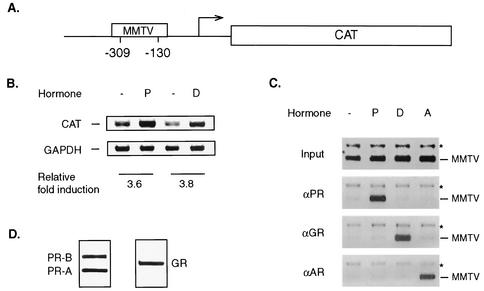
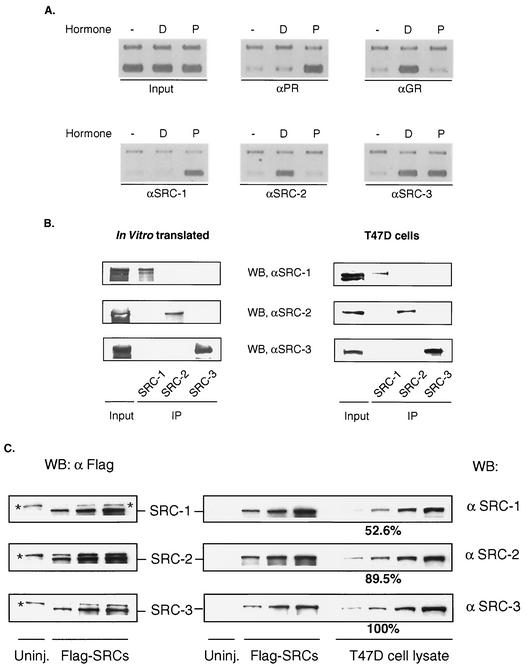
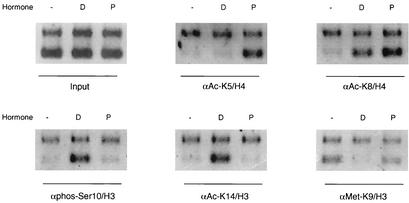
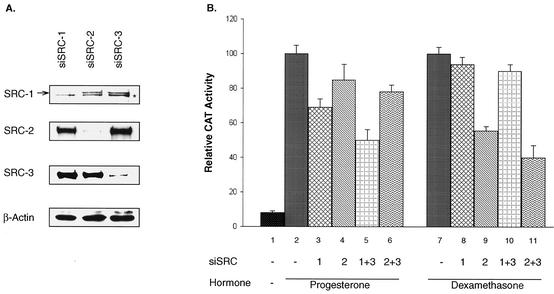
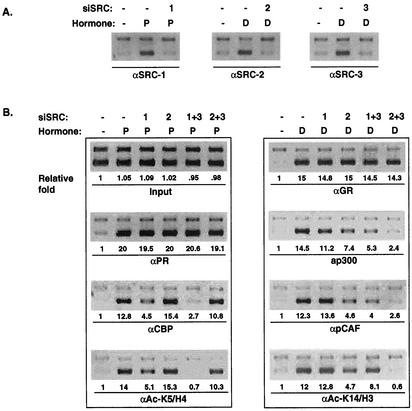
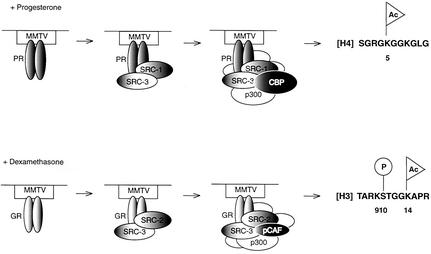
It is well established that steroid receptor function requires interaction with coactivators. However, the mechanisms through which steroid receptors elicit precise assembly of coactivator complexes and the way the steroid activation signal is transduced remain elusive. Using a T47D cell line stably integrated with a mouse mammary tumor virus-chloramphenicol acetyltransferase (MMTV-CAT) reporter, we demonstrate that specific steroid receptors exhibit preferential recruitment of SRC-1 family coactivators, which determines the subsequent recruitment of specific downstream coregulator molecules. Upon ligand treatment, progesterone receptor (PR) interacted preferentially with SRC-1, which recruited CBP and significantly enhanced acetylation at K5 of histone H4. In contrast, activated glucocorticoid receptor (GR) preferentially associated with SRC-2 (TIF-2/GRIP-1), which subsequently recruited pCAF and led to specific modification of histone H3, suggesting that specific coactivators recruit distinct histone acetyltransferases to modulate the transcription of steroid-responsive genes. Loss-of-function experiments further support the predicted roles of SRC-1 and SRC-2 in, respectively, PR- and GR-mediated transcription on the MMTV promoter. This study indicates that differential recruitment of coactivators by nuclear receptors determines the assembly of coactivator complexes on target promoters to mediate specific transcription signals.
Figures

References
-
- Alen, P., F. Claessens, E. Schoenmakers, J. V. Swinnen, G. Verhoeven, W. Rombauts, and B. Peeters. 1999. Interaction of the putative androgen receptor-specific coactivator ARA70/ELE1alpha with multiple steroid receptors and identification of an internally deleted ELE1beta isoform. Mol. Endocrinol. 13:117-128. - PubMed
-
- Allan, G. F., N. H. Ing, S. Y. Tsai, G. Srinivasan, N. L. Weigel, E. B. Thompson, M. J. Tsai, and B. W. O'Malley. 1991. Synergism between steroid response and promoter elements during cell-free transcription. J. Biol. Chem. 266:5905-5910. - PubMed
-
- Bhakat, K. K., and S. Mitra. 2000. Regulation of the human O(6)-methylguanine-DNA methyltransferase gene by transcriptional coactivators cAMP response element-binding protein-binding protein and p300. J. Biol. Chem. 275:34197-34204. - PubMed
-
- Borud, B., T. Hoang, M. Bakke, A. L. Jacob, J. Lund, and G. Mellgren. 2002. The nuclear receptor coactivators p300/CBP/cointegrator-associated protein (p/CIP) and transcription intermediary factor 2 (TIF2) differentially regulate PKA-stimulated transcriptional activity of steroidogenic factor 1. Mol. Endocrinol. 16:757-773. - PubMed
Publication types
MeSH terms
Substances
Grants and funding
LinkOut - more resources
Full Text Sources
Other Literature Sources
Molecular Biology Databases
Research Materials
Miscellaneous
