


Activin induces x-zone apoptosis that inhibits luteinizing hormone-dependent adrenocortical tumor formation in inhibin-deficient mice
- PMID: 12748296
- PMCID: PMC155220
- DOI: 10.1128/MCB.23.11.3951-3964.2003
Activin induces x-zone apoptosis that inhibits luteinizing hormone-dependent adrenocortical tumor formation in inhibin-deficient mice
Abstract
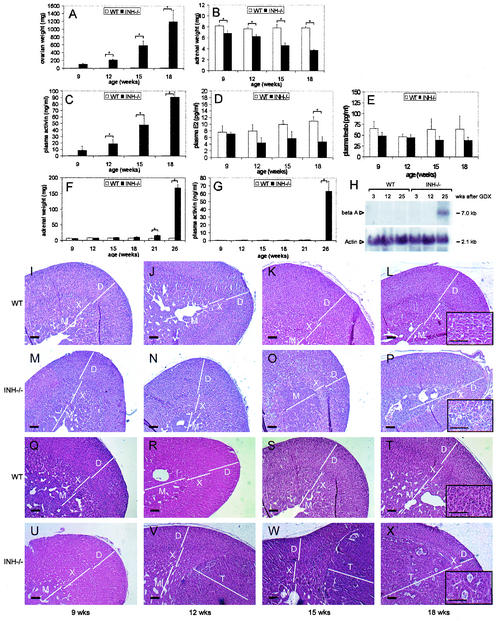
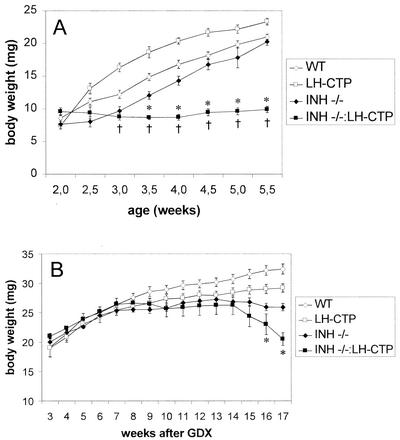
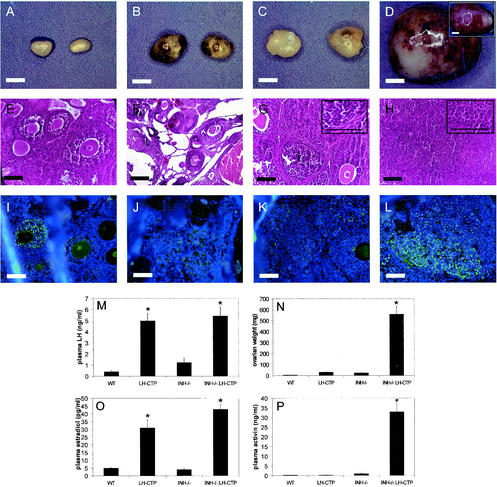
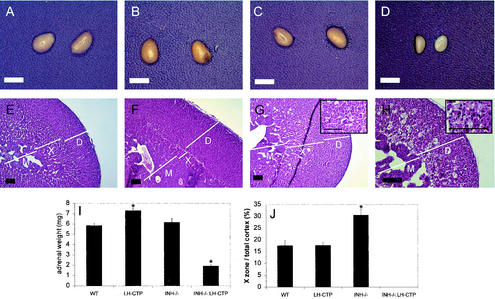
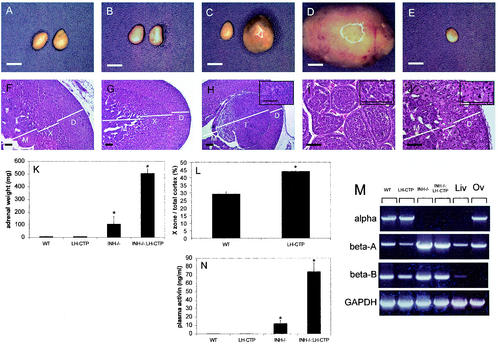
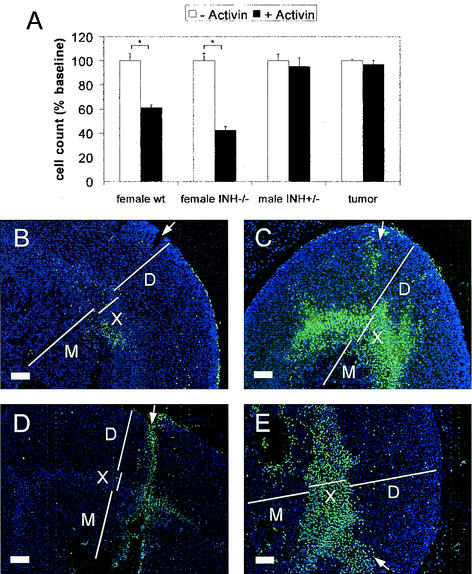
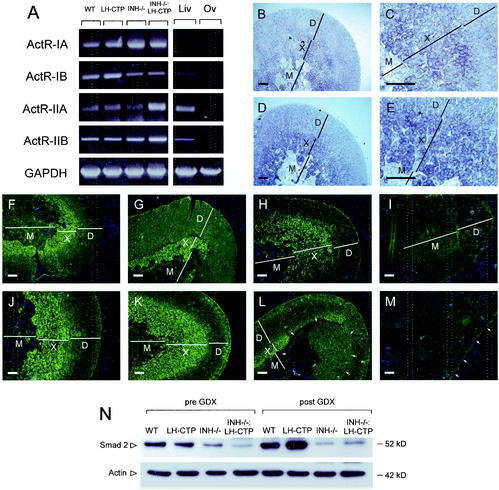
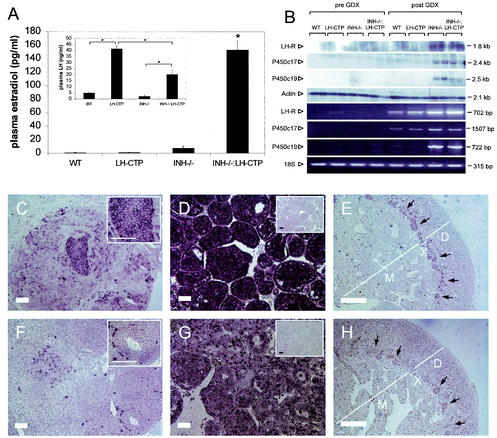
Inhibin and activin are members of the transforming growth factor beta (TGF-beta) family of ligands produced and secreted primarily by the gonads and adrenals. Inhibin-null (INH(-/-)) mice develop gonadal tumors and-when gonadectomized-adrenocortical carcinoma. The mechanisms leading to adrenal tumorigenesis have been proposed to involve the lack of a gonadal factor and/or a compensatory increase in gonadotropins. In order to achieve elevation of gonadotropins without the concomitant loss of a gonadal hormone, we crossed INH(-/-) mice with a transgenic mouse strain that has chronically elevated luteinizing hormone (LH) levels (LH-CTP). Compound INH(-/-)-LH-CTP mice die within 6 weeks of age from severe cancer cachexia induced by large, activin-secreting ovarian tumors. Unexpectedly, INH(-/-)-LH-CTP mice not only fail to develop adrenal tumors but have smaller adrenals, with a regressed x zone, indicating that elevated LH levels are not sufficient to induce adrenal tumor formation. However, following gonadectomy, INH(-/-)-LH-CTP mice develop large, sex steroid-producing adrenal tumors that arise from the x zone, indicating a growth-promoting effect of high levels of LH on the adrenal cortex in the absence of ovarian tumors. In addition, in vivo and in vitro data indicate that activin induces apoptosis specifically in the adrenal x zone. The restricted expression of activin receptor subunits and Smad2 in cells of the adrenal x zone, together with the elevated activin levels in INH(-/-)-LH-CTP mice, supports the conclusion that activin inhibits adrenal tumor growth by inducing x-zone regression.
Figures
References
-
- Beuschlein, F., C. Mutch, D. L. Bavers, Y. M. Ulrich-Lai, W. C. Engeland, C. Keegan, and G. D. Hammer. 2002. Steroidogenic factor-1 is essential for compensatory adrenal growth following unilateral adrenalectomy. Endocrinology 143:3122-3135. - PubMed
-
- Billiar, R. B., M. G. Leavitt, P. Smith, E. D. Albrecht, and G. J. Pepe. 1999. Functional capacity of fetal zone cells of the baboon fetal adrenal gland: a major source of α-inhibin. Biol. Reprod. 61:142-146. - PubMed
-
- Chen, Y. G., H. M. Lui, S. L. Lin, J. M. Lee, and S. Y. Ying. 2002. Regulation of cell proliferation, apoptosis, and carcinogenesis by activin. Exp. Biol. Med. (Maywood) 227:75-87. - PubMed
-
- Cipriano, S. C., L. Chen, K. H. Burns, A. Koff, and M. M. Matzuk. 2001. Inhibin and p27 interact to regulate gonadal tumorigenesis. Mol. Endocrinol. 15:985-996. - PubMed
-
- Coerver, K. A., T. K. Woodruff, M. J. Finegold, J. Mather, A. Bradley, and M. M. Matzuk. 1996. Activin signaling through activin receptor type II causes the cachexia-like symptoms in inhibin-deficient mice. Mol. Endocrinol. 10:534-543. - PubMed
Publication types
MeSH terms
Substances
Grants and funding
LinkOut - more resources
Full Text Sources
Molecular Biology Databases
