


Pneumocystis carinii pneumonia as a complication of bendamustine monotherapy in a patient with advanced progressive breast cancer
- PMID: 12756557
- PMCID: PMC12162061
- DOI: 10.1007/s00432-003-0441-y
Pneumocystis carinii pneumonia as a complication of bendamustine monotherapy in a patient with advanced progressive breast cancer
Abstract
Background: Bendamustine is an alkylator with anticipated antimetabolic activity. It has shown activity in malignant lymphoma, multiple myeloma, and breast cancer. Recognized side-effects are relatively mild with myelosuppression as the dose-limiting toxicity. The CD4/CD8 ratio may be reduced. To what extent the alteration of lymphocytes, especially CD4(+) lymphocytes, correlates with an increase in opportunistic infections cannot be definitively answered.
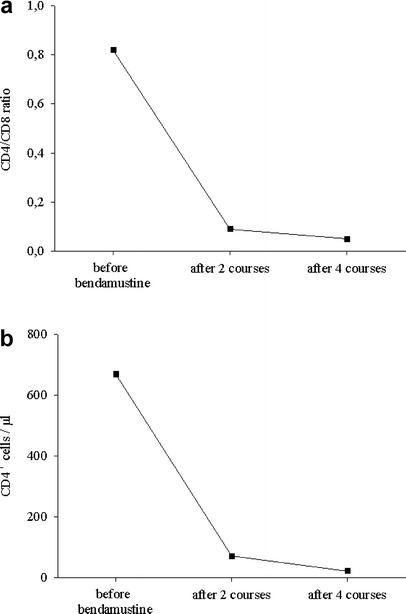
Case report: The patient, female, aged 48 years, was suffering from an advanced progressive breast cancer. After initial treatment with several chemotherapies, a cytotoxic therapy was initiated, with bendamustine (150 mg/m(2)) administered on two consecutive days and repeated every 4 weeks. After five courses, the patient developed Pneumocystis carinii pneumonia (PCP), disclosed in the bronchoalveolar lavage. While receiving bendamustine therapy, the CD4(+) and CD8(+) lymphocyte counts in the peripheral blood were determined by flow cytometry. The next-to-normal CD4/CD8 ratio before therapy (0,82) had decreased to 0,05 during the therapy mainly due to a decline of CD4(+) lymphocyte. The patient was seronegative for human immunodeficiency virus. In spite of high-dose intravenous trimethoprim/sulfamethoxazole and methylprednisolone application, the patient died of a respiratory failure 3 days after PCP was diagnosed.
Conclusion: Bendamustine is capable of inducing a reduction in CD4(+) lymphocyte counts causing a severe T-lymphocyte-mediated immunosuppression. Measuring CD4(+) lymphocyte counts may be helpful in determining the risk of PCP in patients treated with bendamustine.
Figures

References
-
- Strumberg D, Harstrick A, Doll K, et al (1996) Bendamustine hydrochloride activity against doxorubicine-resistant human breast carcinoma cell lines. Anti Cancer Drugs 7:415–421 - PubMed
-
- Reck M, Haering B, Koschel G, et al (1998) Chemotherapie des fortgeschrittenen nicht-kleinzelligen und kleinzelligen Bronchialkarzinoms mit Bendamustin—Eine Phase-II-Studie. Pneumologie 52:571–574 - PubMed
-
- Rahn AN, Schilcher RB, Adamietz IA, et al (2001) Palliative Radiochemotherapie mit Bendamustin bei fortgeschrittenen Tumorrezidiven im HNO-Bereich. Strahlenther Onkol 177:189–194 - PubMed
-
- Bremer K, Roth W (1996) Bendamustine, a low-toxic nitrogen-mustard derivative with high efficacy in malignant lymphomas. Tumordiagn Ther 17:1–6
-
- Matthias M, Preiss R, Sohr R, Possinger K (1995) Pharmakokinetics of bendamustine in patients with malignant tumors. Proc Am Assoc Clin Oncol 14:458 [abstr]
Publication types
MeSH terms
Substances
LinkOut - more resources
Full Text Sources
Medical
Research Materials
