


Febrile-range hyperthermia augments pulmonary neutrophil recruitment and amplifies pulmonary oxygen toxicity
- PMID: 12759256
- PMCID: PMC1868125
- DOI: 10.1016/S0002-9440(10)64333-7
Febrile-range hyperthermia augments pulmonary neutrophil recruitment and amplifies pulmonary oxygen toxicity
Abstract
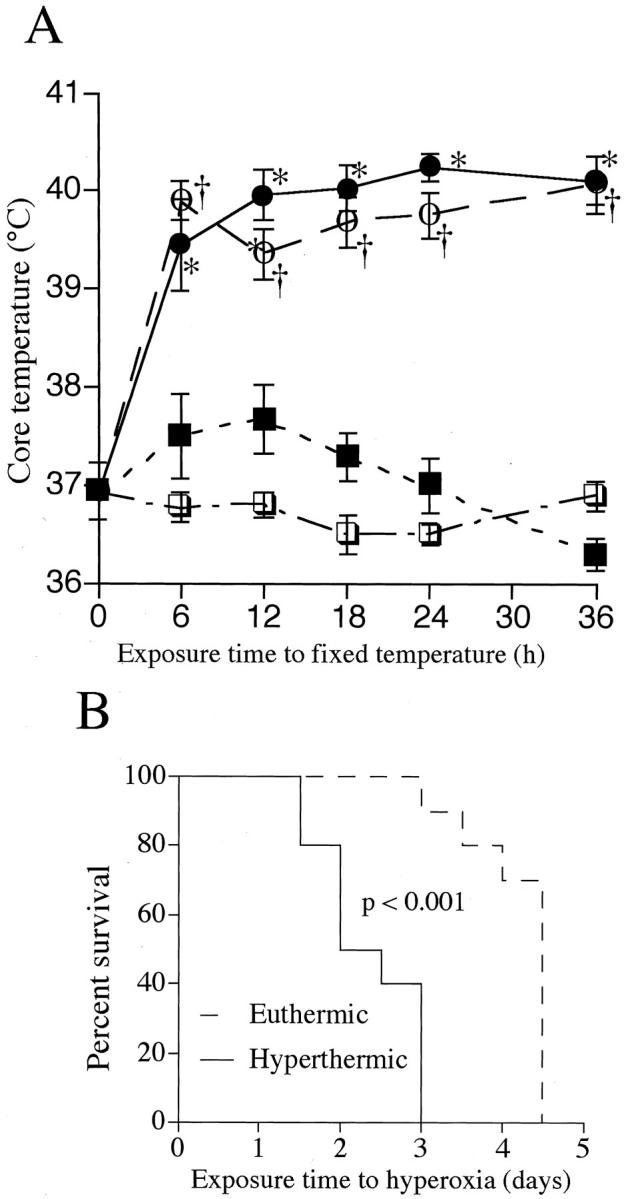
Febrile-range hyperthermia (FRH) improves survival in experimental infections by accelerating pathogen clearance, but may also increase collateral tissue injury. We hypothesized that FRH would worsen the outcome of inflammation stimulated by a non-replicating agonist and tested this hypothesis in a murine model of pulmonary oxygen toxicity. Using a conscious, temperature-controlled mouse model, we showed that maintaining a core temperature at FRH (39 degrees C to 40 degrees C) rather than at euthermic levels (36.5 degrees C to 37 degrees C) during hyperoxia exposure accelerated lethal pulmonary vascular endothelial injury, reduced the inspired oxygen threshold for lethality, induced expression of granulocyte-colony stimulating factor, and expanded the circulating neutrophil pool. In these same mice, FRH augmented pulmonary expression of the ELR(+) CXC chemokines, KC and LPS-induced CXC chemokine, enhanced recruitment of neutrophils, and changed the histological pattern of lung injury to a neutrophilic interstitial pneumonitis. Immunoblockade of CXC receptor-2 abrogated neutrophil recruitment, reduced pulmonary vascular injury, and delayed death. These combined data demonstrate that FRH may enlist distinct mediators and effector cells to profoundly shift the host response to a defined injurious stimulus, in part by augmenting delivery of neutrophils to sites of inflammation, such as may occur in infections. In certain conditions, such as in the hyperoxic lung, this process may be deleterious.
Figures


References
-
- Kluger MJ, Kozac W, Conn CA, Leon LR, Soszynski D: The adaptive value of fever. Mackowiak PA eds. Fever: Basic Mechanisms and Management. 1996:pp 255-266 Raven Press, New York
-
- Hasday JD, Fairchild KD, Shanholtz C: The role of fever in the infected hosts. Microbes and Infection 2000, 2:1891-1904 - PubMed
-
- Hasday JD, Fairchild KD, Shanholtz C: The role of fever in the infected host. Microbes and Infection 2000, 2:1-14 - PubMed
-
- Kuikka A, Sivonen A, Emelianova A, Valtonen VV: Prognostic factors associated with improved outcome of Escherichia coli bacteremia in a Finnish university hospital. Eur J Clin Microbiol Infect Dis 1997, 16:125-134 - PubMed
Publication types
MeSH terms
Substances
Grants and funding
LinkOut - more resources
Full Text Sources
Other Literature Sources
Medical
