


Treatment with a broad-spectrum cephalosporin versus piperacillin-tazobactam and the risk for isolation of broad-spectrum cephalosporin-resistant Enterobacter species
- PMID: 12760862
- PMCID: PMC155863
- DOI: 10.1128/AAC.47.6.1882-1886.2003
Treatment with a broad-spectrum cephalosporin versus piperacillin-tazobactam and the risk for isolation of broad-spectrum cephalosporin-resistant Enterobacter species
Abstract
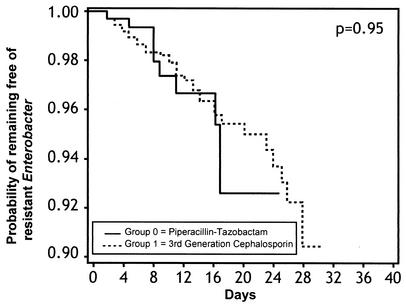
Receipt of a broad-spectrum cephalosporin is a strong risk factor for isolation of broad-spectrum cephalosporin-resistant Enterobacter species, and yet the risk from other broad-spectrum beta-lactams hydrolyzed by group 1 beta-lactamases has not been well characterized. We compared the risk conferred by broad-spectrum cephalosporins to that conferred by piperacillin-tazobactam, alone or in combination with an aminoglycoside or a fluoroquinolone. A retrospective cohort was monitored from treatment onset until a broad-spectrum cephalosporin-resistant Enterobacter strain was isolated or the patient was discharged. There were 447 patients in the piperacillin-tazobactam group and 2,341 patients in the broad-spectrum cephalosporin group. Groups were similar in age (mean, 62.5 years). The piperacillin-tazobactam group had a smaller percentage of men (32% versus 44%, P < 0.001) and a lower rate of intensive care unit stay (25% versus 38%, P < 0.001) but a higher rate of surgery (41% versus 26%, P < 0.001). Groups differed in the distribution of comorbidities. Resistant Enterobacter strains were isolated from 62 patients, 2% in each group (hazard ratio [RR] = 1.02 [P = 0.95]). In multivariable analysis, risk was similar among treatment groups (RR = 0.71 [P = 0.32]). Intensive care unit stay and surgery were associated with increased risk (RR = 4.53 [P < 0.001] and RR = 1.97 [P = 0.015], respectively), fluoroquinolones were protective (RR = 0.24 [P = 0.003]), and aminoglycosides did not affect risk (RR = 0.98 [P = 0.95]). The protective effect of fluoroquinolones against isolation of broad-spectrum cephalosporin-resistant Enterobacter spp. and the equivalence in risk associated with piperacillin-tazobactam and broad-spectrum cephalosporins may have important clinical and epidemiologic implications.
Figures
References
-
- Carmeli, Y., N. Troillet, A. W. Karchmer, and M. H. Samore. 1999. Health and economic outcomes of antibiotic resistance in Pseudomonas aeruginosa. Arch. Intern. Med. 159:1127-1132. - PubMed
-
- Chow, J. W., M. J, Fine, D. M. Shlaes, J. P. Quinn, D. C. Hooper, M. P. Johnson, R. Ramphal, M. M. Wagener, D. K. Miyashiro, and V. L. Yu. 1991. Enterobacter bacteremia: clinical features and emergence of antibiotic resistance during therapy. Ann. Intern. Med. 115:585-590. - PubMed
-
- Chow, J. W., V. L. Yu, and D. M. Shlaes. 1994. Epidemiologic perspectives on Enterobacter for the infection control professional. Am. J. Infect. Control 22:195-201. - PubMed
-
- Cosgrove, S. E., K. S. Kaye, G. M. Eliopoulous, and Y. Carmeli. 2002. Health and economic outcomes of the emergence of third-generation cephalosporin resistance in Enterobacter species. Arch. Intern. Med. 162:185-190. - PubMed
Publication types
MeSH terms
Substances
Grants and funding
LinkOut - more resources
Full Text Sources
Medical
Miscellaneous
