


Review
doi: 10.1128/IAI.71.6.2983-2992.2003.
Extracellular enzymes with immunomodulating activities: variations on a theme in Streptococcus pyogenes
Affiliations
- PMID: 12761074
- PMCID: PMC155735
- DOI: 10.1128/IAI.71.6.2983-2992.2003
Item in Clipboard
Review
Extracellular enzymes with immunomodulating activities: variations on a theme in Streptococcus pyogenes
Infect Immun.
2003 Jun.
No abstract available
Figures
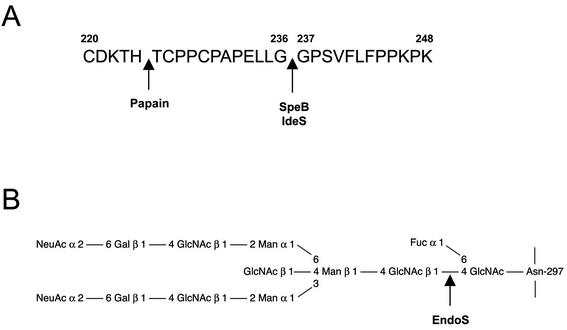
SpeB, IdeS, and EndoS activity on human IgG. Cleavage sites in human IgG of S. pyogenes IgG-proteases and IgG glycan-hydrolases. (A) Residues 220 to 248 of the flexible hinge region of IgG1 heavy chain showing where SpeB and IdeS cleave between glycine residues 236 and 237. The papain cleavage site is shown for comparison. (B) Diagram showing one of the two identical conserved N-linked glycans attached to asparagine 297 in the heavy chain of IgG and also where EndoS hydrolyzes the chitibiose core of the glycan, leaving the innermost GlcNAc with a core fucose.
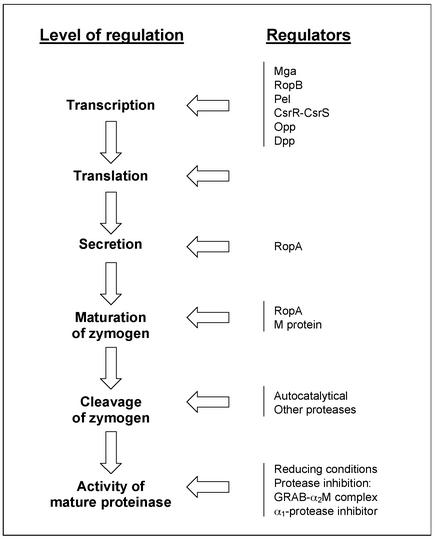
Schematic overview of the factors influencing SpeB activity. The column to the left outlines the synthesis and maturation of SpeB from transcription to mature active enzyme. The right column shows examples of different regulators know to affect the process and on what level it takes place.
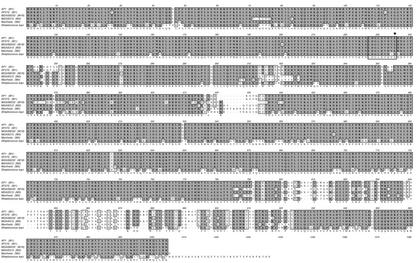
CLUSTALW amino acid sequence alignment of EndoS homologs from different S. pyogenes serotypes and S. equi. Strain names or species are shown to the left and M serotypes are shown in parentheses. Amino acid identities are shown in dark gray, similarities are shown in light gray, and the consensus sequence is shown under the alignment. The conserved chitinase motif is boxed, and the glutamic acid essential for activity is marked with an asterisk above the alignment.
References
-
- Ajdic, D., W. M. McShan, D. J. Savic, D. Gerlach, and J. J. Ferretti. 2000. The NAD-glycohydrolase (nga) gene of Streptococcus pyogenes. FEMS Microbiol. Lett. 191:235-241. - PubMed
-
- Axford, J. S., L. Mackenzie, P. M. Lydyard, F. C. Hay, D. A. Isenberg, and I. M. Roitt. 1987. Reduced B-cell galactosyltransferase activity in rheumatoid arthritis. Lancet ii:1486-1488. - PubMed
-
- Beres, S. B., G. L. Sylva, K. D. Barbian, B. Lei, J. S. Hoff, N. D. Mammarella, M. Y. Liu, J. C. Smoot, S. F. Porcella, L. D. Parkins, D. S. Campbell, T. M. Smith, J. K. McCormick, D. Y. Leung, P. M. Schlievert, and J. M. Musser. 2002. Genome sequence of a serotype M3 strain of group A Streptococcus: phage-encoded toxins, the high-virulence phenotype, and clone emergence. Proc. Natl. Acad. Sci. USA 99:10078-10083. - PMC - PubMed
-
- Berge, A., and L. Björck. 1995. Streptococcal cysteine proteinase releases biologically active fragments of streptococcal surface proteins. J. Biol. Chem. 270:9862-9867. - PubMed
-
- Bisno, A. L. 2001. Acute pharyngitis. N. Engl. J. Med. 344:205-211. - PubMed
Publication types
MeSH terms
Substances
LinkOut - more resources
Full Text Sources
Other Literature Sources
