


The shape of the Neandertal femur is primarily the consequence of a hyperpolar body form
- PMID: 12761384
- PMCID: PMC165806
- DOI: 10.1073/pnas.1232340100
The shape of the Neandertal femur is primarily the consequence of a hyperpolar body form
Abstract
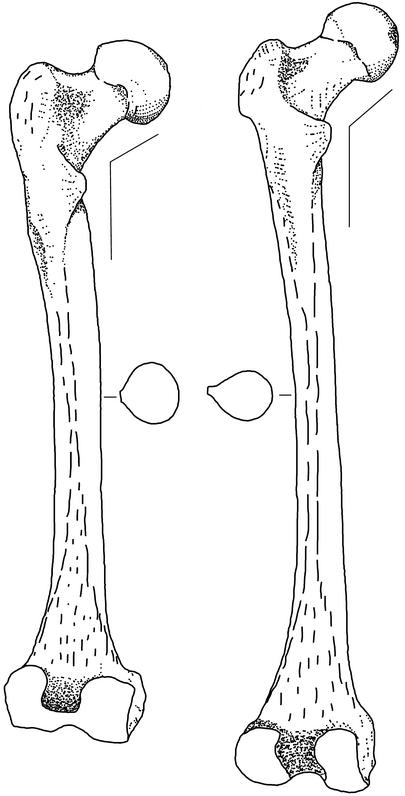
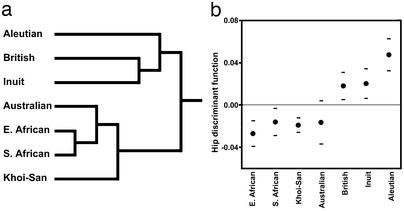
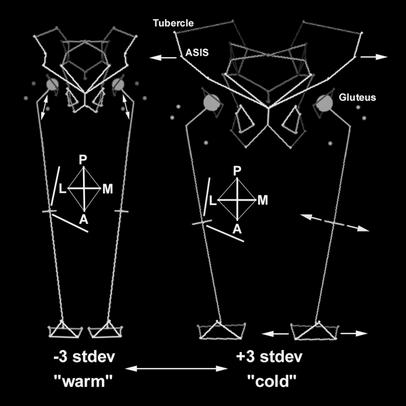
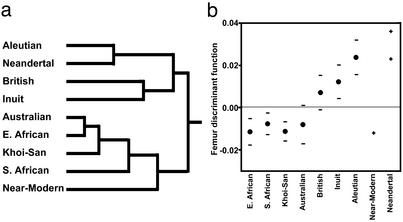
Neandertal femora are distinct from contemporaneous near-modern human femora. Traditionally, these contrasts in femoral shape have been explained as the result of the elevated activity levels and limited cultural abilities of Neandertals. More recently, however, researchers have realized that many of these femoral differences may be explained by the cold-adapted bodies of Neandertals vs. the warm-adapted bodies of near-modern humans. This study explicitly tests this proposed link between climate-induced body proportions and femoral shape by considering the entire hip as a unit by using geometric morphometric methods adapted to deal with articulated structures. Based on recent human patterns of variation, most contrasts in shape between the femora of Neandertals and near-modern humans seem to be secondary consequences of differences in climate-induced body proportions. These results, considered in light of hip mechanics during growth, highlight the importance of developmental and functional integration in determining skeletal form.
Figures
References
-
- Boule, M. (1912) Ann. Paléontol. 7, 105–192.
-
- Weidenreich, F. (1941) Palaeontol. Sinica New Ser. D 5, 1–150.
-
- Trinkaus, E. (1993) J. Hum. Evol. 25, 393–416.
-
- Trinkaus, E. (1983) The Shanidar Neandertals (Academic, New York).
-
- Stringer, C. B. & Gamble, C. (1993) In Search of the Neanderthals: Solving the Puzzle of Human Origins (Thames and Hudson, New York).
Publication types
MeSH terms
LinkOut - more resources
Full Text Sources
