. 2003 Jun;77(12):6879-88.
doi: 10.1128/jvi.77.12.6879-6888.2003.

Characterization of a novel simian immunodeficiency virus (SIVmonNG1) genome sequence from a mona monkey (Cercopithecus mona)

Affiliations

Characterization of a novel simian immunodeficiency virus (SIVmonNG1) genome sequence from a mona monkey (Cercopithecus mona)

Katrina L Barlow et al. J Virol. 2003 Jun.

Abstract

A novel simian immunodeficiency virus (SIV) sequence has been recovered from RNA extracted from the serum of a mona monkey (Cercopithecus mona) wild born in Nigeria. The sequence was obtained by using novel generic (degenerate) PCR primers and spans from two-thirds into the gag gene to the 3' poly(A) tail of the SIVmonNG1 RNA genome. Analysis of the open reading frames revealed that the SIVmonNG1 genome codes for a Vpu protein, in addition to Gag, Pol, Vif, Vpr, Tat, Rev, Env, and Nef proteins. Previously, only lentiviruses infecting humans (human immunodeficiency virus type 1 [HIV-1]) and chimpanzees (SIVcpz) were known to have a vpu gene; more recently, this has also been found in SIVgsn from Cercopithecus nictitans. Overall, SIVmonNG1 most closely resembles SIVgsn: the env gene sequence groups with HIV-1/SIVcpz env sequences, whereas the pol gene sequence clusters closely with the pol sequence of SIVsyk from Cercopithecus albogaris. By bootscanning and similarity plotting, the first half of pol resembles SIVsyk, whereas the latter part is closer to SIVcol from Colobus guereza. The similarities between the complex mosaic genomes of SIVmonNG1 and SIVgsn are consistent with a shared or common lineage. These data further highlight the intricate nature of the relationships between the SIVs from different primate species and will be helpful for unraveling these associations.


Figures
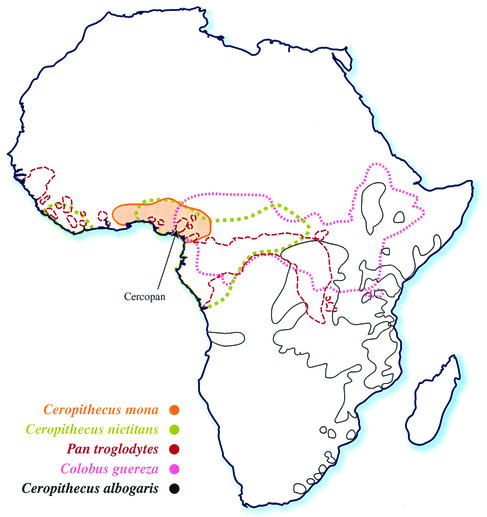
FIG. 1.
FIG. 1.
Map of Africa showing the natural ranges of the mona monkey, Cercopithecus mona, the greater spot-nosed monkey, Cercopithecus nictitans, the chimpanzee, Pan troglodytes, the Sykes monkey, Cercopithecus albogaris, and the colobus monkey, Colobus guereza. The data were obtained from the study by Rowe (36) and from an online source (http://gorilla.bio.uniroma.it/). The approximate location of the Cercopan Project in Nigeria is arrowed.
FIG. 2.
FIG. 2.
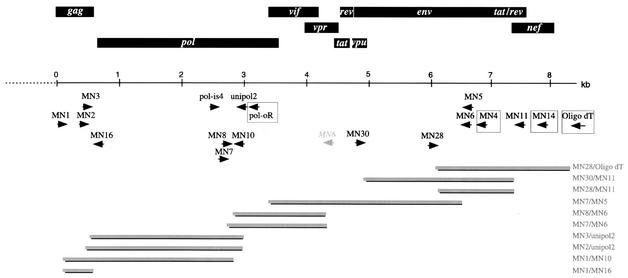
Genome organization and PCR cloning strategy for SIVmonNG1 RNA. The identified ORFs are indicated by rectangular boxes above the scale bar. The alternative binding site of MN6 is shown in italics. The primers used for PCR are shown below the scale bar; primers used for cDNA synthesis are boxed. The position of the clones is shown by solid bars, and the primers used to obtain them are indicated on the right.
FIG. 3.
FIG. 3.
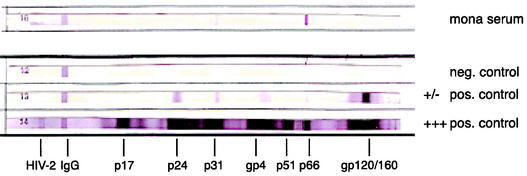
Antibody profile of serum from the mona monkey revealed on a Genelabs Western blot. At the top is the serum from the mona monkey; below are a negative human serum control, a weak anti-HIV-1-positive human serum control, and a strong anti-HIV-1-positive human serum control.
FIG. 4.
FIG. 4.
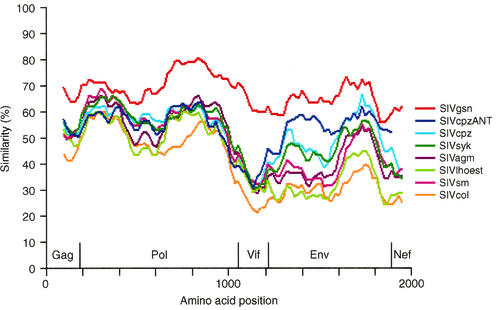
Similarity plotting of SIVmonNG1 against the six major SIV lineages (SIVsyk, SIVlhoest, SIVcol, SIVagm, SIVcpz, and SIVsm) and SIVcpzANT and SIVgsn. Alignments of the nonoverlapping regions of gag, pol, vif, env, and nef were concatenated together; gaps were removed from the amino acid alignment; a window of 200 residues was used. The relative position of the genome proteins is shown. Sequences for comparison were obtained from the Los Alamos HIV Database/GenBank.
FIG. 5.
FIG. 5.
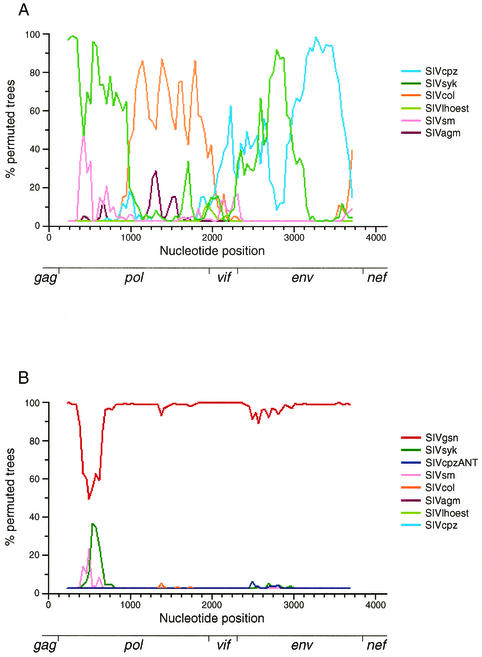
(A) DNA bootscanning comparisons of SIVmonNG1 against single sequences from the major SIV lineages (SIVsyk, SIVlhoest, SIVcol, SIVagmGRI, SIVcpz, and SIVsm). (B) Similar analysis including SIVgsn and SIVcpzANT. Alignments of the nonoverlapping regions of gag, pol, vif, env, and nef were concatenated together, and third-codon positions and gaps were excluded. A sliding window of 450 bases in 40 base steps and 1,000 bootstrap replicates was used for bootscanning with the Kimura 2 parameter model and a transition/transversion ratio of 0.75. The relative positions of the genes are shown at the bottom of the figures.
FIG. 6.
FIG. 6.
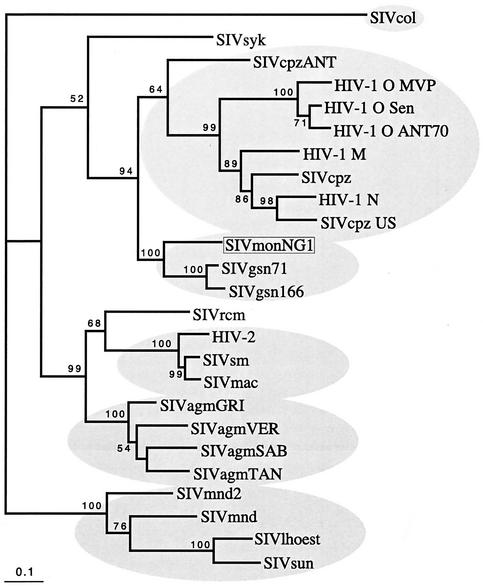
Phylogenetic comparison of env SIV and HIV sequences. An in-frame nucleotide alignment of env sequences was derived from the corresponding amino acid alignment, and gaps and codon third-position bases were excluded. The best-fitting model of evolution found by using Modeltest (35) with PAUP* was the general time reversible with the following parameters. The rates were as follows: A-C = 1.3738, A-G = 0.9821, A-T = 0.3369, C-G = 1.5349, C-T = 1.2473, and G-T = 1.0. The base frequencies were as follows: A = 0.3135, C = 0.1323, G = 0.2273, and T = 0.3269. The gamma distribution shape parameter (alpha) was 4.6652, and the proportion of invariable sites was 0.0093. The branch lengths of the tree shown were derived by a maximum-likelihood search with the above parameters. The bootstrap values (of 1,000) were derived from a congruent distance/neighbor-joining tree found with the same model of evolution. The scale bar indicates the number of nucleotide substitutions per site. Sequences for comparison were obtained from the Los Alamos HIV Database/GenBank.
FIG. 7.
FIG. 7.
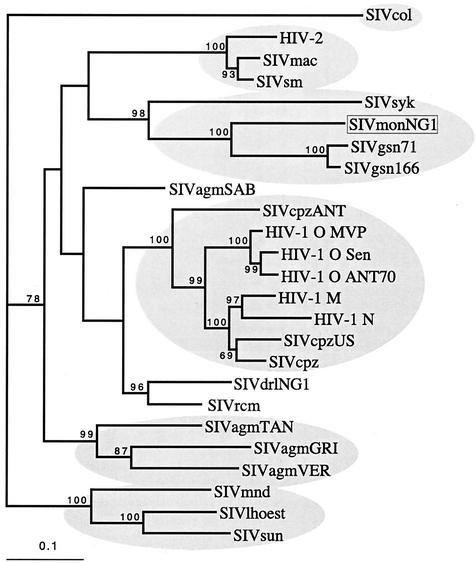
Phylogenetic comparison of pol SIV and HIV sequences. An in-frame nucleotide alignment of pol sequences was derived from the corresponding amino acid alignment, and gaps and codon third-position bases were excluded. The best-fitting model of evolution found by using Modeltest (35) with PAUP* was the general time reversible. The rates were as follows: A-C = 2.9306, A-G = 3.2906, A-T = 1.9048, C-G = 3.1502, C-T = 5.2621, and G-T = 1.0. The base frequencies were as follows: A = 0.3709, C = 0.2021, G = 0.2353, and T = 0.1917. The gamma distribution shape parameter was alpha = 1.2972. The proportion of invariable sites was 0.2594. The branch lengths of the tree shown were derived by a maximum-likelihood search with the above parameters. The bootstrap values (of 1,000) were derived from a congruent distance/neighbor-joining tree found with the same model of evolution. The scale bar indicates the number of nucleotide substitutions per site. Apart from SIVmonNG1, sequences were obtained from the Los Alamos HIV Database/GenBank.
FIG. 8.
FIG. 8.
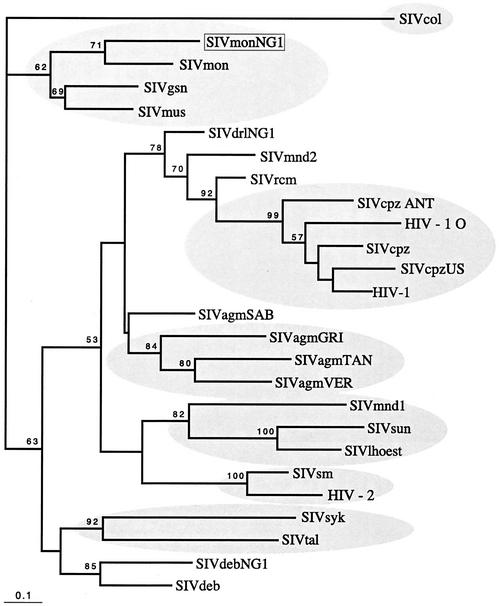
Maximum-likelihood tree of a 520-bp pol sequence, with significant bootstrap values (of 100) indicated. The sequences represent the amplicon derived by using the Polis4/Unipol2 primers (9, 28). The best-fitting model of evolution found by using Modeltest (35) with PAUP* was the general time reversible. The rates were as follows: A-C = 2.4379, A-G = 5.8145, A-T = 2.2893, C-G = 3.5281, C-T = 12.703, and G-T = 1.0. The base frequencies were as follows: A = 0.4341, C = 0.1827, G = 0.2021, and T = 0.1811. The gamma distribution shape parameter was alpha = 0.9683. The proportion of invariable sites was 0.2127. Both the branch lengths and the bootstrap proportions (of 100) were derived by maximum-likelihood searching. The scale bar indicates the number of nucleotide substitutions per site. SIVmonNG1 (AJ549283), SIVdrlNG1 (AJ310481), and SIVdebNG1 (AJ549756) were sequenced as part of the present study; SIVmon (99CM-CML1), SIVgsn (99CM-CN71), SIVmus (01CM-S1239), SIVmnd2, SIVtal, and SIVdeb are from Peeters et al. (33): these latter sequences and others were obtained from the Los Alamos HIV Database/GenBank.

References

    1. Allan, J. S., M. Short, M. E. Taylor, S. Su, V. M. Hirsch, P. R. Johnson, G. M. Shaw, and B. H. Hahn. 1991. Species-specific diversity among simian immunodeficiency viruses from African green monkeys. J. Virol. 65:2816-2828. - PMC - PubMed
    1. Beer, B. E., E. Bailes, G. Dapolito, B. J. Campbell, R. M. Goeken, M. K. Axthelm, P. D. Markham, J. Bernard, D. Zagury, G. Franchini, P. M. Sharp, and V. M. Hirsch. 2000. Patterns of genomic sequence diversity among their simian immunodeficiency viruses suggest that L'Hoest monkeys (Cercopithecus lhoesti) are a natural lentivirus reservoir. J. Virol. 74:3892-3898. - PMC - PubMed
    1. Beer, B. E., E. Bailes, R. Goeken, G. Dapolito, C. Coulibaly, S. G. Norley, R. Kurth, J. P. Gautier, A. Gautier-Hion, D. Vallet, P. M. Sharp, and V. M. Hirsch. 1999. Simian immunodeficiency virus (SIV) from sun-tailed monkeys (Cercopithecus solatus): evidence for host-dependent evolution of SIV within the C. lhoesti superspecies. J. Virol. 73:7734-7744. - PMC - PubMed
    1. Beer, B. E., E. Bailes, P. M. Sharp, and V. M. Hirsch. 1999. Diversity and evolution of primate lentiviruses, p. 460-474. In C. L. Kuiken, B. Foley, B. Hahn, P. A. Marx, F. McCutchan, J. W. Mellors, J. I. Mullins, S. Wolinsky, and B. Korber (ed.), Human retroviruses and AIDS. Los Alamos National Laboratory, Los Alamos, N.Mex.
    1. Beer, B. E., B. T. Foley, C. L. Kuiken, Z. Tooze, R. M. Goeken, C. R. Brown, J. Hu, M. S. Claire, B. T. Korber, and V. M. Hirsch. 2001. Characterization of novel simian immunodeficiency viruses from red-capped mangabeys from Nigeria (SIVrcmNG409 and -NG411). J. Virol. 75:12014-12027. - PMC - PubMed

MeSH terms

Substances

Associated data

LinkOut - more resources