. 2003 Mar 24;2(1):8.
doi: 10.1186/1475-2883-2-8.

Impact of ivermectin on onchocerciasis transmission: assessing the empirical evidence that repeated ivermectin mass treatments may lead to elimination/eradication in West-Africa

Affiliations

Impact of ivermectin on onchocerciasis transmission: assessing the empirical evidence that repeated ivermectin mass treatments may lead to elimination/eradication in West-Africa

Gerard JJM Borsboom et al. Filaria J. .

Abstract

BACKGROUND: The Onchocerciasis Control Program (OCP) in West Africa has been closed down at the end of 2002. All subsequent control will be transferred to the participating countries and will almost entirely be based on periodic mass treatment with ivermectin. This makes the question whether elimination of infection or eradication of onchocerciasis can be achieved using this strategy of critical importance. This study was undertaken to explore this issue. METHODS: An empirical approach was adopted in which a comprehensive analysis was undertaken of available data on the impact of more than a decade of ivermectin treatment on onchocerciasis infection and transmission. Relevant entomological and epidemiological data from 14 river basins in the OCP and one basin in Cameroon were reviewed. Areas were distinguished by frequency of treatment (6-monthly or annually), endemicity level and additional control measures such as vector control. Assessment of results were in terms of epidemiological and entomological parameters, and as a measure of inputs, therapeutic and geographical coverage rates were used. RESULTS: In all of the river basins studied, ivermectin treatment sharply reduced prevalence and intensity of infection. Significant transmission, however, is still ongoing in some basins after 10-12 years of ivermectin treatment. In other basins, transmission may have been interrupted, but this needs to be confirmed by in-depth evaluations. In one mesoendemic basin, where 20 rounds of four-monthly treatment reduced prevalence of infection to levels as low as 2-3%, there was significant recrudescence of infection within a few years after interruption of treatment. CONCLUSIONS: Ivermectin treatment has been very successful in eliminating onchocerciasis as a public health problem. However, the results presented in this paper make it almost certain that repeated ivermectin mass treatment will not lead to the elimination of transmission of onchocerciasis from West Africa. Data on 6-monthly treatments are not sufficient to draw definitive conclusions.


Figures
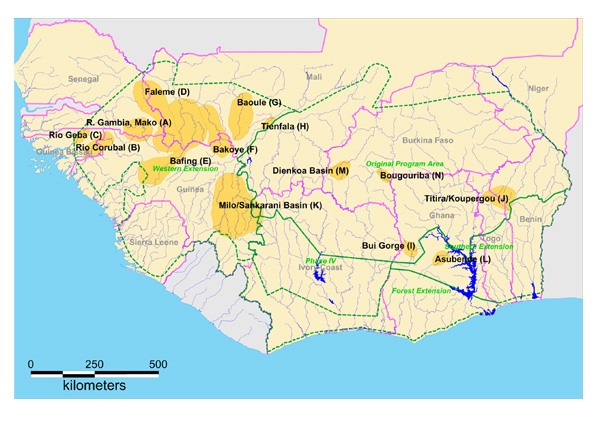
Figure 1
Figure 1
Map of the 14 study areas within the area covered by the OCP.
Figure 2
Figure 2
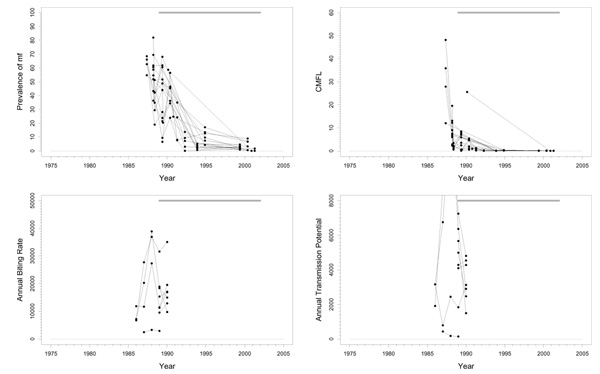
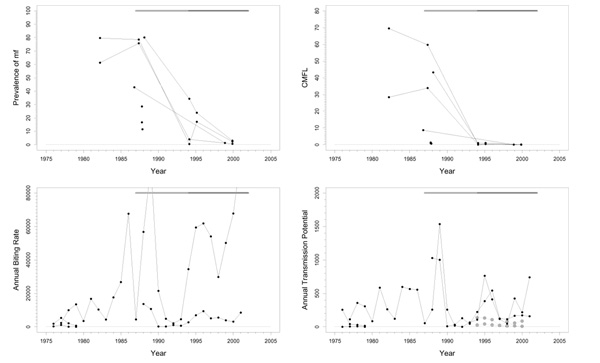
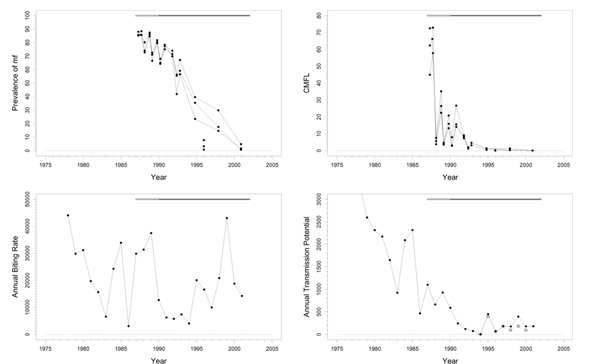
Prevalence of microfilariae (mf), community microfilarial load (CMFL), annual biting rate (ABR), and crude annual transmission potential (ATP) against time in the River Gambia / Mako (A) study area. The thick grey lines at the top indicate the period over which ivermectin mass treatment was given. Note that the top two panels refer to survey villages, and the bottom two panels to capture points.
Figure 3
Figure 3
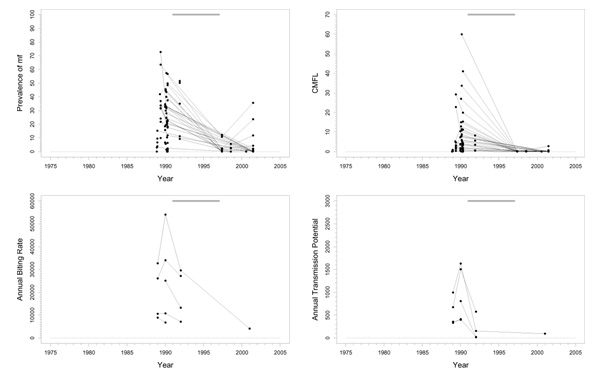
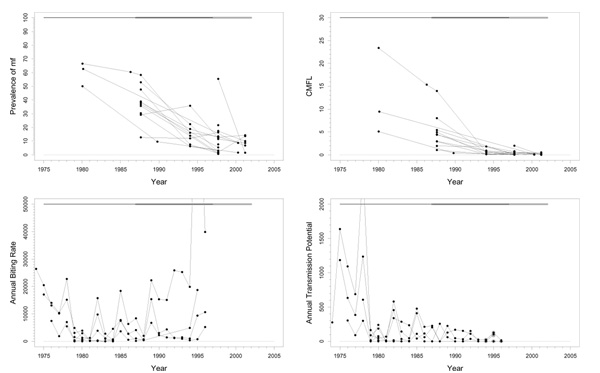
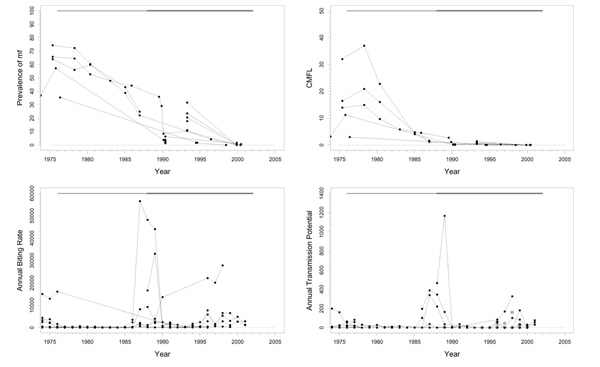
Prevalence of microfilariae (mf), community microfilarial load (CMFL), annual biting rate (ABR), and crude annual transmission potential (ATP) against time in the Rio Corubal (B) study area. The thick grey lines at the top indicate the period over which ivermectin mass treatment was given. Note that the top two panels refer to survey villages, and the bottom two panels to capture points.
Figure 4
Figure 4
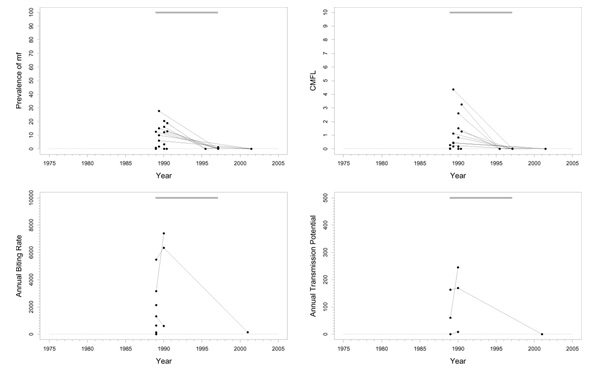
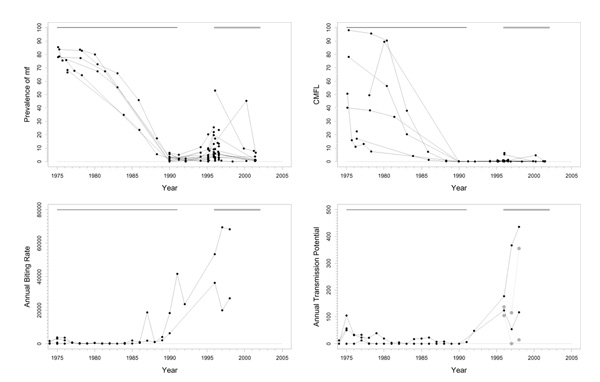
Prevalence of microfilariae (mf), community microfilarial load (CMFL), annual biting rate (ABR), and crude annual transmission potential (ATP) against time in the Rio Gêba (C) study area. The thick grey lines at the top indicate the period over which ivermectin mass treatment was given. Note that the top two panels refer to survey villages, and the bottom two panels to capture points.
Figure 5
Figure 5
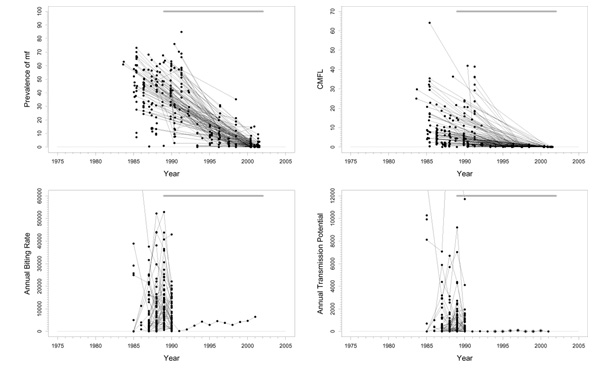
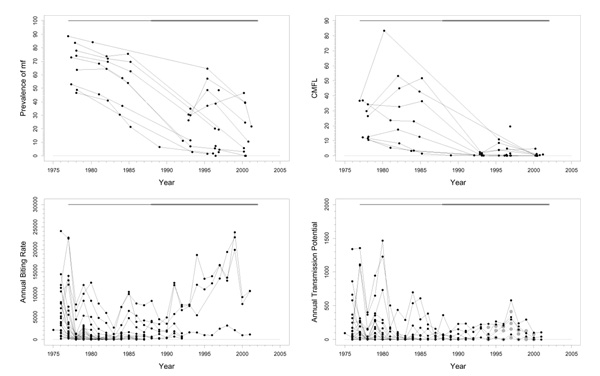
Prevalence of microfilariae (mf), community microfilarial load (CMFL), annual biting rate (ABR), and crude and O. volvulus specific annual transmission potentials (ATP and ATPO. volv.) against time in the Falémé(D), Bafing (E), Bakoye (F), and Baoulé (G) study areas. The thick grey lines at the top indicate the period over which ivermectin mass treatment was given. Note that the top two panels refer to survey villages, and the bottom two panels to capture points. ATPO. volv. values are denoted by the grey symbols in the plot for ATP.
Figure 6
Figure 6
Prevalence of microfilariae (mf), community microfilarial load (CMFL), annual biting rate (ABR), and crude and O. volvulus specific annual transmission potentials (ATP and ATPO. volv.) against time in the Tienfala (H) study area. The thick grey lines at the top indicate the period over which ivermectin mass treatment was given, while thin black lines indicate the period of vector control. Note that the top two panels refer to survey villages, and the bottom two panels to capture points. ATPO. volv. values are denoted by the grey symbols in the plot for ATP.
Figure 7
Figure 7
Prevalence of microfilariae (mf), community microfilarial load (CMFL), annual biting rate (ABR), and crude and O. volvulus specific annual transmission potentials (ATP and ATPO.volv.) against time in the Bui Gorge (I) study area. The thick grey lines at the top indicate the period over which ivermectin mass treatment was given, while thin black lines indicate the period of vector control. Note that the top two panels refer to survey villages, and the bottom two panels to capture points. ATPO.volv. values are denoted by the grey symbols in the plot for ATP.
Figure 8
Figure 8
Prevalence of microfilariae (mf), community microfilarial load (CMFL), annual biting rate (ABR), and crude and O. volvulus specific annual transmission potentials (ATP and ATPO. volv.) against time in the Titira and Kouporgou (J) study area. The thick grey lines at the top indicate the period over which ivermectin mass treatment was given, while thin black lines indicate the period of vector control. Note that the top two panels refer to survey villages, and the bottom two panels to capture points. ATPO. volv. values are denoted by the grey symbols in the plot for ATP.
Figure 9
Figure 9
Prevalence of microfilariae (mf), community microfilarial load (CMFL), annual biting rate (ABR), and crude and O. volvulus specific annual transmission potentials (ATP and ATPO. volv.) against time in the Milo and Sankarani (K) study area. The thick grey lines at the top indicate the period over which ivermectin mass treatment was given, while thin black lines indicate the period of vector control. Note that the top two panels refer to survey villages, and the bottom two panels to capture points. ATPO. volv. values are denoted by the grey symbols in the plot for ATP.
Figure 10
Figure 10
Prevalence of microfilariae (mf), community microfilarial load (CMFL), annual biting rate (ABR), and crude and O. volvulus specific annual transmission potentials (ATP and ATPO. volv.) against time in the Asubende (L) study area. The thick grey lines at the top indicate the period over which ivermectin mass treatment was given, while thin black lines indicate the period of vector control. Note that the top two panels refer to survey villages, and the bottom two panels to capture points. ATPO. volv. values are denoted by the grey symbols in the plot for ATP.
Figure 11
Figure 11
Prevalence of microfilariae (mf), community microfilarial load (CMFL), annual biting rate (ABR), and crude and O. volvulus specific annual transmission potentials (ATP and ATPO. volv.) against time in the Dienkoa (M) study area. The thick grey lines at the top indicate the period over which ivermectin mass treatment was given, while thin black lines indicate the period of vector control. Note that the top two panels refer to survey villages, and the bottom two panels to capture points. ATPO. volv. values are denoted by the grey symbols in the plot for ATP.
Figure 12
Figure 12
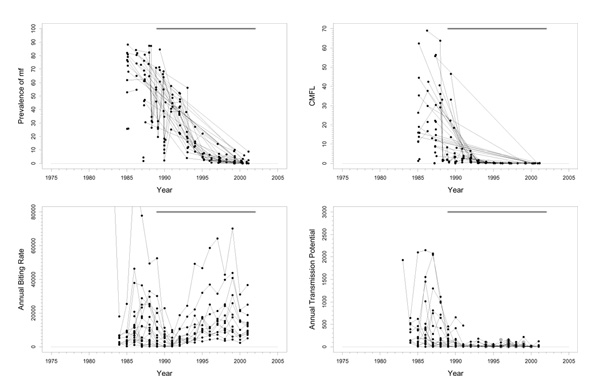
Prevalence of microfilariae (mf), community microfilarial load (CMFL), annual biting rate (ABR), and crude and O. volvulus specific annual transmission potentials (ATP and ATPO. volv.) against time in the Bougouriba (N) study area. The thick grey lines at the top indicate the period over which ivermectin mass treatment was given, while thin black lines indicate the period of vector control. Note that the top two panels refer to survey villages, and the bottom two panels to capture points. ATPO. volv. values are denoted by the grey symbols in the plot for ATP.

References

    1. De Sole G, Awadzi K, Remme J, Dadzie KY, Ba O, Giese J, Karam M, Keita FM, Opoku NO. A community trial of ivermectin in the onchocerciasis focus of Asubende, Ghana. II. Adverse reactions. Trop Med Parasitol. 1989;40:375–382. - PubMed
    1. Remme J, De Sole G, Dadzie KY, Alley ES, Baker RH, Habbema JD, Plaisier AP, van Oortmarssen GJ, Samba EM. Large scale ivermectin distribution and its epidemiological consequences. Acta Leiden. 1990;59:177–191. - PubMed
    1. Remme J, Baker RH, De Sole G, Dadzie KY, Walsh JF, Adams MA, Alley ES, Avissey HS. A community trial of ivermectin in the onchocerciasis focus of Asubende, Ghana. I. Effect on the microfilarial reservoir and the transmission of Onchocerca volvulus. Trop Med Parasitol. 1989;40:367–374. - PubMed
    1. Winnen M, Plaisier AP, Alley ES, Nagelkerke NJD, van Oortmarssen G, Boatin B, Habbema JDF. Can ivermectin mass treatments eliminate onchocerciasis in Africa? Bull World Health Organ. 2002;80:384–390. - PMC - PubMed
    1. Remme JHF. The African programme for onchocerciasis control: preparing to launch. Parasitol Today. 1995;11:403–406. doi: 10.1016/0169-4758(95)80017-4. - DOI

LinkOut - more resources