Involvement of H2O2 in superoxide-dismutase-induced enhancement of endothelium-dependent relaxation in rabbit mesenteric resistance artery
- PMID: 12770950
- PMCID: PMC1573853
- DOI: 10.1038/sj.bjp.0705255
Involvement of H2O2 in superoxide-dismutase-induced enhancement of endothelium-dependent relaxation in rabbit mesenteric resistance artery
Abstract
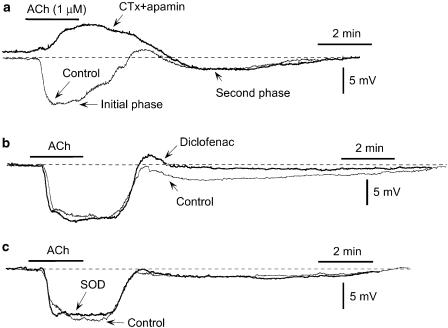
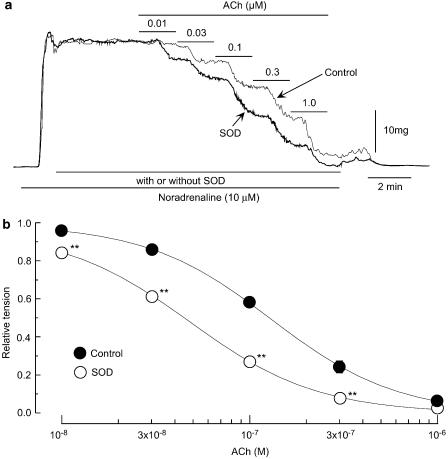
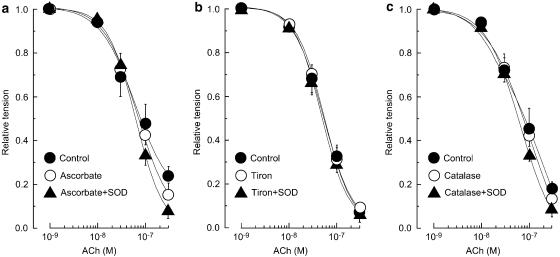
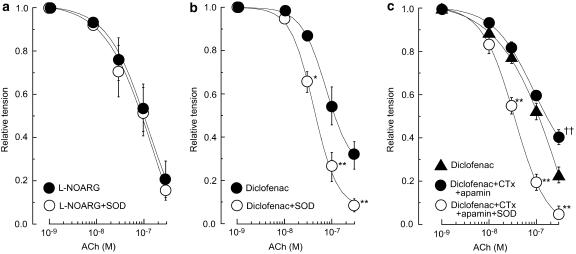
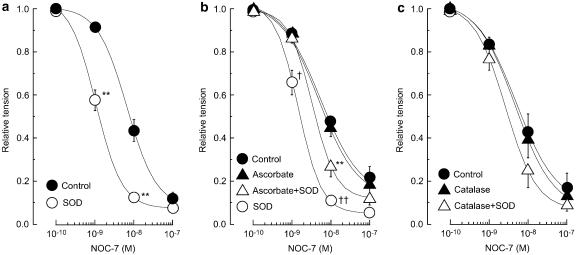
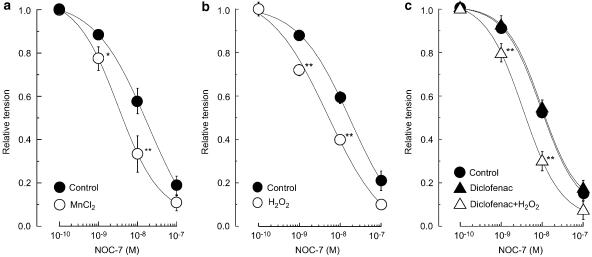
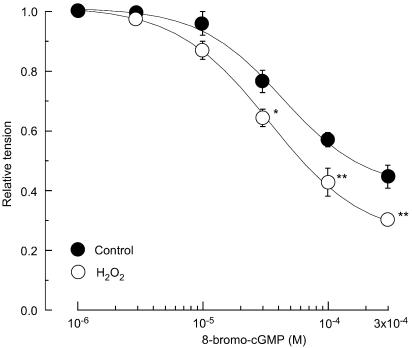
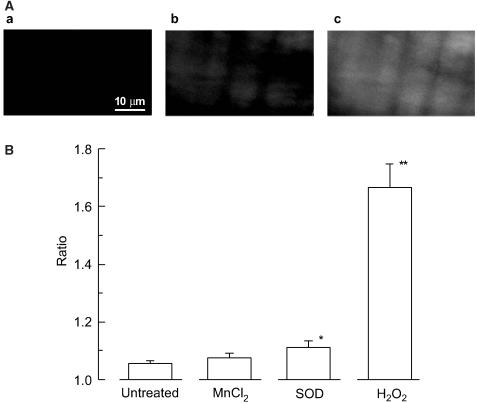
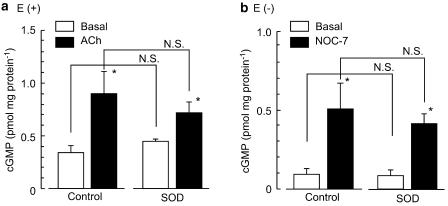
1 The mechanism underlying the enhancement by superoxide dismutase (SOD) of endothelium-dependent relaxation was investigated in rabbit mesenteric resistance arteries. 2 SOD (200 U ml(-1)) increased the production of H(2)O(2) in smooth muscle cells (as indicated by the use of an H(2)O(2)-sensitive fluorescent dye). 3 Neither SOD nor catalase (400 U ml(-1)) modified either the resting membrane potential or the hyperpolarization induced by acetylcholine (ACh, 1 micro M) in smooth muscle cells. 4 In arteries constricted with noradrenaline, the endothelium-dependent relaxation induced by ACh (0.01-1 micro M) was enhanced by SOD (200 U ml(-1)) (P<0.01). This action of SOD was inhibited by L-N(G)-nitroarginine (nitric oxide (NO)-synthase inhibitor) but not by either charybdotoxin+apamin (Ca(2+)-activated-K(+)-channel blockers) or diclofenac (cyclooxygenase inhibitor). 5 Neither ascorbate (50 micro M) nor tiron (0.3 mM), superoxide scavengers, had any effect on the ACh-induced relaxation, but each attenuated the enhancing effect of SOD on the ACh-induced relaxation. Similarly, catalase (400 U ml(-1)) inhibited the effect of SOD without changing the ACh-induced relaxation. 6 In endothelium-denuded strips constricted with noradrenaline, SOD enhanced the relaxation induced by the NO donor 1-hydroxy-2-oxo-3-(N-methyl-3-aminopropyl)-3-methyl-1-triazene (NOC-7) (P<0.05). Ascorbate and catalase each attenuated this effect of SOD. 7 H(2)O(2) (1 micro M) enhanced the relaxation on the noradrenaline contraction induced by NOC-7 and that induced by 8-bromo-cGMP, a membrane-permeable analogue of guanosine 3',5' cyclic monophosphate (cGMP). 8 SOD had no effect on cGMP production, whether measured in endothelium-intact strips following an application of ACh (0.1 micro M) or in endothelium-denuded strips following an application of NOC-7 (0.1 micro M). 9 It is suggested that in rabbit mesenteric resistance arteries, SOD increases the ACh-induced, endothelium-dependent relaxation by enhancing the action of NO in the smooth muscle via its H(2)O(2)-producing action (rather than via a superoxide-scavenging action).
Figures
References
-
- ABRAHAMSSON T., BRANDT U., MARKLUND S.L., SJOQVIST P.O. Vascular bound recombinant extracellular superoxide dismutase type C protects against the detrimental effects of superoxide radicals on endothelium-dependent arterial relaxation. Circ. Res. 1992;70:264–271. - PubMed
-
- BARLOW R.S., ABDALLA M.E., RICHARD E.W. H2O2 opens BKCa channels via the PLA2-arachidonic acid signaling cascade in coronary artery smooth muscle. Am. J. Physiol. 2000;279:H475–H483. - PubMed
-
- BARLOW R.S., WHITE R.E. Hydrogen peroxide relaxes porcine coronary arteries by stimulating BKCa channel activity. Am. J. Physiol. 1998;275:H1283–H1289. - PubMed
-
- BHARADWAJ L., PRASAD K. Mediation of H2O2-induced vascular relaxation by endothelium-derived relaxing factor. Mol. Cell. Biochem. 1995;149–150:267–270. - PubMed
-
- DAEMEN M.J., LOMBARDI D.M., BOSMAN F.T., SCHWARTZ S.M. Angiotensin II induces smooth muscle cell proliferation in the normal and injured rat arterial wall. Circ. Res. 1991;68:450–456. - PubMed
Publication types
MeSH terms
Substances
LinkOut - more resources
Full Text Sources
Miscellaneous