. 2003 Jun 1;31(11):2769-77.
doi: 10.1093/nar/gkg396.

Overexpression of FABP7 in Down syndrome fetal brains is associated with PKNOX1 gene-dosage imbalance

Affiliations

Overexpression of FABP7 in Down syndrome fetal brains is associated with PKNOX1 gene-dosage imbalance

Ma Francisca Sánchez-Font et al. Nucleic Acids Res. .

Abstract

Suppression subtractive hybridization performed on Down syndrome (DS) fetal brains revealed a differentially expressed gene, FABP7, mapped to 6q22-23. FABP7 overexpression in DS brains was verified by real-time PCR (1.63-fold). To elucidate the molecular basis of FABP7 overexpression and establish the relationship with chromosome 21 trisomy, the FABP7 promoter was cloned by genomic inverse PCR. Comparison to the mouse ortholog revealed conservation of reported regulatory elements, among them a Pbx/POU binding site, known to be the target of PBX heteromeric complexes. PBX partners include homeobox-containing proteins, such as PKNOX1 (PREP1), a transcription factor mapping at 21q22.3. We report here: (i) overexpression of PKNOX1 in DS fetal brains; (ii) in vitro specific binding of PKNOX1 to the Pbx/POU site of the FABP7 promoter; (iii) in vivo FABP7 promoter trans-activation in cultured neuroblastoma cells caused by PKNOX1 overexpression. To our knowledge this is the first report of a direct relation between dosage imbalance of a chromosome 21 gene and altered expression of a downstream gene mapping on another chromosome. Given the role of FABP7 in the establishment, development and maintenance of the CNS, we suggest that the overexpression of FABP7 could contribute to DS-associated neurological disorders.


Figures
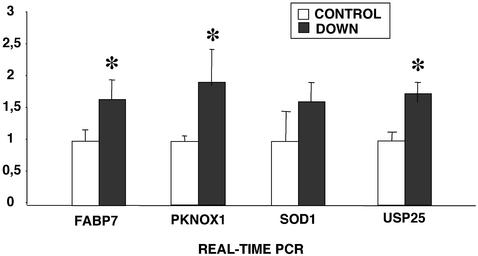
Figure 1
Figure 1
Average expression of FABP7 and other chromosome 21 genes (PKNOX1, SOD1 and USP25) in control and DS fetal brains, as detected by real-time PCR. All values are given in arbitrary units and normalized using G3PDH as an endogenous control. The statistical error is also shown. The asterisks indicate that the expression differences between trisomic and disomic brains are statistically significant (Mann–Whitney test, P < 0.05).
Figure 2
Figure 2
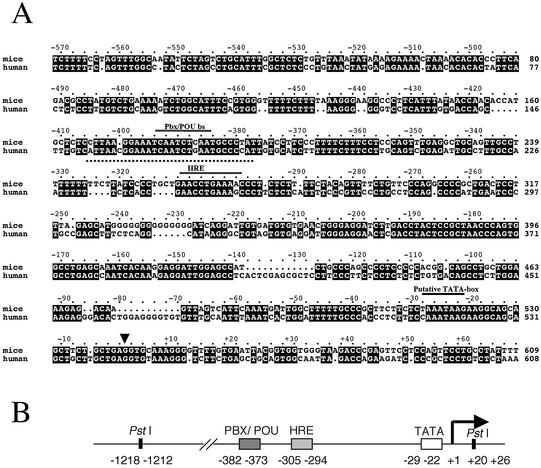
(A) Sequence alignment of murine and human FABP7 (BFABP) promoters. Nucleotide identities are boxed in black. Conserved regulatory motifs (the conserved HRE, the Pbx/POU binding site and the TATA box), are indicated by a black bar above. The dotted underline indicates the sequence of the probe used for EMSA. The transcription initiation site is marked by an arrow. (B) Diagram depicting the organization and relative position of the conserved regulatory elements in the human promoter.
Figure 3
Figure 3
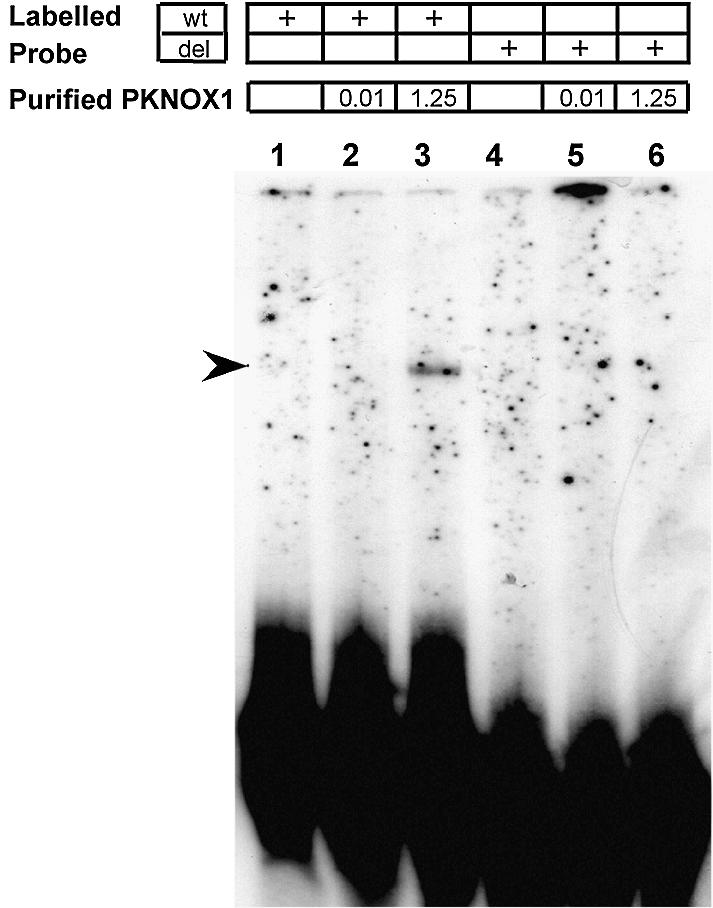
EMSA analysis using recombinant PKNOX1 protein and two different labeled ds oligonucleotides (as indicated above): wt probe, which encompasses the Pbx/POU binding site of the FABP7 promoter, and del probe, which contains the same sequence but for the deletion of the Pbx/POU binding site. Lanes 1 and 6, probes with no protein added; lanes 2 and 4, probes plus 10 ng of purified recombinant PKNOX1; lanes 3 and 5, probes plus 1.25 µg of purified recombinant PKNOX1.
Figure 4
Figure 4
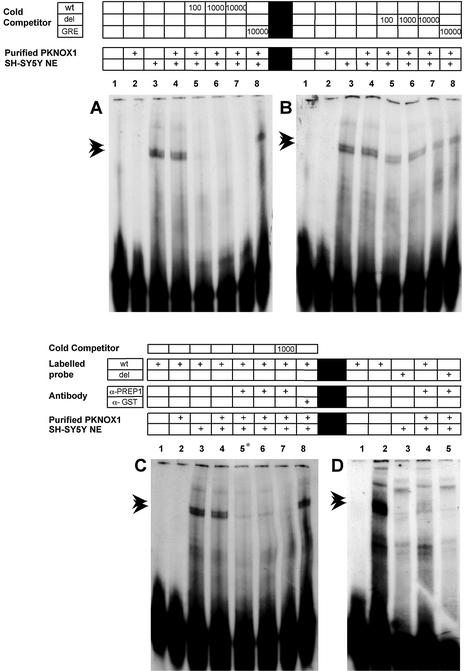
PKNOX1 is present in SH-SY5Y nuclear extracts and binds specifically to the Pbx/POU binding site of the FABP7 promoter. (A) Specific competitions (100-, 1000- and 10 000-fold molar excess) with cold wt probe and non-specific competition with the GRE oligonucleotide (10 000-fold molar excess). (B) Specific competitions with cold mutated del probe (100-, 1000- and 10 000-fold molar excess). (C) Disruption of the PKNOX1-binding complexes by co-incubation with an anti-PKNOX1 antibody. The asterisk on lane 5 indicates that the antibody was added from the beginning of the reaction instead of addition after the 10 min incubation on ice (see Materials and Methods). (D) PKNOX1 binds specifically to the Pbx/POU target site and this binding is abolished by the anti-PKNOX1 antibody. The presence of nuclear extract, purified recombinant PKNOX1 (10 ng), type of oligonucleotide probes, competitors and antibodies used are indicated above each lane. Specific retarded bands due to protein binding at the Pbx/POU target site are indicated by arrows. Note their disappearance after addition of the anti-PKNOX1 antibody.
Figure 5
Figure 5
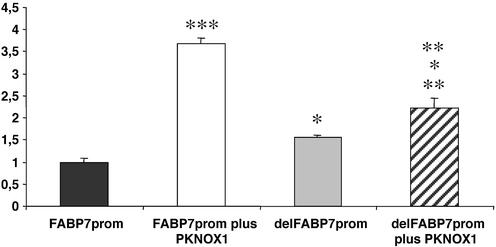
PKNOX1-dependent trans-activation of the FABP7 promoter on cultured transfected SH-SY5Y cells. Luciferase/β-gal activity ratios are given in arbitrary units with respect to the wild-type promoter without added PKNOX1. The average values and the standard deviation are obtained after nine replicas for the wild-type promoter with or without co-expression of recombinant PKNOX1 and four replicas for the mutant deleted promoter with or without PKNOX1. Statistical significance was calculated by the Mann–Whitney test (*P < 0.05; **P < 0.005; ***P < 0.001; the first level above the histogram: statistical significance when comparing the values to the wild-type promoter without added PKNOX1; second level above the histogram: statistical significance when comparing to the mutant deleted promoter without added PKNOX1; third level above the histogram: statistical significance of the trans-activation differences between the wild-type and mutant promoters after addition of PKNOX1).

References

    1. Hassold T. and Jacobs,P. (1984) Trisomy in man. Annu. Rev. Genet., 18, 69–97. - PubMed
    1. Epstein C.J. (1995) Epilogue: toward twenty-first century with Down syndrome—a personal view of how far we have come and how far we can reasonably expect to go. Prog. Clin. Biol. Res., 393, 241–246. - PubMed
    1. Epstein C.J. (1986) The Consequences of Chromosome Imbalance: Principles, Mechanisms and Models. Cambridge University Press, New York.
    1. Hattori M., Fujiyama,A., Taylor,T.D., Watanabe,H., Yada,T., Parks,H.S., Toyoda,A., Ishii,K., Totoki,Y., Choi,D.K. et al. (2000) The DNA sequence of human chromosome 21. Nature, 405, 311–319. - PubMed
    1. Reymond A., Marigo,V., Yaylaoglu,M.B., Leoni. A., Ucla,C., Scamuffa,N., Cacciopoli,C., Dermitzakis,E.T., Lyle,R., Banfi,S. et al. (2002) Human chromosome 21 gene expression atlas in the mouse. Nature, 420, 582–586. - PubMed

Publication types

MeSH terms

Associated data