


Effective behavioral treatment of focal hand dystonia in musicians alters somatosensory cortical organization
- PMID: 12771383
- PMCID: PMC164692
- DOI: 10.1073/pnas.1231193100
Effective behavioral treatment of focal hand dystonia in musicians alters somatosensory cortical organization
Abstract
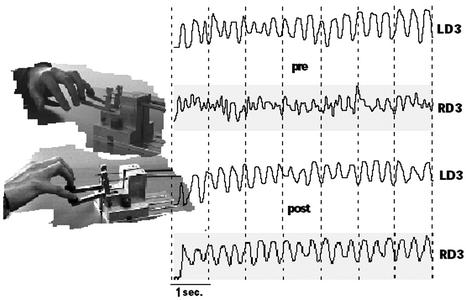
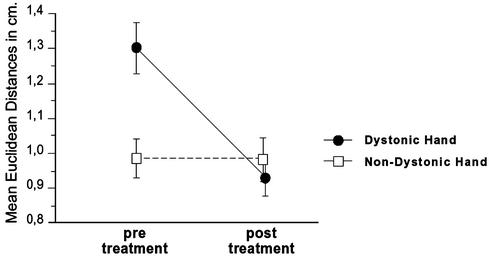
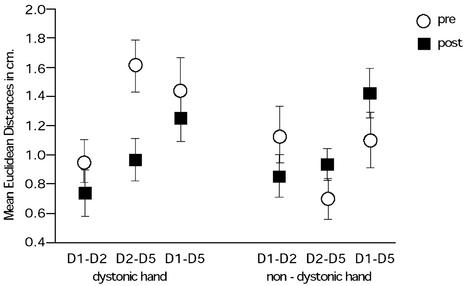
New perspectives in neurorehabilitation suggest that behavioral treatments of movement disorders may modify the functional organization of central somatosensory neural networks. On the basis of the assumption that use-dependent reorganization in these networks contributes to the fundamental abnormalities seen in focal dystonia, we treated 10 affected musicians and measured the concomitant somatosensory changes by using whole-head magnetoencephalography. We found that effective treatment, using the method of sensory motor retuning, leads to alterations in the functional organization of the somatosensory cortex. Specifically, before treatment, somatosensory relationships of the individual fingers differ between the affected and unaffected hands, whereas after treatment, finger representations contralateral to the dystonic side become more similar to the less-affected side. Further, somatosensory finger representations are ordered more according to homuncular principles after treatment. In addition, the observed physiologic changes correlated with behavioral data. These results confirm that plastic changes in parallel with emergent neurological dysfunction may be reversed by context-specific, intensive training-based remediation.
Figures
Comment in
-
Retuning the misfiring brain.Proc Natl Acad Sci U S A. 2003 Jun 24;100(13):7425-7. doi: 10.1073/pnas.1533210100. Epub 2003 Jun 16. Proc Natl Acad Sci U S A. 2003. PMID: 12810942 Free PMC article. No abstract available.
References
-
- Taub, E., Uswatte, G. & Elbert, T. (2002) Nat. Rev. Neurosci. 3, 228-236. - PubMed
-
- Elbert, T., Candia, V., Altenmüller, E., Rau, H., Sterr, A., Rockstroh, B., Pantev, C. & Taub, E. (1998) NeuroReport 9, 3571-3575. - PubMed
-
- Candia, V., Elbert, T., Altenmüller, E., Rau, H., Schäfer, T. & Taub, E. (1999) Lancet 42, 353. - PubMed
-
- Candia, V., Schäfer, T., Taub, E., Rau, H., Altenmüller, E., Rockstroh, B. & Elbert, T. (2002) Arch. Phys. Med. Rehab. 83, 1342-1348. - PubMed
-
- Bara-Jimenez, W., Catalan, M. J., Hallett, M. & Gerloff, C. (1998) Ann. Neurol. 44, 828-831. - PubMed
Publication types
MeSH terms
LinkOut - more resources
Full Text Sources
Medical
