


Mutations in the fumarate hydratase gene cause hereditary leiomyomatosis and renal cell cancer in families in North America
- PMID: 12772087
- PMCID: PMC1180594
- DOI: 10.1086/376435
Mutations in the fumarate hydratase gene cause hereditary leiomyomatosis and renal cell cancer in families in North America
Abstract
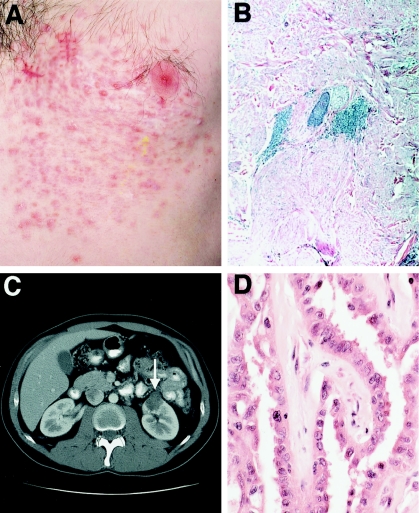
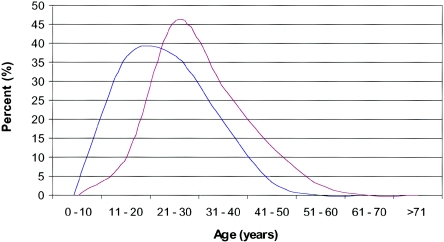
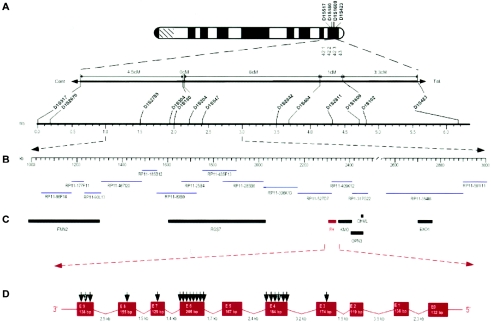
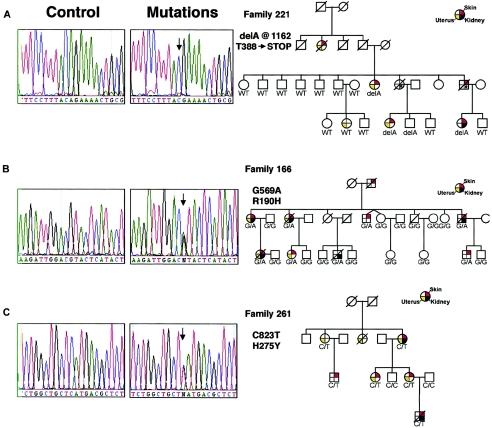
Hereditary leiomyomatosis and renal cell cancer (HLRCC) is an autosomal dominant disorder characterized by smooth-muscle tumors of the skin and uterus and/or renal cancer. Although the identification of germline mutations in the fumarate hydratase (FH) gene in European families supports it as the susceptibility gene for HLRCC, its role in families in North America has not been studied. We screened for germline mutations in FH in 35 families with cutaneous leiomyomas. Sequence analysis revealed mutations in FH in 31 families (89%). Twenty different mutations in FH were identified, of which 18 were novel. Of these 20 mutations, 2 were insertions, 5 were small deletions that caused frameshifts leading to premature truncation of the protein, and 13 were missense mutations. Eleven unrelated families shared a common mutation: R190H. Eighty-one individuals (47 women and 34 men) had cutaneous leiomyomas. Ninety-eight percent (46/47) of women with cutaneous leiomyomas also had uterine leiomyomas. Eighty-nine percent (41/46) of women with cutaneous and uterine leiomyomas had a total hysterectomy, 44% at age < or =30 years. We identified 13 individuals in 5 families with unilateral and solitary renal tumors. Seven individuals from four families had papillary type II renal cell carcinoma, and another individual from one of these families had collecting duct carcinoma of the kidney. The present study shows that mutations in FH are associated with HLRCC in North America. HLRCC is associated with clinically significant uterine fibroids and aggressive renal tumors. The present study also expands the histologic spectrum of renal tumors and FH mutations associated with HLRCC.
Figures
References
Electronic-Database Information
-
- Celera, http://www.celera.com/
-
- DHPLC Melt Program, http://insertion.stanford.edu/melt.html
-
- Ensembl Genome Browser, http://www.ensembl.org/
-
- GenBank, http://www.ncbi.nlm.nih.gov/Genbank/ (for mitochondrial FH precursor cDNA [accession number U59309] and BAC genomic sequences [accession numbers AL359764 and AL591898])
-
- National Center for Biotechnology Information, http://www.ncbi.nlm.nih.gov/
References
-
- Akiba T, Hiraga K, Tuboi S (1984) Intracellular distribution of fumarase in various animals. J Biochem 96:189–195 - PubMed
-
- Alam NA, Bevan S, Churchman M, Barclay E, Barker K, Jaeger EE, Nelson HM, Healy E, Pembroke AC, Friedmann PS, Dalziel K, Calonje E, Anderson J, August PJ, Davies MG, Felix R, Munro CS, Murdoch M, Rendall J, Kennedy S, Leigh IM, Kelsell DP, Tomlinson IP, Houlston RS (2001) Localization of a gene (MCUL1) for multiple cutaneous leiomyomata and uterine fibroids to chromosome 1q42.3-q43. Am J Hum Genet 68:1264–1269 - PMC - PubMed
-
- Choyke PL, Walther MM, Glenn GM, Wagner JR, Venzon DJ, Lubensky IA, Zbar B, Linehan WM (1997) Imaging features of hereditary papillary renal cancers. J Comput Assist Tomogr 21:737–741 - PubMed
-
- Coughlin EM, Christensen E, Kunz PL, Krishnamoorthy KS, Walker V, Dennis NR, Chalmers RA, Elpeleg ON, Whelan D, Pollitt RJ, Ramesh V, Mandell R, Shih VE (1998) Molecular analysis and prenatal diagnosis of human fumarase deficiency. Mol Genet Metab 63:254–262 - PubMed
Publication types
MeSH terms
Substances
Grants and funding
LinkOut - more resources
Full Text Sources
Medical
Molecular Biology Databases
Miscellaneous
