


A modified version of the unique cue theory accounts for olfactory compound processing in honeybees
- PMID: 12773584
- PMCID: PMC202310
- DOI: 10.1101/lm.55803
A modified version of the unique cue theory accounts for olfactory compound processing in honeybees
Abstract
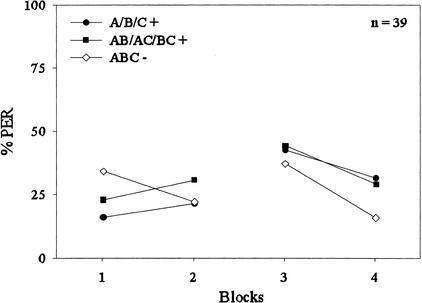
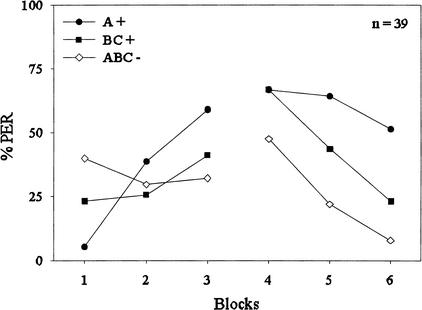
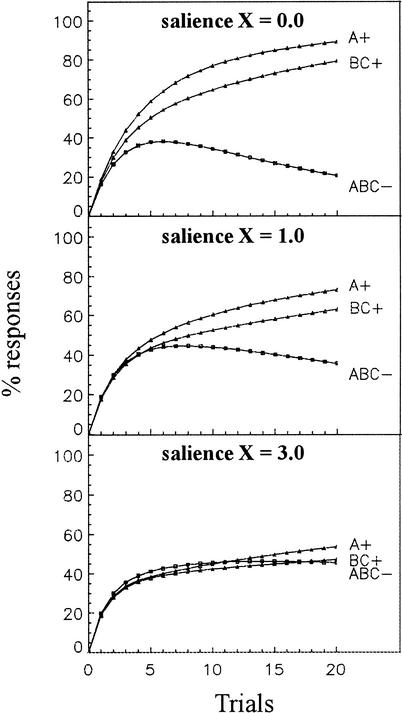
We investigated the capability of honeybees to discriminate between single odorants, binary olfactory mixtures, and ternary olfactory mixtures in olfactory conditioning of the proboscis extension reflex. In Experiment 1, three single odorants (A+, B+, and C+) and three binary mixtures of these odors (AB+, AC+, and BC+) were reinforced while the ternary compound, consisting of all three odors (ABC-), was nonreinforced. In Experiment 2, only one single odorant (A+) and one binary olfactory compound (BC+) were reinforced while the ternary compound (ABC-) consisting of the single odor and the binary compound was nonreinforced. We studied whether bees can solve these problems and whether the course of differentiation can be predicted by the unique cue theory, a modified unique cue theory, or Pearce's configural theory. Honeybees were not able to differentiate reinforced from nonreinforced stimuli in Experiment 1. However, summation to ABC observed at the beginning of training contradicts the predictions of Pearce's configural theory. In Experiment 2, differentiation between the single odorant A and the ternary compound developed more easily than between the binary compound BC and ABC. This pattern of differentiation is in line with a modified unique cue theory and Pearce's configural theory. Summation to ABC at the beginning of training, however, again was at odds with Pearce's configural theory. Thus, olfactory compound processing in honeybees can best be explained by a modified unique cue theory.
Figures
References
-
- Atkinson, R. and Shiffrin, R. 1968. Human memory: A proposed system and its control processes. In The psychology of learning and motivation: Advances in research and theory (ed. K. Spence), Vol. 2, pp. 89–195. Academic Press, New York, NY.
-
- Aydin, A. and Pearce, J.M. 1997. Some determinants of response summation. Anim. Learn. Behav. 25: 108–121.
-
- Bahçekapili, H.G. 1997. “An evaluation of Rescorla and Wagner's elemenistic model versus Pearce's configural model in discrimination learning.” Ph.D thesis. Yale University, New Haven, CT.
-
- Bitterman, M.E., Menzel, R., Fietz, A., and Schäfer, S. 1983. Classical conditioning of proboscis extension in honeybees (Apis mellifera). J. Comp. Psychol. 97: 107–119. - PubMed
Publication types
MeSH terms
LinkOut - more resources
Full Text Sources