. 2003 Jun;185(12):3508-14.
doi: 10.1128/JB.185.12.3508-3514.2003.

PhoP-responsive expression of the Salmonella enterica serovar typhimurium slyA gene

Affiliations

PhoP-responsive expression of the Salmonella enterica serovar typhimurium slyA gene

Valia A Norte et al. J Bacteriol. 2003 Jun.

Abstract

The SlyA protein of Salmonella enterica serovar Typhimurium is a member of the MarR family of transcription regulators and is required for virulence and survival in professional macrophages. Isolated SlyA protein was able to bind a specific DNA target without posttranslational modification. This suggested that SlyA might not be activated by directly sensing an external signal but rather that the intracellular concentration of SlyA is enhanced in appropriate environments through the action of other transcription factors. Analysis of slyA transcription reveals the presence of a promoter region located upstream of the previously recognized SlyA repressed promoter. The newly identified upstream promoter region did not respond to SlyA but was activated by Mg(II) starvation in a PhoP-dependent manner. We present here evidence for a direct link between two transcription factors (PhoP and SlyA) crucial for Salmonella virulence.


Figures
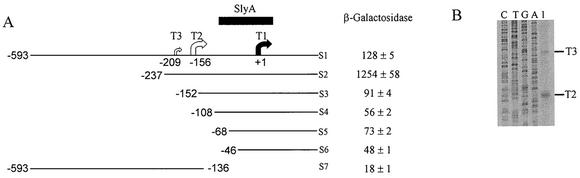
FIG. 1.
FIG. 1.
Identification of a second slyA promoter region. (A) β-Galactosidase activities of aerobically grown cultures of ST12/75 each containing one of a series (S1 to S6) of slyA::lacZ fusions in which DNA upstream of the previously established transcript start (T1, solid arrow) (24), was progressively deleted. The slyA DNA ends at position +165 in this series of fusions. A further slyA::lacZ fusion (S7) in which the previously recognized slyA promoter (T1) was deleted was also analyzed. The solid box indicates the region of the promoter protected by SlyA in footprinting studies. Two newly identified slyA transcript starts (T2 and T3, open arrows; see panel B) are also indicated. β-Galactosidase activities were measured in duplicate from at least two independent cultures; the means ± the standard errors are shown. Units of β-galactosidase activity are as defined by Miller (15). (B) Primer extension analysis of RNA isolated form ST12/75(pGS1534). Lanes C, T, G, and A are the sequence ladders for this region of slyA; lane 1 shows the primer extension products from the slyA gene.
FIG. 2.
FIG. 2.
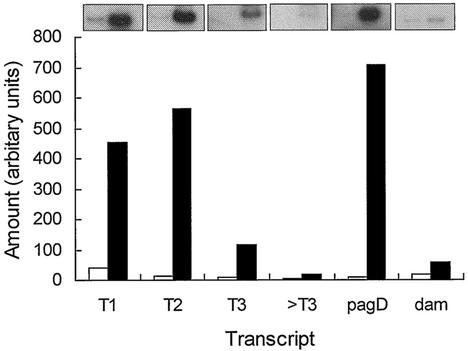
Effect of Mg(II) on transcription of chromosomal slyA. Expression of slyA was estimated by RT-PCR with total RNA (2 μg) isolated from Mg(II)-replete (open bars) and Mg(II)-starved (solid bars) stationary-phase cultures as the template. Oligonucleotide primers complementary to the T1, T2, and T3 transcript starts, as well as a primer complementary to a region upstream of T3 (>T3), were used to define the upstream limit of the slyA message. The Mg(II)-responsive pagD and unresponsive dam transcripts served as controls. Radiolabeled PCR products were separated on polyacrylamide gels, and the amount of product formed was estimated by quantitative densitometry of the corresponding autoradiographs. Representative autoradiographs are shown above the bar chart.
FIG. 3.
FIG. 3.
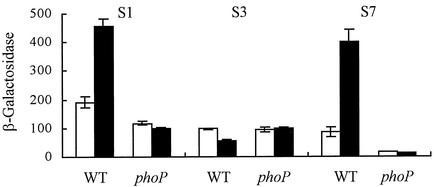
Transcription from the upstream region of the slyA promoter is regulated by PhoP in response to Mg(II) starvation. β-Galactosidase activities were measured for cultures of ST12/75 and ST12/75ΔphoP containing the indicated slyA::lacZ fusion (S1, S3, or S7; see Fig. 1A) in Mg(II)-replete (open bars) and Mg(II)-starved (solid bars) minimal medium. β-Galactosidase activities were measured in triplicate from at least two independent cultures; means ± the standard errors are shown. Units of β-galactosidase activity are as defined by Miller (15).
FIG. 4.
FIG. 4.
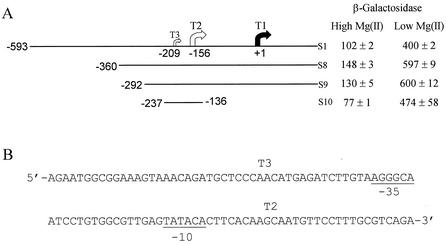
The slyA T2 transcript is Mg(II) responsive. (A) β-Galactosidase activities of aerobic cultures of ST12/75 containing the indicated slyA::lacZ fusion (S1, S8, S9, or S10) in Mg(II)-replete and Mg(II)-starved minimal medium. β-Galactosidase activities were measured in duplicate from at least two independent cultures; means ± the standard errors are shown. Units of β-galactosidase activity are as defined by Miller (15). (B) Sequence of the PhoP-responsive slyA promoter. The locations of the 5′ ends of the major T2 and the minor T3 upstream slyA transcripts are indicated. Potential −10 and −35 elements associated with T2 are indicated.
FIG. 5.
FIG. 5.
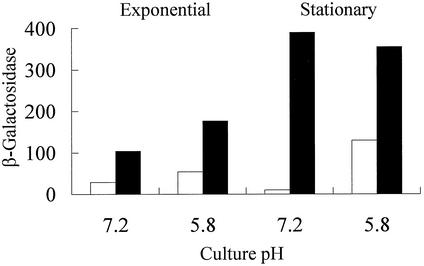
Effect of culture pH and Mg(II) availability on slyA expression. β-Galactosidase activities were measured for cultures of ST12/75 containing the S7 slyA::lacZ fusion (see Fig. 1A) in Mg(II)-replete (10 mM, open bars) and Mg(II)-starved (0.01 mM, solid bars) Bis-Tris minimal medium buffered at either pH 7.2 or pH 5.8. β-Galactosidase activities were measured in triplicate, and the mean values that varied by <10% are presented. Units of β-galactosidase activity are as defined by Miller (15).
FIG. 6.
FIG. 6.
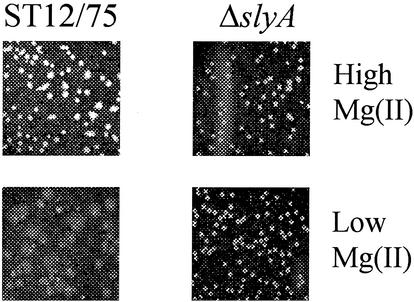
Growth of ST12/75 and ST12/75 (ΔslyA) on solid medium containing high or low levels of Mg(II). The indicated strains were grown for 48 h at 37°C on agarose medium containing either 10 mM MgCl2 (upper row) or 0.25 mM MgCl2 (lower row).
FIG. 7.
FIG. 7.
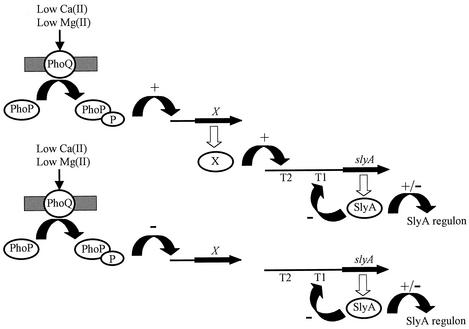
Model for PhoP-mediated regulation of slyA expression. Intracellular Salmonella are exposed to a low-Mg(II) environment. This is sensed by the periplasmic domain of PhoQ protein and, consequently, the phospho-PhoP dephosphorylase activity of PhoQ is inhibited. Phospho-PhoP regulates the expression of >40 genes. We suggest that there is an as-yet-unidentified transcription factor (X), which activates transcription from the slyA promoter T2. Alternatively, if factor X acts as a repressor of the slyA T2 promoter, PhoP-PhoQ might repress the expression of X and thereby relieve repression of slyA expression. Consequently, the intracellular concentration of SlyA is increased to a level at which it can regulate transcription from its target promoters, including repression of the slyA T1 promoter.

References

    1. Aguirre, A., S. Lejona, E. G. Vescovi, and F. C. Soncini. 2000. Phosphorylated PmrA interacts with the promoter region of ugd in Salmonella enterica serovar Typhimurium. J. Bacteriol. 182:3874-3876. - PMC - PubMed
    1. Alekshun, M. N., S. B. Levy, T. R. Mealy, B. A. Seaton, and J. F. Head. 2001. The crystal structure of MarR, a regulator of multiple antibiotic resistance, at 2.3 Å resolution. Nat. Struct. Biol. 8:710-714. - PubMed
    1. Blanc-Potard, A.-B., and E. Groisman. 1997. The Salmonella selC locus contains a pathogenicity island mediating intramacrophage survival. EMBO J. 16:5376-5385. - PMC - PubMed
    1. Buchmeier, N., S. Bossie, C. Chen, F. C. Fang, D. G. Guiney, and S. Libby. 1997. SlyA, a transcriptional regulator of Salmonella typhimurium, is required for resistance to oxidative stress and is expressed in the intracellular environment of macrophages. Infect. Immun. 65:3725-3730. - PMC - PubMed
    1. Chang, A. C. Y., and S. N. Cohen. 1978. Construction and characterization of amplifiable multicopy DNA cloning vehicles derived from the P15A cryptic miniplasmid. J. Bacteriol. 134:1141-1156. - PMC - PubMed

Publication types

MeSH terms

LinkOut - more resources