. 2003 Jun;69(6):3176-80.
doi: 10.1128/AEM.69.6.3176-3180.2003.

Enhanced mercury biosorption by bacterial cells with surface-displayed MerR

Affiliations

Enhanced mercury biosorption by bacterial cells with surface-displayed MerR

Weon Bae et al. Appl Environ Microbiol. 2003 Jun.

Abstract

The metalloregulatory protein MerR, which exhibits high affinity and selectivity toward mercury, was exploited for the construction of microbial biosorbents specific for mercury removal. Whole-cell sorbents were constructed with MerR genetically engineered onto the surface of Escherichia coli cells by using an ice nucleation protein anchor. The presence of surface-exposed MerR on the engineered strains enabled sixfold-higher Hg(2+) biosorption than that found in the wild-type JM109 cells. Hg(2+) binding via MerR was very specific, with no observable decline even in the presence of 100-fold excess Cd(2+) and Zn(2+). The Hg(2+) binding property of the whole-cell sorbents was also insensitive to different ionic strengths, pHs, and the presence of metal chelators. Since metalloregulatory proteins are currently available for a wide variety of toxic heavy metals, our results suggest that microbial biosorbents overexpressing metalloregulatory proteins may be used similarly for the cleanup of other important heavy metals.


Figures
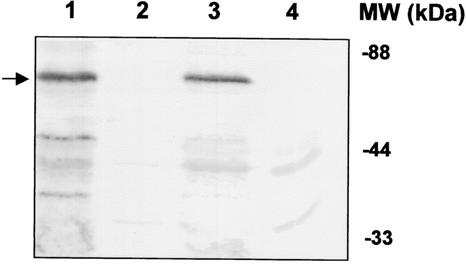
FIG. 1.
FIG. 1.
Expression of INP-MerR in different cellular fractions. Total cell proteins were separated by SDS-PAGE (12.5% [wt/vol] polyacrylamide) and transferred to a nitrocellulose membrane. Western blot analysis with anti-INP sera was performed at a 1:3,000 dilution. Lanes 1, 2, and 3 represent the total protein, soluble fraction, and membrane fraction of JM109/pUNIM. Lane 4 represents the total protein of JM109/pUC18Not. The desired fusion proteins are marked with an arrow. MW, molecular mass.
FIG. 2.
FIG. 2.
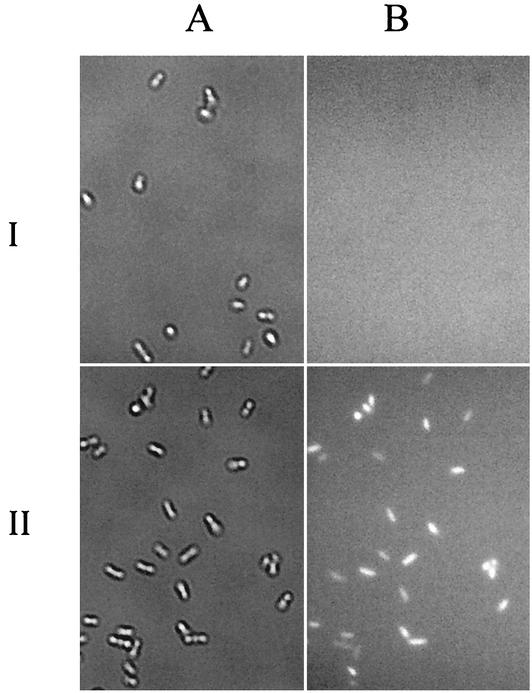
Phase-contrast micrographs (A) and immunofluorescence micrographs (B) of E. coli JM109 cells harboring pUC18Not (I) or pUNIMH (II). Cells were probed with anti-(His)6 sera and fluorescently stained with a goat anti-mouse IgG conjugated with Alexa Fluor 488.
FIG. 3.
FIG. 3.
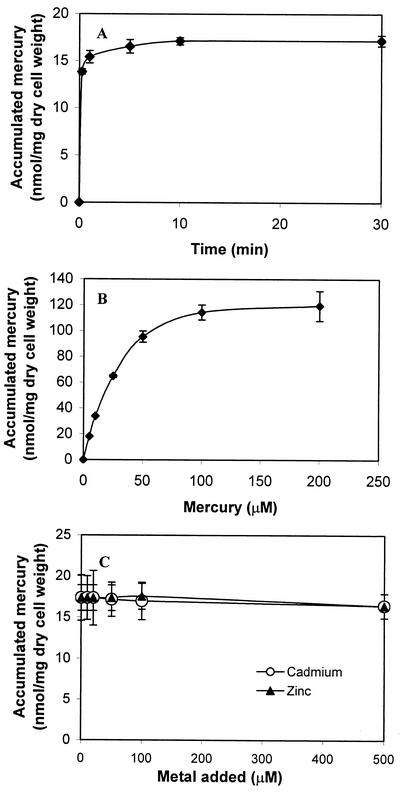
Hg2+ binding by E. coli strain JM109 carrying pUNIM. (A) Time profile of mercury uptake by resting cells harboring pUNIM. Resting cells (0.265 mg [dry weight]) were resuspended in Tris buffer (pH 7.4) containing 5 μM Hg2+ and incubated for the indicated lengths of time. (B) Hg2+ binding isotherm for JM109/pUNIM cells. Hg2+ binding was determined at various concentrations after 1 h of incubation. (C) Selectivity of Hg2+ binding in the presence of competing cadmium and zinc ions. JM109/pUNIM cells were incubated with 5 μM Hg2+ and various concentrations of competing heavy metals. Hg2+ binding was determined after 1 h of incubation. The data shown are the mean values (± standard deviation) obtained from three independent experiments.
FIG. 4.
FIG. 4.
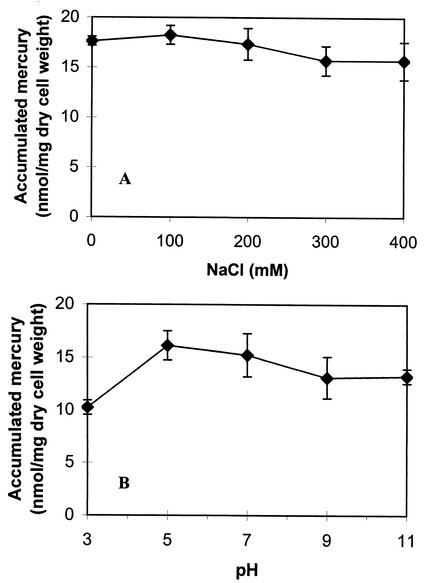
Evaluation of mercury binding by JM109 cells harboring pUNIM. (A) Effect of sodium ion on mercury binding. Resting cells (0.265 mg [dry weight]) were resuspended in Tris buffer (pH 7.4) containing 5 μM Hg2+, and the indicated concentrations of NaCl were added. Hg2+ binding was determined after 1 h of incubation. (B) pH profile of mercury binding. Resting cells (0.265 mg [dry weight]) were resuspended in citric-phosphate-borate buffer containing 5 μM Hg2+ with pHs ranging from 3 to 11. Hg2+ binding was determined after 1 h of incubation. The data shown are the mean values (± standard deviation) obtained from three independent experiments.

References

    1. Bae, W., W. Chen, A. Mulchandani, and R. Mehra. 2000. Enhanced bioaccumulation of heavy metals by bacterial cells displaying synthetic phytochelatins. Biotechnol. Bioeng. 70:518-523. - PubMed
    1. Bae, W., R. K. Mehra, A. Mulchandani, and W. Chen. 2001. Genetic engineering of Escherichia coli for enhanced uptake and bioaccumulation of mercury. Appl. Environ. Microbiol. 67:5335-5338. - PMC - PubMed
    1. Bae, W., A. Mulchandani, and W. Chen. 2002. Cell surface display of synthetic phytochelatins using ice nucleation protein for enhanced heavy metal bioaccumulation. J. Inorg. Biochem. 88:223-227. - PubMed
    1. Bontidean, I., C. Berggren, G. Johansson, E. Csorgi, B. Mattiasson, J. R. Lloyd, K. J. Jakeman, and N. L. Brown. 1998. Detection of heavy metal ions at femtomolar levels using protein-based biosensors. Anal. Chem. 70:4162-4169. - PubMed
    1. Brown, W. C., and J. L. Campbell. 1993. A new cloning vector and expression strategy for genes encoding proteins toxic to Escherichia coli. Gene 127:99-103. - PubMed

Publication types

MeSH terms