


doi: 10.1128/JCM.41.6.2690-2693.2003.
Molecular characterization of isolates of waterborne Cryptosporidium spp. collected during an outbreak of gastroenteritis in South Burgundy, France
Affiliations
- PMID: 12791906
- PMCID: PMC156555
- DOI: 10.1128/JCM.41.6.2690-2693.2003
Item in Clipboard
Molecular characterization of isolates of waterborne Cryptosporidium spp. collected during an outbreak of gastroenteritis in South Burgundy, France
J Clin Microbiol.
2003 Jun.
Abstract
In September 2001, a waterborne outbreak of gastroenteritis occurred in eastern France. Of 31 fecal samples from symptomatic individuals, 19 tested positive for Cryptosporidium with two PCRs targeting the Hsp70 and the 18S rRNA genes of CRYPTOSPORIDIUM: Sequencing of the PCR fragments produced sequences identical to that of Cryptosporidium parvum genotype 1.
Figures
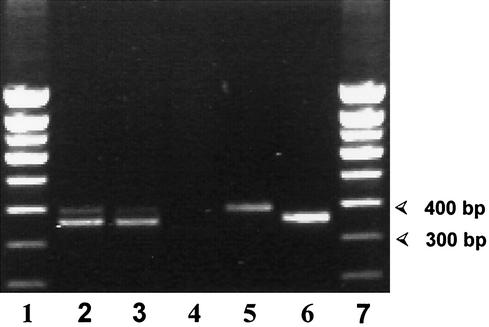
Coamplification of the CPHSP2 region of the Cryptosporidium Hsp70 gene together with the corresponding internal control. Ten copies of the internal control were added to the amplification reactions analyzed in lanes 2 to 5. The 394-bp fragment corresponds to the internal control amplification product. The 361-bp fragment corresponds to amplified C. parvum DNA. Lanes 1 and 7, molecular weight markers (Smart ladder; Eurogentec) with apparent molecular sizes given in base pairs. Lanes 2 to 4, PCR products obtained from isolate 15 of the Dracy le Fort outbreak. Two and five microliters of fecal lysates were used as templates of the PCRs displayed in lanes 2 and 3, respectively. For the PCR analyzed in lane 4, 10 μl of the fecal lysate was used as the template; the absence of PCR product is due to the increased amount of PCR inhibitors resulting from the increased fecal template. Lane 5, isolate 1 from the Dracy le Fort outbreak. Amplification of the 394-bp internal control fragment indicates that this result is a true negative. Lane 6, positive control (genomic DNA from purified C. parvum oocysts as a template).
References
-
- Bonnin, A., T. Petrella, J. F. Dubremetz, J. F. Michiels, D. Puygauthier-Toubas, and P. Camerlynck. 1990. Histopathological method for diagnosis of cryptosporidiosis using monoclonal antibodies. Eur. J. Clin. Microbiol. Infect. Dis. 9:664-666. - PubMed
-
- Bretagne, S., J. M. Costa, M. Vidaud, J. Tran, V. Nhieu, and J. Fleury-Feith. 1993. Detection of Toxoplasma gondii by competitive DNA amplification of bronchoalveolar lavage samples. J. Infect. Dis. 168:1585-1588. - PubMed
-
- Caccio, S., W. Homan, R. Camilli, G. Traldi, T. Kortbeek, and E. Pozio. 2000. A microsatellite marker reveals population heterogeneity within human and animal genotypes of Cryptosporidium parvum. Parasitology 120:237-244. - PubMed
Publication types
MeSH terms
Substances
Associated data
- Actions
LinkOut - more resources
Full Text Sources
Other Literature Sources
Medical
Miscellaneous
