


Knee injury and Osteoarthritis Outcome Score (KOOS) - validation and comparison to the WOMAC in total knee replacement
- PMID: 12801417
- PMCID: PMC161802
- DOI: 10.1186/1477-7525-1-17
Knee injury and Osteoarthritis Outcome Score (KOOS) - validation and comparison to the WOMAC in total knee replacement
Abstract
Background: The Knee injury and Osteoarthritis Outcome Score (KOOS) is an extension of the Western Ontario and McMaster Universities Osteoarthrtis Index (WOMAC), the most commonly used outcome instrument for assessment of patient-relevant treatment effects in osteoarthritis. KOOS was developed for younger and/or more active patients with knee injury and knee osteoarthritis and has in previous studies on these groups been the more responsive instrument compared to the WOMAC. Some patients eligible for total knee replacement have expectations of more demanding physical functions than required for daily living. This encouraged us to study the use of the Knee injury and Osteoarthritis Outcome Score (KOOS) to assess the outcome of total knee replacement.
Methods: We studied the test-retest reliability, validity and responsiveness of the Swedish version LK 1.0 of the KOOS when used to prospectively evaluate the outcome of 105 patients (mean age 71.3, 66 women) after total knee replacement. The follow-up rates at 6 and 12 months were 92% and 86%, respectively.
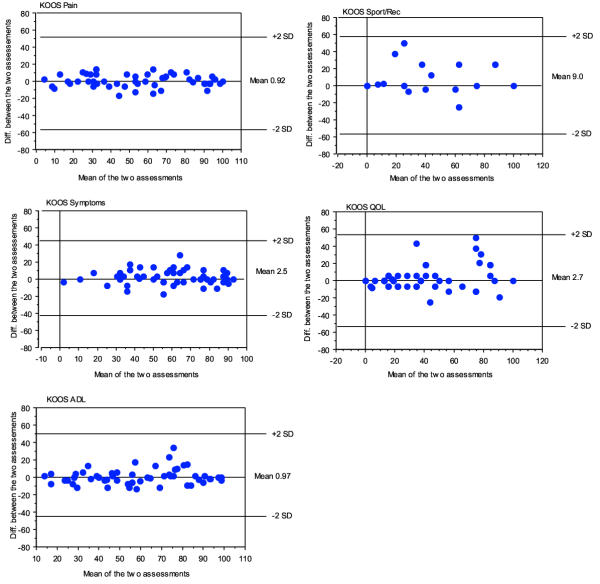
Results: The intraclass correlation coefficients were over 0.75 for all subscales indicating sufficient test-retest reliability. Bland-Altman plots confirmed this finding. Over 90% of the patients regarded improvement in the subscales Pain, Symptoms, Activities of Daily Living, and knee-related Quality of Life to be extremely or very important when deciding to have their knee operated on indicating good content validity. The correlations found in comparison to the SF-36 indicated the KOOS measured expected constructs. The most responsive subscale was knee-related Quality of Life. The effect sizes of the five KOOS subscales at 12 months ranged from 1.08 to 3.54 and for the WOMAC from 1.65 to 2.56.
Conclusion: The Knee injury and Osteoarthritis Outcome Score (KOOS) is a valid, reliable, and responsive outcome measure in total joint replacement. In comparison to the WOMAC, the KOOS improved validity and may be at least as responsive as the WOMAC.
Figures
References
-
- Bellamy N, Kirwan J, Boers M, Brooks P, Strand V, Tugwell P, Altman R, Brandt K, Dougados M, Lequesne M. Recommendations for a core set of outcome measures for future phase III clinical trials in knee, hip, and hand osteoarthritis. Consensus development at OMERACT III. J Rheumatol. 1997;24:799–802. - PubMed
-
- Bellamy N. Musculoskeletal Clinical Metrology. London: Kluwer Academic Publishers. 1993.
-
- Kazis LE, Anderson JJ, Meenan RF. Effect sizes for interpreting changes in health status. Med Care. 1989;27:S178–89. - PubMed
-
- Liang MH, Fossel AH, Larson MG. Comparisons of five health status instruments for orthopedic evaluation. Med Care. 1990;28:632–42. - PubMed
-
- Liang MH, Larson MG, Cullen KE, Schwartz JA. Comparative measurement efficiency and sensitivity of five health status instruments for arthritis research. Arthritis Rheum. 1985;28:542–7. - PubMed
Publication types
MeSH terms
LinkOut - more resources
Full Text Sources
Other Literature Sources
Medical
