


Impairment of reward-related learning by cholinergic cell ablation in the striatum
- PMID: 12802017
- PMCID: PMC164696
- DOI: 10.1073/pnas.1032899100
Impairment of reward-related learning by cholinergic cell ablation in the striatum
Abstract
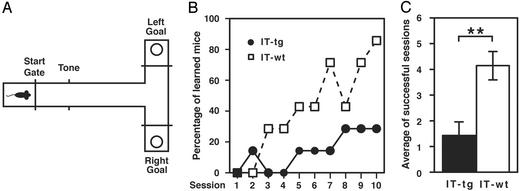
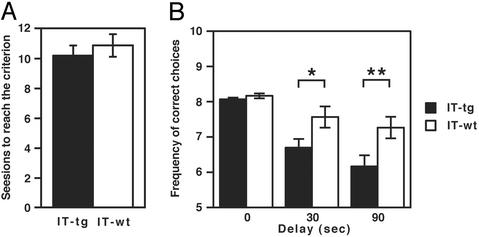
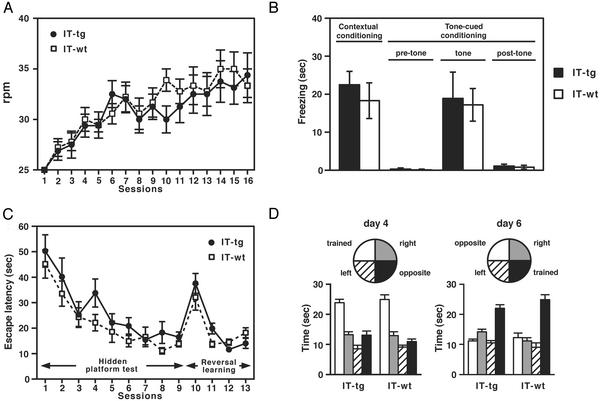
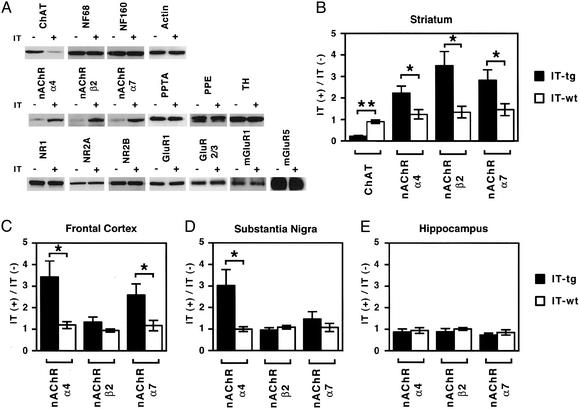
The striatum in the basal ganglia-thalamocortical circuitry is a key neural substrate that is implicated in motor balance and procedural learning. The projection neurons in the striatum are dynamically modulated by nigrostriatal dopaminergic input and intrastriatal cholinergic input. The role of intrastriatal acetylcholine (ACh) in learning behaviors, however, remains to be fully clarified. In this investigation, we examine the involvement of intrastriatal ACh in different categories of learning by selectively ablating the striatal cholinergic neurons with use of immunotoxin-mediated cell targeting. We show that selective ablation of cholinergic neurons in the striatum impairs procedural learning in the tone-cued T-maze memory task. Spatial delayed alternation in the T-maze learning test is also impaired by cholinergic cell elimination. In contrast, the deficit in striatal ACh transmission has no effect on motor learning in the rota-rod test or spatial learning in the Morris water-maze test or on contextual- and tone-cued conditioning fear responses. We also report that cholinergic cell elimination adaptively up-regulates nicotinic ACh receptors not only within the striatum but also in the cerebral cortex and substantia nigra. The present investigation indicates that cholinergic modulation in the local striatal circuit plays a pivotal role in regulation of neural circuitry involving reward-related procedural learning and working memory.
Figures
Similar articles
-
The cholinergic system and spatial learning.Behav Brain Res. 2011 Aug 10;221(2):389-411. doi: 10.1016/j.bbr.2010.11.036. Epub 2010 Nov 23. Behav Brain Res. 2011. PMID: 21108971 Review.
-
Acetylcholine-dopamine balance hypothesis in the striatum: an update.Geriatr Gerontol Int. 2010 Jul;10 Suppl 1:S148-57. doi: 10.1111/j.1447-0594.2010.00588.x. Geriatr Gerontol Int. 2010. PMID: 20590830 Review.
-
Effects of complete immunotoxin lesions of the cholinergic basal forebrain on fear conditioning and spatial learning.Hippocampus. 2004;14(2):244-54. doi: 10.1002/hipo.10169. Hippocampus. 2004. PMID: 15098729
-
Involvement of basal ganglia and orbitofrontal cortex in goal-directed behavior.Prog Brain Res. 2000;126:193-215. doi: 10.1016/S0079-6123(00)26015-9. Prog Brain Res. 2000. PMID: 11105648 Review.
-
Intraseptal muscarinic ligands and galanin: influence on hippocampal acetylcholine and cognition.Neuroscience. 2004;126(3):541-57. doi: 10.1016/j.neuroscience.2004.03.058. Neuroscience. 2004. PMID: 15183504
Cited by
-
Activation of muscarinic and nicotinic acetylcholine receptors in the nucleus accumbens core is necessary for the acquisition of drug reinforcement.J Neurosci. 2006 May 31;26(22):6004-10. doi: 10.1523/JNEUROSCI.4494-05.2006. J Neurosci. 2006. PMID: 16738243 Free PMC article.
-
Targeted ablation of cholinergic interneurons in the dorsolateral striatum produces behavioral manifestations of Tourette syndrome.Proc Natl Acad Sci U S A. 2015 Jan 20;112(3):893-8. doi: 10.1073/pnas.1419533112. Epub 2015 Jan 5. Proc Natl Acad Sci U S A. 2015. PMID: 25561540 Free PMC article.
-
Recurrent inhibitory network among striatal cholinergic interneurons.J Neurosci. 2008 Aug 27;28(35):8682-90. doi: 10.1523/JNEUROSCI.2411-08.2008. J Neurosci. 2008. PMID: 18753369 Free PMC article.
-
Contribution of both M1 and M4 receptors to muscarinic agonist-mediated attenuation of the cocaine discriminative stimulus in mice.Psychopharmacology (Berl). 2012 Apr;220(4):673-85. doi: 10.1007/s00213-011-2516-9. Epub 2011 Oct 1. Psychopharmacology (Berl). 2012. PMID: 21964721 Free PMC article.
-
Targeting neuronal populations of the striatum.Front Neuroanat. 2011 Jul 15;5:40. doi: 10.3389/fnana.2011.00040. eCollection 2011. Front Neuroanat. 2011. PMID: 21811438 Free PMC article.
References
-
- Salmon, D. P. & Butters, N. (1995) Curr. Opin. Neurobiol. 5, 184-190. - PubMed
-
- Knowlton, B. J., Mangels, J. A. & Squire, L. R. (1996) Science 273, 1399-1402. - PubMed
-
- Gerfen, C. R. (1992) Annu. Rev. Neurosci. 15, 285-320. - PubMed
-
- Ribak, C. E., Vaughn, J. E. & Roberts, E. (1979) J. Comp. Neurol. 187, 261-283. - PubMed
Publication types
MeSH terms
Substances
LinkOut - more resources
Full Text Sources
Other Literature Sources
Molecular Biology Databases
