. 2003 May;14(5):1852-67.
doi: 10.1091/mbc.e02-11-0707. Epub 2003 Feb 6.

Dual prenylation is required for Rab protein localization and function

Affiliations

Dual prenylation is required for Rab protein localization and function

Monica Calero et al. Mol Biol Cell. 2003 May.

Abstract

The majority of Rab proteins are posttranslationally modified with two geranylgeranyl lipid moieties that enable their stable association with membranes. In this study, we present evidence to demonstrate that there is a specific lipid requirement for Rab protein localization and function. Substitution of different prenyl anchors on Rab GTPases does not lead to correct function. In the case of YPT1 and SEC4, two essential Rab genes in Saccharomyces cerevisiae, alternative lipid tails cannot support life when present as the sole source of YPT1 and SEC4. Furthermore, our data suggest that double geranyl-geranyl groups are required for Rab proteins to correctly localize to their characteristic organelle membrane. We have identified a factor, Yip1p that specifically binds the di-geranylgeranylated Rab and does not interact with mono-prenylated Rab proteins. This is the first demonstration that the double prenylation modification of Rab proteins is an important feature in the function of this small GTPase family and adds specific prenylation to the already known determinants of Rab localization.


Figures
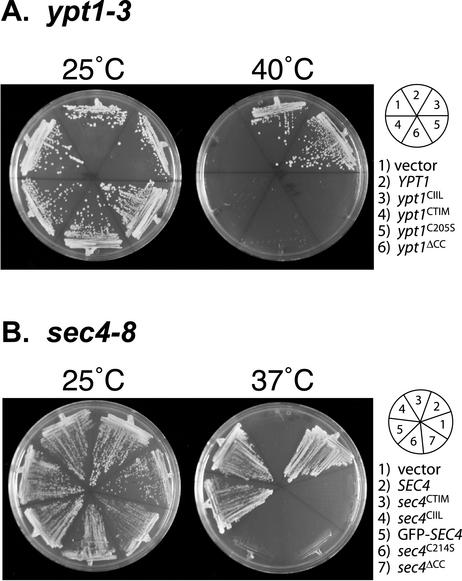
Figure 1.
Figure 1.
Suppression of sec4 and ypt1 temperature-sensitive strains indicate that correct lipid modification is required for full function. The indicated constructs were transformed into ypt1ts (A) and sec4ts (B) strains. These strains contain the temperature-sensitive alleles ypt1-3 and sec4-8 that grow at 25°C but not at 40°C or at 37°C, respectively. Transformants were then streaked on selection media and incubated at the indicated temperatures for 2–3 d.
Figure 2.
Figure 2.
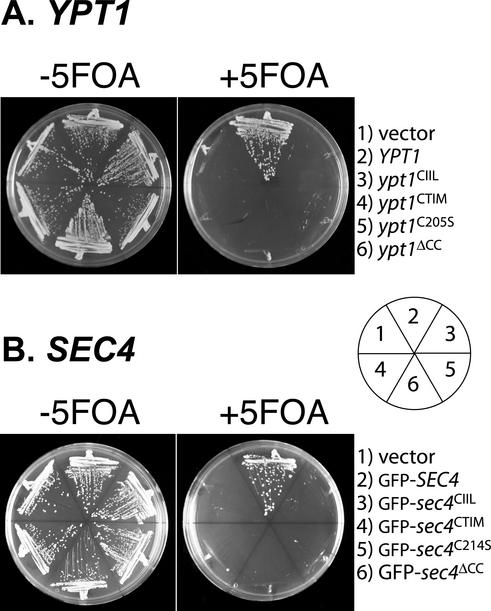
Only di-geranylgeranylated proteins can function as the sole cellular source of the essential Rab proteins Sec4p and Ypt1p. The indicated constructs were transformed into RCY1510 (A) or RCY1509 (B), disruption strains for YPT1 or SEC4 that contain a URA3 CEN plasmid with either YPT1 or SEC4. Transformants were then streaked on plates containing 5-FOA. Growth was assessed 2–3 d later. Only the wild-type copies of YPT1 or SEC4 are able to act as the only source of the Rab in the cell. None of the prenylation mutants are able to provide the essential function of the wild-type Rab gene. Note that GFP-SEC4 is functional when present as the sole cellular source of SEC4.
Figure 3.
Figure 3.
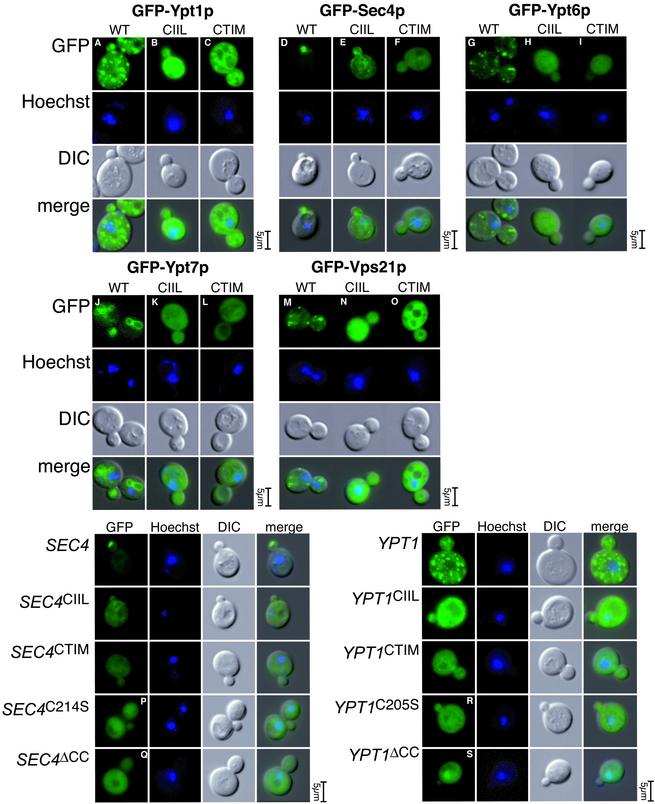
Rab lipid tail variants are unable to correctly localize in vivo. Wild-type and CAAX-containing variants of GFP-YPT1,-SEC4,-YPT6,-YPT7, and -VPS21 were cloned in expression plasmids at wild-type protein levels. These constructs were transformed into NY605 and the localization was assessed by fluorescence microscopy. The mutants containing a CAAX box with CIIL sequence (B, E, H, K, and N) should contain a single geranylgeranyl lipid group and mutants containing CTIM sequence as the CAAX box (C, F, I, L, and O) should contain a single farnesyl lipid group. These mutants do not localize to the typical wild-type compartment of their respective Rab (A, D, G, J, and M). In addition to the CAAX mutants, we cloned GFP-SEC4C214S, GFP-SEC4ΔCC, GFP-YPT1C205S, and GFP-YPT1ΔCC. The point mutants should contain a single geranylgeranyl lipid group, and the ΔCC mutants are unprenylated and should remain cytosolic. These constructs were transformed into cells and the localization was assessed by fluorescence microscopy. These mutants (O–R), similar to the CAAX-containing mutants (shown immediately above for direct comparison), do not localize to the typical wild-type compartment of Sec4p (bud tip) or Ypt1 (Golgi). Cells were incubated with Hoechst to visualize the nuclei.
Figure 4.
Figure 4.
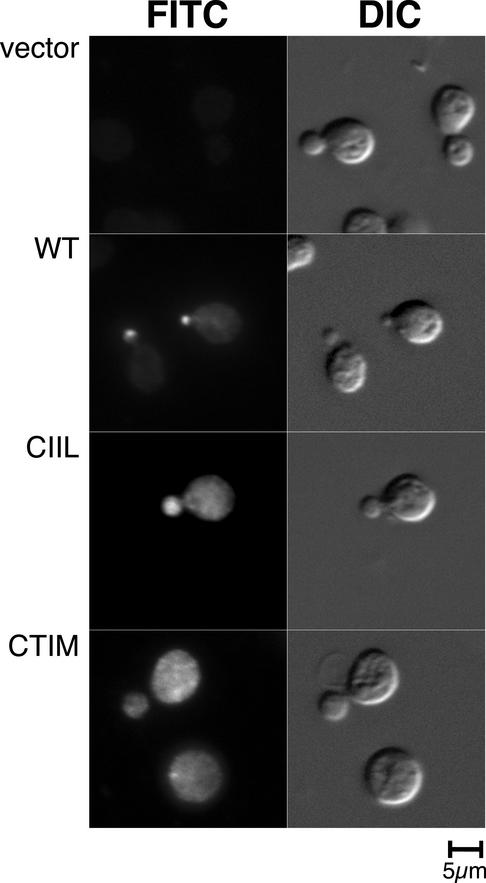
Sec4p immunofluorescence of untagged constructs in an antigenically silent background. Untagged plasmid constructs containing SEC4, SEC4CTIM, SEC4CIIL, and control vector only were transformed into a strain with functional SEC4 gene that is antigenically silent to the anti-Sec4p antibody 1.2.3. The cells were grown to log phase and processed for immunofluorescence with the mAb 1.2.3. As expected, the control, vector only strain gave no signal demonstrating that the antibody only recognizes the episomal plasmid protein product (5a). The localization of wild-type Sec4p (5b) is very similar to the localization of GFP-Sec4p (3D, 4a). The CAAX box mutants (5, c and d) did not show to the typical localization of Sec4p, indicating that the mislocalization of the equivalent GFP-tagged constructs shown in Figures 3 and 4 are independent of the GFP-tag.
Figure 5.
Figure 5.
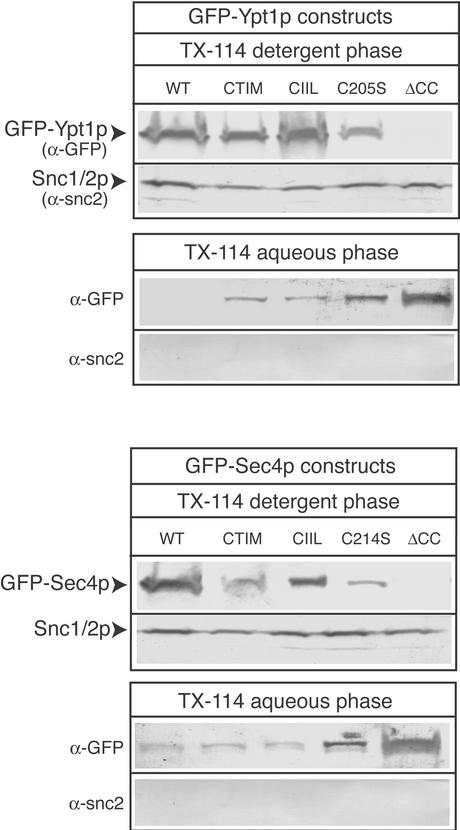
TX-114 extraction demonstrates hydrophobic modifications to Rab lipid tail variants. Triton X-114 fractionation generating a detergent-enriched and aqueous phase was performed as described under MATERIALS AND METHODS on cells expressing GFP-Ypt1p, -Ypt1pCTIM, -Ypt1pCIIL, -Ypt1pC205S, -Ypt1pΔCC, -Sec4p, -Sec4pCTIM, -Sec4pCIIL, -Sec4pC214S, and -Sec4pΔCC. The detergent-enriched phase was then subjected to trichoroacetic acid precipitation followed by SDS-PAGE electrophoresis and Western blotting to detect the GFP-fusion proteins. As a control, the fractions were probed for the transmembrane protein Snc1/2p. Relevant protein markers are indicated.
Figure 6.
Figure 6.
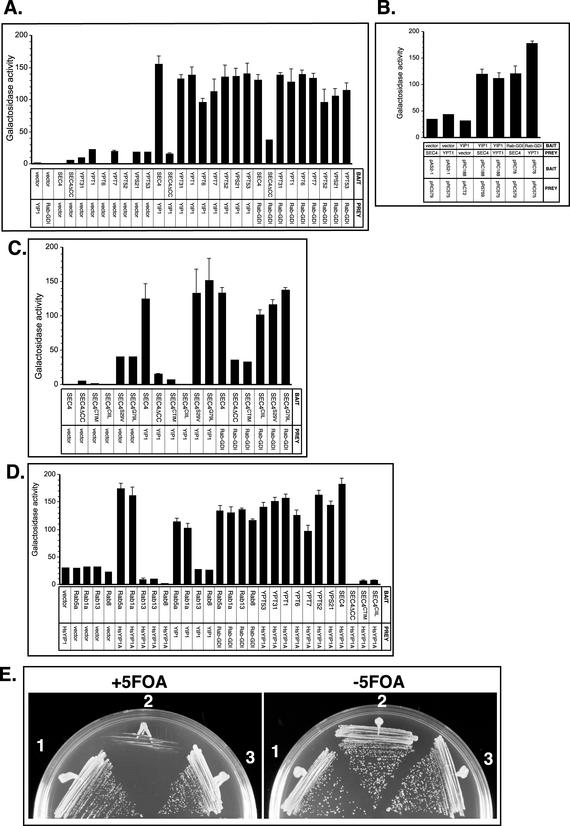
Prenylation status of Rab proteins is a critical determinant for interactions with Yip1p. (A) Yip1p has the ability to interact with several Rab proteins in yeast. Pairs of constructs were coexpressed in the reporter strain Y190, and β-galactosidase activity (arbitrary units) in the resulting transformants was measured as described in Calero et al. (2002). The β-galactosidase activity of 12 independent transformants was tested for each pair. The Rab protein bait constructs as indicated on the x-axis were tested against prey constructs of Yip1p, yeast Rab-GDI, or vector only controls. The plasmids pAS2–1 and pACTII were used for vector only bait and prey controls, respectively. Plasmid constructs are listed in Table 2. (B) Yip1p Y2H interactions with Rab proteins are preserved with bait/prey reversal. The Yip1p or Rab-GDI protein bait constructs were tested against prey constructs of Ypt1p, Sec4p, or vector only controls as indicated on the x-axis. Transformants were processed for β-galactosidase activity as described in Figure 7A. Both Yip1p and Rab-GDI bait constructs maintain Y2H interactions with prey constructs of Yptp1p and Sec4p. Background activity is observed with vector only controls cotransformed with each construct. (C) YIP1 interaction with Sec4p requires di-geranylgeranylation. Rab protein bait constructs expressing wild-type Sec4p, Sec4p with no C-terminal cysteines, CTIM, or CIIL lipid tail variants and the point mutations S29V and Q79L were tested against prey constructs of Yip1p, as indicated on the x-axis. Interactions with Rab-GDI and vector only controls are shown for comparison. Transformants were processed for β-galactosidase activity as described in Figure 7A. Both Yip1p and Rab-GDI will interact with wild-type Sec4p, Sec4S29Vp and Sec4Q79Lp. Neither Yip1p or Rab-GDI will interact with the farnesylated Sec4CTIMp or unprenylated Sec4ΔCCp, and only Rab-GDI but not Yip1p will interact with the mono-geranylgeranylated Sec4CIILp construct. Plasmid constructs are listed in Table 2. (D) Human YIP1A will not interact with human Rab proteins containing C-terminal CAAX motifs, although they will interact with highly homologous di-geranylgeranylated Rab proteins. Rab protein bait constructs as indicated on the x-axis were tested against prey constructs of human YIP1A (HsYIP1A). Interactions with Rab-GDI, yeast YIP1 and vector only controls are shown for comparison, also see Figure 6, A and B. Transformants were processed for β-galactosidase activity as described in Figure 7A. Note that yeast Yip1p and human YIP1A are promiscuous in their ability to interact with several Rab proteins, which include mammalian Rab1a, mammalian Rab5a, Sec4p, Ypt31p, Ypt1p, Ypt6p, Ypt7p, Vps21p, Ypt52p, and Ypt53p. Neither human or yeast YIP1 can interact with the mono-geranylgeranylated version of Sec4p or with the mammalian CAAX box containing Rab proteins Rab8 or Rab13, even though these are highly homologous to wild-type Sec4p. For comparison, interactions with Rab-GDI are shown, both Rab13 and Rab8 are fully capable of interaction with Rab-GDI. None of the constructs used showed any autoactivation with vector only cotransformations. Plasmid constructs are listed in Table 2. (E) Human homolog of Yip1p, HsYIP1A, can substitute for YIP1 function in budding yeast. Cells bearing their only copy of YIP1 on plasmid containing the counterselectable marker URA3 were tested for ability to grow on 5-FOA after transformation with the human ORF YIP1A. Colonies transformed with centromeric, single-copy vectors containing (1) YIP1, (2) no insert vector only, or (3) human YIP1A placed under the control of the endogenous YIP1 promoter and ADH1 terminator elements. Transformants were tested for growth on complete media at 30°C with and without 5-FOA to select against retention of the URA3 YIP1 plasmid. Both cells containing wild-type YIP1 or the human homolog YIP1A plasmid can survive the loss of the URA3 YIP1-containing plasmid on 5FOA, whereas transformants containing the no insert control plasmid are dead.
Figure 7.
Figure 7.
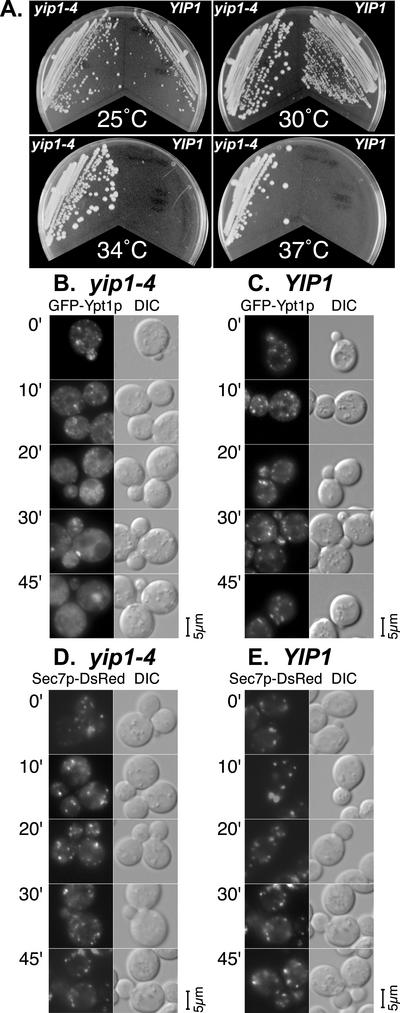
(A) Cells bearing the yip1-4 allele are thermosensitive. yip1-4 mutant cells bearing the single point mutation E70K are thermosensitive with a restrictive temperature of 34°C on rich media. Growth of yip1-4 cells on YPD are compared with isogenic wild-type controls at the temperatures indicated. (B–E) yip1-4 mutant cells are defective in Golgi localization of the Rab protein Ypt1p at the restrictive temperature. The localization of GFP-Ypt1p was measured in yip1-4 mutant and wild-type cells following a shift to the restrictive temperature (37°C) for the time indicated. The cells were visualized by fluorescence microscopy. The left side of each panel shows GFP fluorescence, whereas the right side is differential interference contrast optics. The characteristic punctate Golgi distribution of GFP-Ypt1p becomes diffuse and cytosolic after only a 10-min shift to the restrictive temperature and becomes maximal by 30 min of shift. This is in contrast to another peripheral Golgi marker, Sec7p, which maintains characteristic Golgi puncta at restrictive temperatures in yip1-4 cells. (B) yip1-4 mutant cells (RCY1764) expressing GFP-Ypt1p after shift to restrictive temperature for the times indicated. (C) isogenic wild-type cells (RCY1768) expressing GFP-Ypt1p after shift to restrictive temperature for the times indicated. (B) yip1-4 mutant cells (RCY1764) expressing Sec7p-DsRed after shift to restrictive temperature for the times indicated. Sec7p-DsRed after shift to restrictive temperature for the times indicated.

References

    1. Bai, C., and Elledge, S.J. (1996). Gene identification using the yeast two-hybrid system. Methods Enzymol. 1996, 331–347. - PubMed
    1. Beranger, F., Paterson, H., Powers, S., de, G.J., and Hancock, J.F. (1994). The effector domain of Rab6, plus a highly hydrophobic C terminus, is required for Golgi apparatus localization. Mol. Cell. Biol. 14, 744–758. - PMC - PubMed
    1. Bevis, B.J., and Glick, B.S. (2002). Rapidly maturing variants of the Discosoma red fluorescent protein (DsRed). Nat. Biotechnol. 20, 83–87. - PubMed
    1. Black, S.D. (1992). Development of hydrophobicity parameters for prenylated proteins. Biochem. Biophys. Res. Commun. 186, 1437–1442. - PubMed
    1. Bordier, C. (1981). Phase separation of integral membrane proteins in Triton X-114 solution. J. Biol. Chem. 256, 1604–1607. - PubMed

Publication types

MeSH terms

Substances