. 2003 May;14(5):1868-81.
doi: 10.1091/mbc.e02-10-0687. Epub 2003 Jan 26.

Ykt6p is a multifunctional yeast R-SNARE that is required for multiple membrane transport pathways to the vacuole

Affiliations

Ykt6p is a multifunctional yeast R-SNARE that is required for multiple membrane transport pathways to the vacuole

Youngseok Kweon et al. Mol Biol Cell. 2003 May.

Abstract

Intracellular membrane fusion requires that membrane-bound soluble N-ethylmaleimide-sensitive factor attachment protein receptor (SNARE) proteins on both vesicle and target membranes form a highly specific complex necessary to bring the membranes close in space. Ykt6p is a yeast R-SNARE protein that has been implicated in retrograde transport to the cis-Golgi compartment. Ykt6p has been also been found to fractionate with vacuole membranes and participate in a vacuolar SNARE complex in homotypic vacuole fusion. To investigate the role of Ykt6p in membrane traffic to the vacuole we generated temperature-sensitive mutations in YKT6. One mutation produces an early Golgi block to secretion, and overexpression of the SNARE protein Sft1p suppresses the growth and secretion defects of this mutation. These results are consistent with Ykt6p and Sft1p participating in a SNARE complex associated with retrograde transport to the cis-Golgi. A second set of mutations in YKT6 specifically affects post-Golgi membrane traffic to the vacuole, and the effects of these mutations are not suppressed by Sft1p overexpression. Defects are seen in carboxypeptidase Y sorting, alkaline phosphatase transport, and aminopeptidase I delivery, and in one mutant, overexpression of the SNARE protein Nyv1p suppresses the alkaline phosphatase transport defect. By mutationally separating early and late requirements for Ykt6p, our findings have revealed that Ykt6p is a R-SNARE protein that functions directly in the three biosynthetic pathways to the vacuole.


Figures
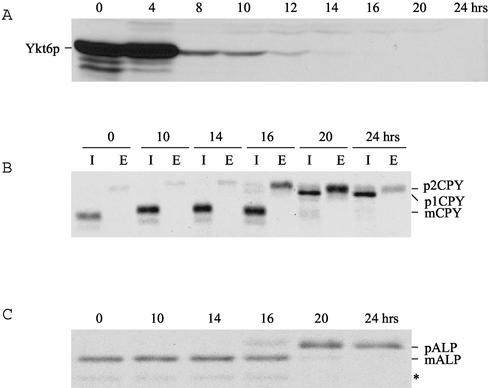
Figure 1.
Figure 1.
Depletion of Ykt6p results in Golgi and post-Golgi membrane transport blocks. (A) Ykt6p Western blot of whole cell extracts of GAL1-YKY6 strains (ARY1) grown in galactose and glucose media. The cultures were diluted when they reached an optical density of ∼1 to keep cells growing in logarithmic phase. Cells (10 OD) were collected at the indicated times and equivalent cell extracts were analyzed by SDS-PAGE and immunoblotting with antiserum against Ykt6p. (B) Strains were pulse labeled with [35S]methionine for 10 min at 30°C and chased for 45 min, and CPY was immunoprecipitated from intracellular (I) and extracellular (E) fractions and analyzed by SDS-PAGE and autoradiography. (C) Strains were labeled and chased as described above, and ALP was immunoprecipitated and the protein resolved by SDS-PAGE, and visualized by autoradiography. PEP4-dependent cleavage of proALP (pALP) results in the formation of the mature form (mALP) as well as an additional commonly observed degradation product (*).
Figure 2.
Figure 2.
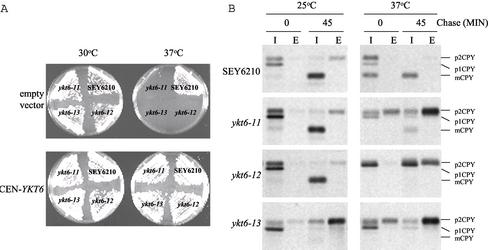
ykt6 mutants are temperature sensitive for growth and CPY sorting. (A) Wild-type (SEY6210), ykt6-11 (YKY10), ykt6-12 (YKY5), and ykt6-13 (YKY11) cells were transformed with either a low copy plasmid carrying YKT6 (bottom) or an empty vector (top). The transformants were streaked on YEPD plates and incubated for3dat either 30°C (left) or 37°C (right). The growth defects are suppressed by the presence of the YKT6 plasmid. (B) Indicated strains were labeled with [35S]methionine for 10 min at 25°C or for 10 min at 37°C after a 15-min preincubation at 37°C, and chased for 45 min. CPY was immunoprecipitated from intracellular (I) and extracellular (E) fractions and analyzed by SDS-PAGE and autoradiography.
Figure 3.
Figure 3.
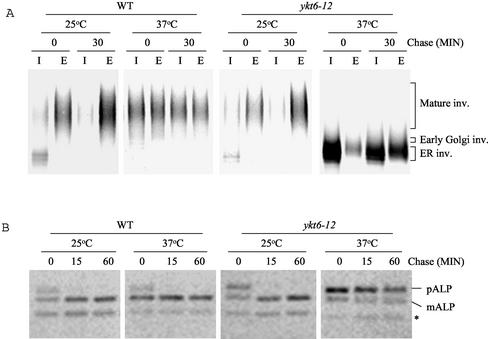
ykt6 cells are defective for invertase and ALP transport at the nonpermissive temperature. (A) Wild-type (SEY6210) and ykt6-12 (YKY5) strains containing a plasmid encoding invertase (pFvM104) were grown in low-glucose (0.1%) medium at 25°C to induce invertase expression. The strains were labeled with [35S]methionine for 10 min at 25°C or for 10 min at 37°C after a 15-min preincubation at 37°C and chased for 30 min. Invertase was immunoprecipitated from intracellular (I) and extracellular (E) fractions, separated by SDS-PAGE, and visualized by autoradiography. (B) Wild-type (SEY6210) and ykt6-12 (YKY5) strains were radiolabeled for 10 min at 25°C or for 10 min at 37°C after a 15-min preincubation at 37°C. After the indicated times, ALP was immunoprecipitated from cell extracts, and analyzed as described above. In addition to pALP and mALP, commonly observed degradation product (*) is indicated.
Figure 4.
Figure 4.
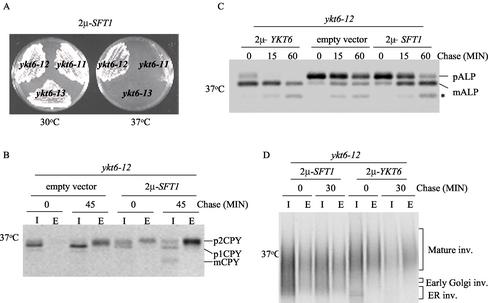
Overexpression of Sft1p suppresses the temperature-sensitive growth and early Golgi transport defects of ykt6-12 cells. (A) ykt6-11 (YKY10), ykt6-12 (YKY5), and ykt6-13 (YKY11) cells carrying a multicopy plasmid with SFT1, streaked on YEPD plates, and incubated at either 30 or 37°C. (B–D) ykt6-12 (YKY5) cells were transformed with an empty vector, or a multicopy plasmid carrying either the YKT6 or SFT1 gene. These cells were labeled with [35S]methionine for 10 min after a 15-min preincubation at 37°C. After the indicated times, CPY, ALP, and invertase were immunoprecipitated as in Figure 3. I, intracellular; E, extracellular; *, ALP degradation product.
Figure 5.
Figure 5.
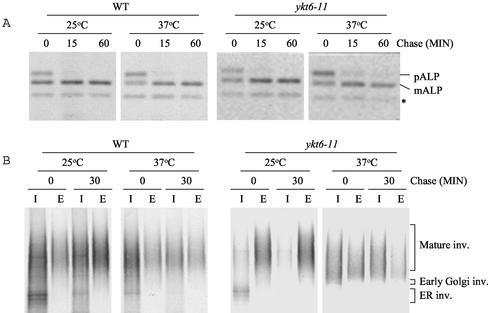
ykt6-11 cells are normal for transport of ALP and secretion of invertase. (A) Wild-type (SEY6210) and ykt6-11 (YKY10) strains were labeled and chased for the indicated times. The cell extracts were subjected to immunoprecipitation with antibodies to ALP, and the samples were analyzed by SDS-PAGE and autoradiography. (B) Wild-type (SEY6210) and ykt6-11 (YKY10) strains containing a plasmid containing SUC2 (pFvM104) were grown in low-glucose (0.1%) medium at 25°C to induce invertase expression. The strains were labeled with [35S]methionine for 10 min at 25°C or for 10 min at 37°C after a 15-min preincubation at 37°C, and chased for 30 min. Invertase was immunoprecipitated from intracellular (I) and extracellular (E) fractions, and analyzed as described for Figure 3. The degradation product of ALP is indicated (*).
Figure 6.
Figure 6.
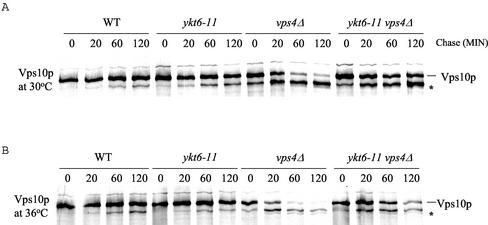
ykt6-11 cells are defective for CPY sorting at a step after the prevacuolar compartment. Wild-type (SEY6210), ykt6-11 (YKY10), vps4Δ (YKY12), and ykt6-11 vps4Δ (YKY13) cells were labeled with [35S]methionine for 10 min at 30°C (A) or 10 min at 36°C (B) after a 15-min preincubation at 36°C, and chased for the indicated times. Cell extracts were subjected to immunoprecipitation with antibodies to Vps10p. The samples were analyzed by SDS-PAGE and autoradiography. The Vps10p proteolytic product is indicated (*).
Figure 7.
Figure 7.
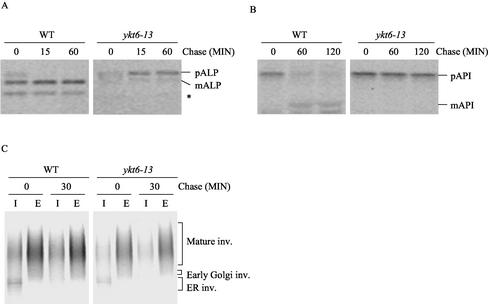
ykt6-13 cells exhibit defects in ALP and API transport to the vacuole, but are normal for secretion. (A and B) Wild-type (SEY6210) and ykt6-13 (YKY11) cells were labeled with [35S]methionine for 10 min at 30°C, and chased for the indicated times. ALP or API was immunoprecipitated from cell extracts and analyzed by SDS-PAGE and autoradiography. (C) Wild-type (SEY6210) and ykt6-11 (YKY10) cells containing the SUC2 plasmid (pFvM104) were grown in low-glucose (0.1%) medium at 25°C to induce invertase expression. The strains were labeled with [35S]methionine for 10 min at 30°C, and chased for 30 min. Invertase was immunoprecipitated from intracellular (I) and extracellular (E) fractions, and analyzed as described in Figure 3. The ALP degradation product is indicated (*).
Figure 8.
Figure 8.
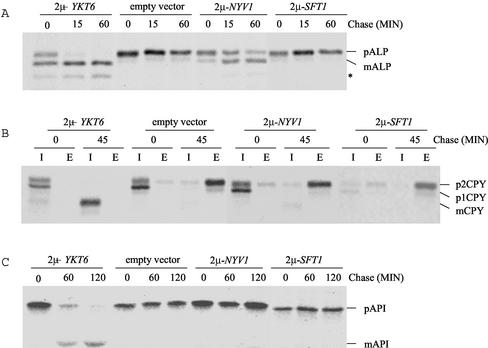
Overexpression of Nyv1p suppresses the ALP trafficking defect of the ykt6-13 mutant. ykt6-13 (YKY11) cells carrying an empty plasmid or a multicopy plasmid with either YKT6, NYV1, or SFT1 were labeled for 10 min at 30°C and chased for the indicated times. Cell extracts were subjected to immunoprecipitation with antibodies to ALP (A), CPY (B), or API (C), and the samples resolved by SDS-PAGE and visualized by autoradiography. I, intracellular; E, extracellular; *, ALP degradation product.
Figure 9.
Figure 9.
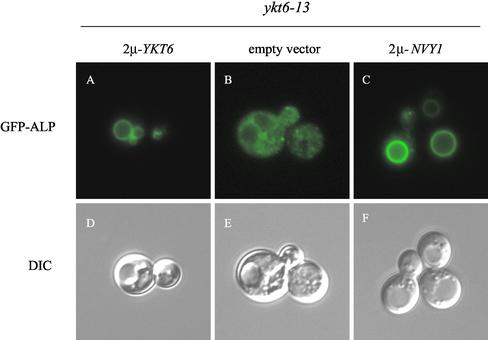
GFP-ALP mislocalization in ykt6-13 cells is overcome by overexpression of Nyv1p. ykt6-13 (YKY11) cells carrying a plasmid expressing GFP-ALP were transformed with an empty, or a multicopy plasmid with either YKT6 or NYV1. GFP-ALP was visualized by fluorescence microscopy after cell growth at 30°C.
Figure 10.
Figure 10.
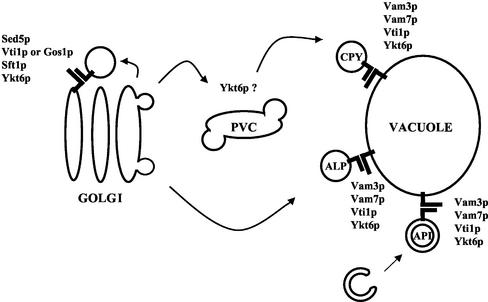
Ykt6p functions in at least two different SNARE complexes in four membrane traffic pathways in yeast. Ykt6p forms a SNARE complex with Sed5p, Sft1p, and Vti1p (or Gos1p) in retrograde transport to the cis-Golgi compartment. Ykt6p also functions in SNARE complex formation with Vam3p, Vam7p, and Vti1p in the CPY, ALP and API transport pathways to the vacuole. Ykt6p may also function in vesicle fusion with the PVC (Dilcher et al., 2001).

References

    1. Babst, M., Sato, T.K., Banta, L.M., and Emr, S.D. (1997). Endosomal transport function in yeast requires a novel AAA-type ATPase, Vps4p. EMBO J. 16, 1820–1831. - PMC - PubMed
    1. Banfield, D.K., Lewis, M.J., and Pelham, H.R. (1995). A SNARE-like protein required for traffic through the Golgi complex. Nature 375, 806–809. - PubMed
    1. Boeke, J.D., LaCroute, F., and Fink, G.R. (1984). A positive selection for mutants lacking orotidine-5′-phosphate decarboxylase activity in yeast: 5-fluoro-orotic acid resistance. Mol. Gen. Genet. 197, 345–346. - PubMed
    1. Bryant, N.J., and Stevens, T.H. (1997). Two separate signals act independently to localize a yeast late Golgi membrane protein through a combination of retrieval and retention. J. Cell Biol. 136, 287–297. - PMC - PubMed
    1. Bryant, N.J., and Stevens, T.H. (1998). Vacuole biogenesis in Saccharomyces cerevisiae: protein transport pathways to the yeast vacuole. Microbiol. Mol. Biol. Rev. 62, 230–247. - PMC - PubMed

Publication types

LinkOut - more resources