


Physical methods for treating fever in children
- PMID: 12804512
- PMCID: PMC6532675
- DOI: 10.1002/14651858.CD004264
Physical methods for treating fever in children
Abstract
Background: Health workers recommend bathing, sponging and other physical methods to treat fever in children and to avoid febrile convulsions. We know little about the most effective methods, or how these methods compare with commonly used drugs.
Objectives: To evaluate the benefits and harms of physical cooling methods used for managing fever in children.
Search strategy: We searched the Cochrane Infectious Diseases Group specialized trials register (February 2003), the Cochrane Central Register of Controlled Trials (Issue 1, 2003), MEDLINE (1966 to February 2003), EMBASE (1988 to November 2002), CINHAL (1982 to February 2003), LILACS (February 2003), Science Citation Index (1981 to February 2003), and reference lists of articles. We also contacted researchers in the field.
Selection criteria: Randomized and quasi-randomized trials comparing physical methods with a drug placebo or no treatment in children with fever of presumed infectious origin. Studies where children in both groups were given an antipyretic drug were included.
Data collection and analysis: Two reviewers independently assessed trial methodological quality. One reviewer extracted data and the other checked the data for accuracy. Results were expressed as Relative Risk (RR) with 95% confidence intervals (CI) for discrete variables, and weighted mean differences for continuous outcomes.
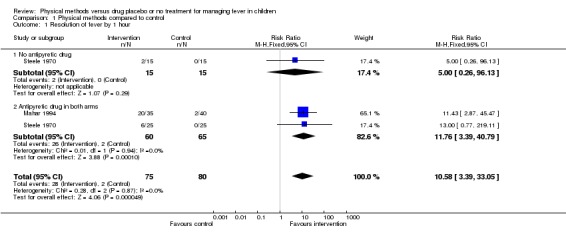
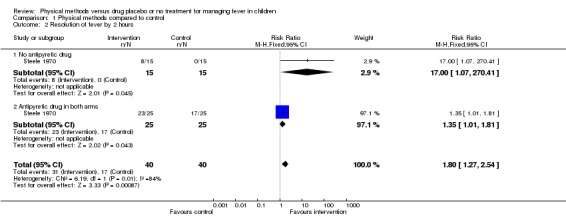
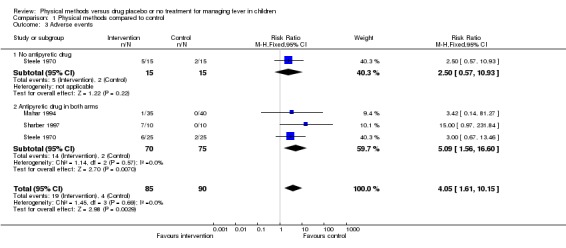
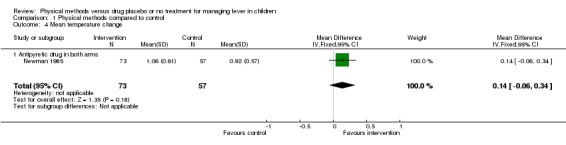
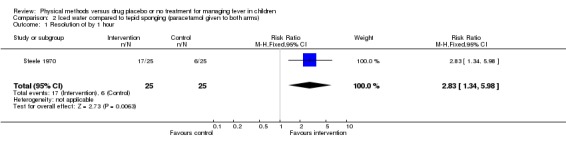
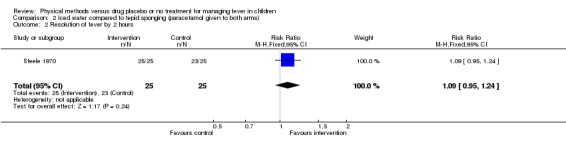
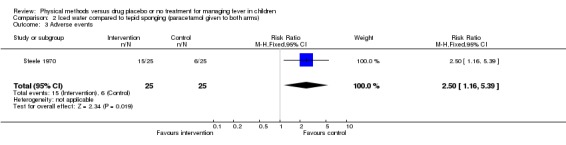
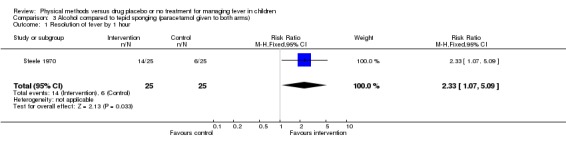
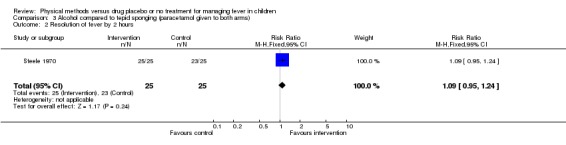
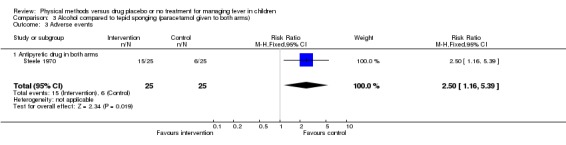
Main results: Seven trials, involving 467 participants, met the inclusion criteria. One small trial (n = 30), comparing physical methods with drug placebo, did not demonstrate a difference in the proportion of children without fever by one hour after treatment in a comparison between physical methods alone and drug placebo. In 2 studies, where all children received an anti-pyretic drug, physical methods resulted in a higher proportion of children without fever at one hour (n=125, RR 11.8, CI 3.39 to 40.8). I; in a third study (n=130), which only reported mean change in temperature, no differences wereas detected. Mild adverse events (shivering and goose pimples) were more common in the physical methods group (3 trials, RR 5.09; CI 1.56 to 16.60).
Reviewer's conclusions: A few small studies demonstrate that tepid sponging helps to reduce fever in children.
Conflict of interest statement
We certify that we have no affiliations with or involvement in any organization or entity with a direct financial interest in the subject matter of the review (eg employment, consultancy, stock ownership, honoraria, expert testimony).
Figures
References
References to studies included in this review
-
- Friedman AD, Barton LL. Efficacy of sponging versus acetaminophen for reduction of fever. Pediatric Emergency Care 1990;6(1):6‐7. - PubMed
-
- Mahar AF, Allen SJ, Milligan P, Suthumnirund S, Chotpitayasunondh T, Sabchareon A, et al. Tepid sponging to reduce temperature in febrile children in a tropical climate. Clinical Pediatrics 1994;4:227‐31. - PubMed
References to studies excluded from this review
-
- Agbolosu NB, Cuevas LE, Milligan P, Broadhead RL, Brewster D, Graham SM. Efficacy of tepid sponging versus paracetamol in reducing temperature in febrile children. Annals of Tropical Paediatrics 1997;17:283‐8. - PubMed
-
- Aksoylar S, Aksit S, Caglayan S, Yaprak I, Bakiler R, Cetin F. Evaluation of sponging and antipyretic medication to reduce body temperature in febrile children. Acta Paediatrica Japonica 1997;39:215‐7. - PubMed
-
- Brandts CH, Ndjave M, Graninger W, Kremsner PG. Effects of paracetamol on parasite clearance time in Plasmodium falciparum malaria. Lancet 1997;350:704‐9. - PubMed
-
- Caruso CC, Hadley BJ, Shukla R, Frame P, Khoury J. Cooling effects and comfort of four cooling blanket temperatures in humans with fever. Nursing Research 1992;41(2):68‐72. - PubMed
-
- Eskerud JR, Hoftvedt BO, Laerum E. Fever: management and self‐medication. Results from a Norwegian population study. Family Practice 1991;8(2):148‐53. - PubMed
Additional references
-
- Al‐Eissa YA, Al‐Zaben AA, Al‐Wakeel AS, Al‐Alola SA, Al‐Shaalan MA, Al‐Amir AA, et al. Physician's perception of fever in children. Facts and myths. Saudi Medical Journal 2001;22(2):124‐8. - PubMed
-
- Arditi M, Killner MS. Coma following the use of rubbing alcohol for fever control. American Journal of Diseases of Children 1987;141:237‐8. - PubMed
-
- Axelrod P. External cooling in the management of fever. Clinical Infectious Diseases 2000;31 Suppl 5:224‐9. - PubMed
-
- Behrmann MD, Kliegman RM, Jenson HB. Nelson textbook of paediatrics. 16th Edition. Philadelphia: WB Saunders, 2000.
-
- Choonara I, Nunn AJ, Barker C. Drugs for childhood fever (Letter). Lancet 1992;339:69. - PubMed
Publication types
MeSH terms
Substances
LinkOut - more resources
Full Text Sources
Medical
Miscellaneous
