


Tumor necrosis factor-alpha causes accumulation of a ubiquitinated form of hypoxia inducible factor-1alpha through a nuclear factor-kappaB-dependent pathway
- PMID: 12808024
- PMCID: PMC194872
- DOI: 10.1091/mbc.e02-09-0598
Tumor necrosis factor-alpha causes accumulation of a ubiquitinated form of hypoxia inducible factor-1alpha through a nuclear factor-kappaB-dependent pathway
Abstract
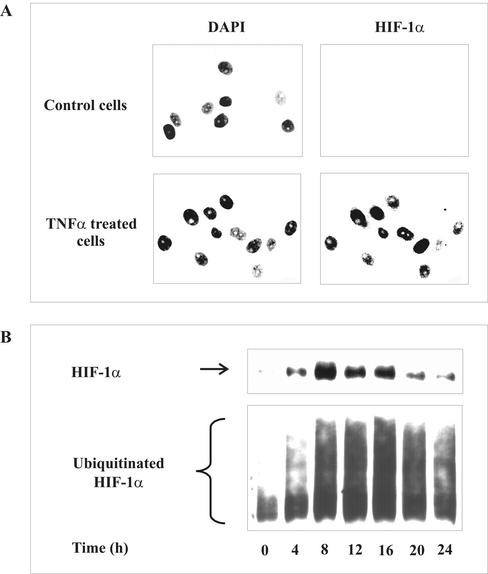
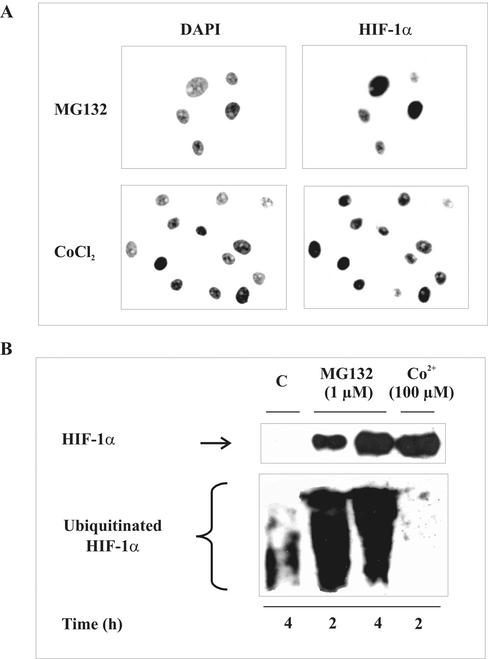
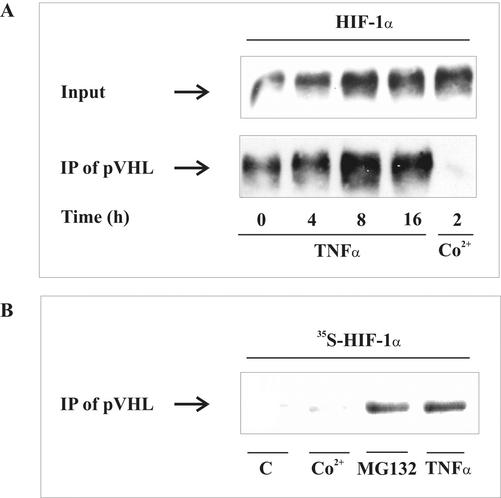
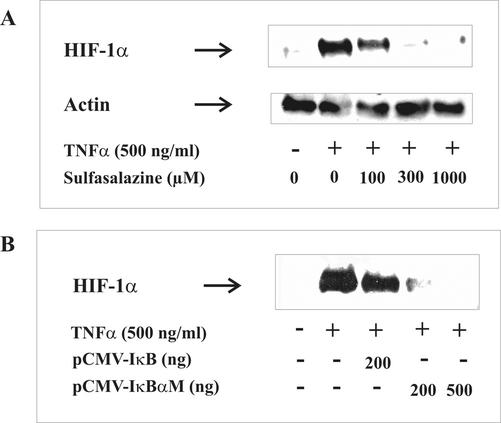
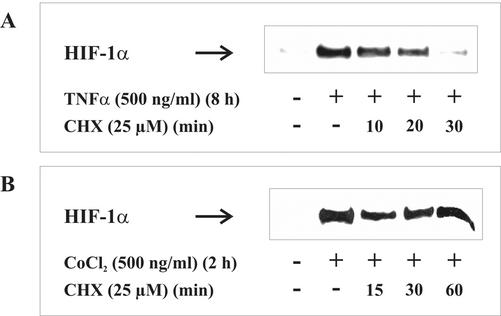
Hypoxia-inducible factor-1 (HIF-1) is a regulator of metabolic adaptation to hypoxia. It is now appreciated that HIF-1alpha accumulation is achieved under normoxic conditions by various factors, such as TNF-alpha. Here, it was our intention to gain insight into the signaling mechanisms used by TNF-alpha to stimulate HIF-1alpha. In tubular LLC-PK1 or human embryonic kidney cells, TNF-alpha induced accumulation of HIF-1alpha protein but not HIF-1alpha mRNA. Blocking nuclear factor (NF)-kappaB with sulfasalazine or expression of an IkappaB superrepressor attenuated HIF-1alpha accumulation, whereas transfection of active p50/p65-NF-kappaB subunits mimicked a TNF-alpha response. Experiments with actinomycin D and cycloheximide also pointed to a transcriptional and translational process in facilitating the TNF-alpha response. Interestingly, and in contrast to established hypoxic signaling concepts, TNF-alpha elicited HIF-1alpha accumulation in a ubiquitinated form that still bound the von Hippel-Lindau (pVHL) protein. These data indicate that HIF-1alpha accumulation by TNF-alpha demands the NF-kappaB pathway, preserves ubiquitination of HIF-1alpha, and allows the HIF-1alpha-pVHL interaction.
Figures



References
-
- Albina, J.E., Mastrofrancesco, B., Vessella, J.A., Louis, C.A., Henry, W.L., Jr., and Reichner, J.S. (2001). HIF-1 expression in healing wounds: HIF-1alpha induction in primary inflammatory cells by TNF-alpha. Am. J. Physiol. Cell Physiol. 281, C1971-C1977. - PubMed
-
- Alvarez-Tejado, M., Alfranca, A., Aragones, J., Vara, A., Landazuri, M.O., and del Peso, L. (2002). Lack of evidence for the involvement of the phosphoinositide 3-kinase/akt pathway in the activation of hypoxia-inducible factors by low oxygen tension. J. Biol. Chem. 277, 13508-13517. - PubMed
-
- Arsham, A.M., Plas, D.R., Thompson, C.B., and Simon, M.C. (2002). Phosphatidylinositol 3-kinase/Akt signaling is neither required for hypoxic stabilization of HIF-1alpha nor sufficient for HIF-1-dependent target gene transcription. J. Biol. Chem. 277, 15162-15170. - PubMed
-
- Baud, V., and Karin, M. (2001). Signal transduction by tumor necrosis factor and its relatives. Trends Cell Biol. 11, 372-377. - PubMed
-
- Chan, D.A., Sutphin, P.D., Denko, N.C., and Giaccia, A.J. (2002). Role of prolyl hydroxylation in oncogenically stabilized hypoxiainducible factor-1alpha. J. Biol. Chem. 277, 40112-40117. - PubMed
Publication types
MeSH terms
Substances
LinkOut - more resources
Full Text Sources
Other Literature Sources
Research Materials
