. 2003 Jul;23(13):4522-31.
doi: 10.1128/MCB.23.13.4522-4531.2003.

Loss of Sin3/Rpd3 histone deacetylase restores the DNA damage response in checkpoint-deficient strains of Saccharomyces cerevisiae

Affiliations

Loss of Sin3/Rpd3 histone deacetylase restores the DNA damage response in checkpoint-deficient strains of Saccharomyces cerevisiae

Kenneth L Scott et al. Mol Cell Biol. 2003 Jul.

Abstract

We previously reported that expression of the human forkhead/winged helix transcription factor, CHES1 (checkpoint suppressor 1; FOXN3), suppresses sensitivity to DNA damage and restores damage-induced G(2)/M arrest in checkpoint-deficient strains of Saccharomyces cerevisiae. We find that a functional glutathione S-transferase-Ches1 fusion protein binds in vivo to Sin3, a component of the S. cerevisiae Sin3/Rpd3 histone deacetylase complex. Checkpoint mutant strains with SIN3 deleted show increased resistance to UV irradiation, which is not further enhanced by CHES1 expression. Conversely, overexpression of SIN3 blocks the Ches1-mediated G(2)/M delay in response to DNA damage, which is consistent with Ches1 acting by inhibiting the Sin3/Rpd3 complex. Deletion of either SIN3 or RPD3 in rad9 or mec1 checkpoint mutant strains suppresses sensitivity to replication blocks and DNA damage resulting from Cdc9 ligase deficiency and UV irradiation. SIN3 or RPD3 deletions also restored G(2)/M arrest after DNA damage without concomitant Rad53 phosphorylation in mec1 mutant strains. This DNA damage response is absent in mad1 spindle checkpoint mutants. These data suggest that modulation of chromatin structure may regulate checkpoint responses in S. cerevisiae. Inhibition of histone deacetylation results in a DNA damage checkpoint response mediated by the spindle checkpoint pathway that compensates for loss of the primary DNA damage checkpoint pathway.


Figures
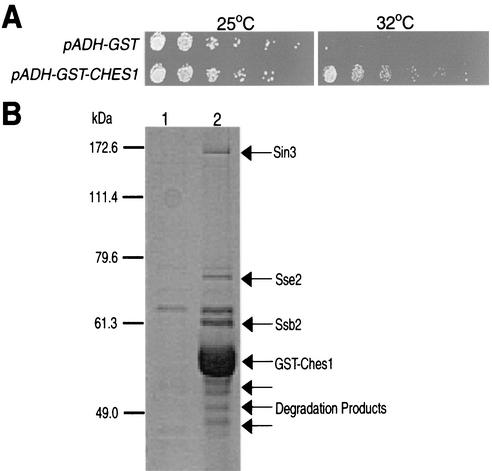
FIG. 1.
FIG. 1.
Sin3 interacts in vivo with a GST-Ches1 fusion protein. (A) Fivefold serial dilutions of the mutant strain cdc9-8 rad9Δ carrying multicopy plasmids expressing either GST (pADH-GST) or the GST-Ches1 fusion protein (pADH-GST-CHES1) were incubated at either 25 or 32°C. (B) Protein lysates prepared from cells (AVL78) expressing either GST alone (lane 1) or GST-Ches1 (lane 2) were incubated with glutathione-bound Sepharose, and the resulting purified material was separated on an SDS-8% polyacrylamide gel electrophoresis gel and Coomassie stained.
FIG. 2.
FIG. 2.
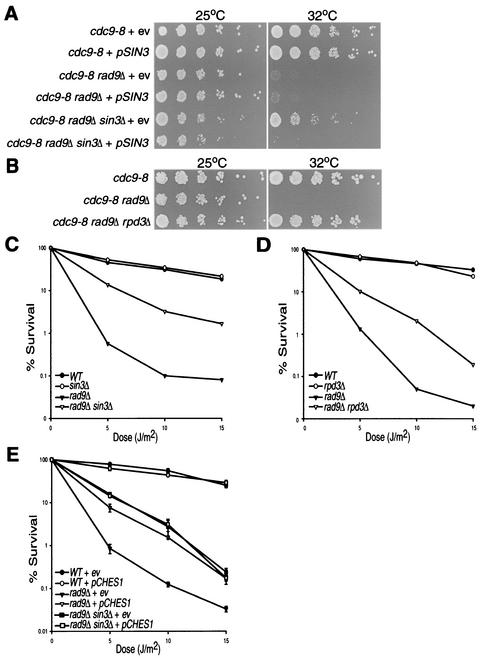
Deletion of SIN3 or RPD3 suppresses cdc9-8 rad9Δ temperature sensitivity and rad9Δ UV sensitivity. (A) Fivefold serial dilutions of cdc9-8 mutant strains containing wild-type or mutant alleles of RAD9 and SIN3 incubated at either 25 or 32°C. Each strain carries low-copy-number plasmids expressing either empty vector (ev) or wild-type Sin3 (pSIN3). (B) Fivefold serial dilutions of cdc9-8 mutant strains containing wild-type or mutant alleles of RAD9 and RPD3 were incubated at either 25 or 32°C. (C to E) Colony survival assays following UV irradiation of yeast containing wild-type or mutant alleles of RAD9 and SIN3 (C), wild-type or mutant alleles of RAD9 and RPD3 (D), or wild-type or mutant alleles of RAD9 and SIN3 (E) transformed with either a high-copy-number CHES1 expression vector, p424-GPD-CHES1 (pCHES1), or the corresponding empty vector, p424-GPD (ev).
FIG. 3.
FIG. 3.
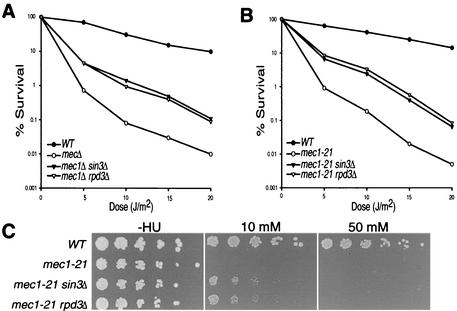
Deletion of SIN3 or RPD3 suppresses mec1 UV and HU sensitivity. (A and B) Colony survival assays of yeast containing wild-type or mutant alleles of SIN3 or RPD3 in combination with MEC1 or mec1Δ (A) and MEC1 or mec1-21 (B) were UV irradiated and colony survival was measured. (C) Fivefold serial dilutions of cells containing wild-type or mutant alleles of MEC1, SIN3, or RPD3 plated on medium supplemented with 0, 10, or 50 mM HU and incubated at 30°C.
FIG. 4.
FIG. 4.
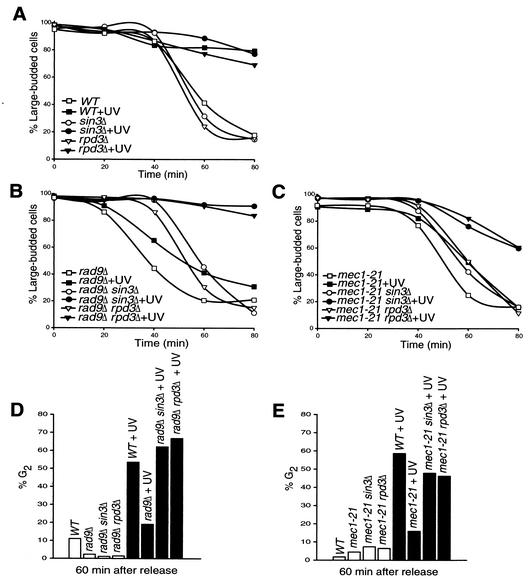
Deletion of SIN3 or RPD3 restores the DNA damage-induced G2/M delay. Cultures of the indicated strains were nocodazole arrested, mock (open symbols) or UV (filled symbols) irradiated (10 J/m2), and released into rich medium for sample collection at the indicated time points. (A) Assessment of strains wild type or mutant for SIN3 or RPD3 for large-budded morphology. (B and C) Assessment of strains wild type or mutant for SIN3 or RPD3 containing rad9Δ (B) or mec1-21 (C) for large-budded morphology. (D and E) Strains wild type or mutant for SIN3 or RPD3 containing rad9Δ (D) or mec1-21 (E) assessed for DAPI staining 60 min after release from nocodazole arrest.
FIG. 5.
FIG. 5.
sin3Δ- or rpd3Δ-dependent restoration of the damage-induced G2/M delay does not require Rad53 phosphorylation. Cultures of the indicated strains were nocodazole arrested, mock (−) or UV (+) irradiated, and released into rich medium for sample collection at 10 min. Lysates were analyzed by Western blotting using an anti-Rad53 polyclonal antibody.
FIG. 6.
FIG. 6.
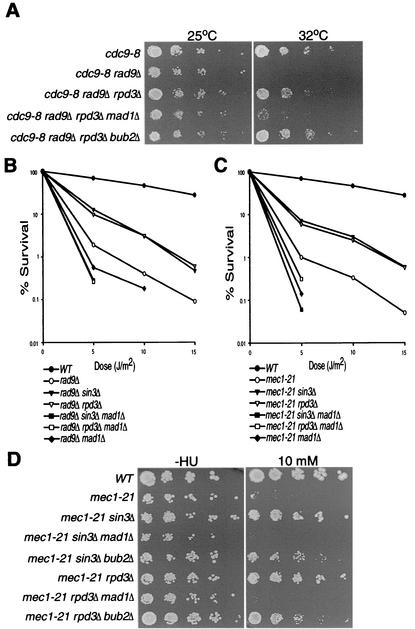
The spindle checkpoint pathway is required for sin3Δ- and rpd3Δ-dependent activity. (A) Fivefold serial dilutions of cdc9-8 mutant strains containing wild-type or mutant alleles of RAD9, RPD3, MAD1, and BUB2 were incubated at either 25 or 32°C. (B and C) Colony survival assays of yeast containing wild-type or mutant alleles of RAD9, SIN3, RPD3, and MAD1 (B) or MEC1, SIN3, RPD3, and MAD1 (C) were UV irradiated, and colony survival was measured. (D) Fivefold serial dilutions of cells containing wild-type or mutant alleles of MEC1, SIN3, RPD3, MAD1, and BUB2 plated on medium supplemented with 0 or 10 mM HU and incubated at 30°C.

References

    1. Adams, A. E., and J. R. Pringle. 1984. Relationship of actin and tubulin distribution to bud growth in wild-type and morphogenetic-mutant Saccharomyces cerevisiae. J. Cell Biol. 98:934-945. - PMC - PubMed
    1. Amon, A. 1999. The spindle checkpoint. Curr. Opin. Genet. Dev. 9:69-75. - PubMed
    1. Bernstein, B. E., J. K. Tong, and S. L. Schreiber. 2000. Genomewide studies of histone deacetylase function in yeast. Proc. Natl. Acad. Sci. USA 97:13708-13713. - PMC - PubMed
    1. Bowdish, K. S., and A. P. Mitchell. 1993. Bipartite structure of an early meiotic upstream activation sequence from Saccharomyces cerevisiae. Mol. Cell. Biol. 13:2172-2181. - PMC - PubMed
    1. Buggy, J. J., M. L. Sideris, P. Mak, D. D. Lorimer, B. McIntosh, and J. M. Clark. 2000. Cloning and characterization of a novel human histone deacetylase, HDAC8. Biochem. J. 350:199-205. - PMC - PubMed

Publication types

MeSH terms