


Loss of force induced by high extracellular [K+] in rat muscle: effect of temperature, lactic acid and beta2-agonist
- PMID: 12813152
- PMCID: PMC2343135
- DOI: 10.1113/jphysiol.2003.041418
Loss of force induced by high extracellular [K+] in rat muscle: effect of temperature, lactic acid and beta2-agonist
Abstract
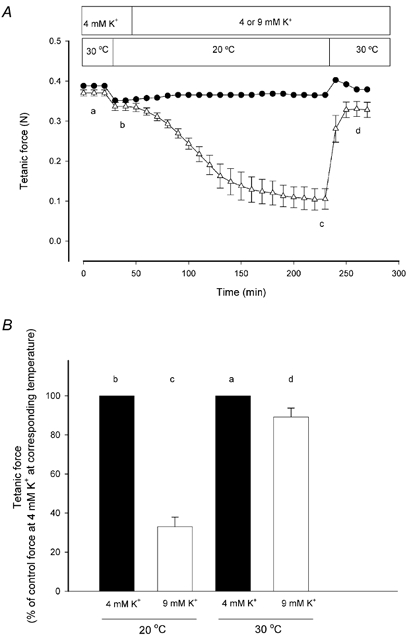
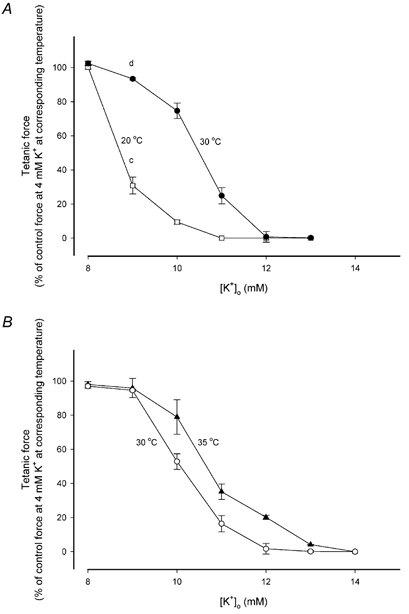
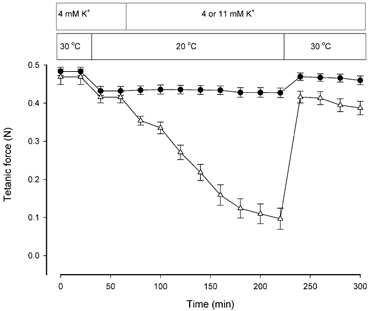
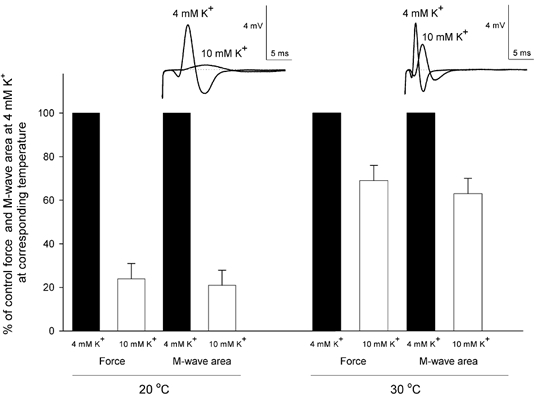
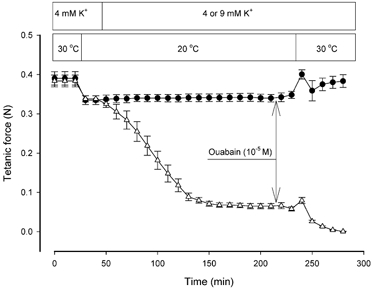
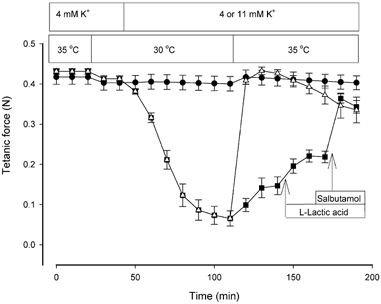
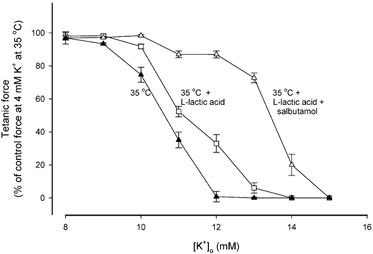
Loss of K+ from active muscles, leading to increased [K+]o, has been proposed to cause muscle fatigue by reducing excitability. Since exercise increases muscle temperature, we investigated the influence of temperature on muscle [K+]o sensitivity. Intact rat soleus or extensor digitorum longus (EDL) muscles were mounted on force transducers and stimulated electrically to evoke short isometric tetani at regular intervals. In each experiment, control force at 4 mM K+ was initially determined at every temperature used. In soleus muscles at 20 degrees C, 9 mM K+ reduced force to 33 +/- 5 % of control force. Increasing the temperature to 30 degrees C restored force to 89 +/- 5 % of control force. Likewise, at 30 degrees C 11 mM K+ reduced force to 16 +/- 4 % and increasing the temperature to 35 degrees C restored force to 35 +/- 5 %. Similar results were obtained using EDL. The force recovery induced by elevating temperature, reflecting reduced [K+]o sensitivity, was associated with improved excitability assessed from compound action potentials. Force recovery induced by a temperature elevation from 20 to 30 degrees C was associated with hyperpolarization (5 mV), reduced [Na+]i and a 93 % increase in Na+-K+ pump activity. The force recovery was blocked by ouabain. Since intensive exercise leads to lactic acidosis and increased plasma catecholamines, the effect of these two factors was also investigated. At 11 mM K+, force was completely restored by combining temperature elevation (30 to 35 degrees C), L-lactic acid (10 mM) and the beta2-agonist salbutamol (10-5 M). We suggest an exercise scenario where the depressing action of exercise-induced hyperkalaemia is counteracted by elevated muscle temperature, lactic acidosis and catecholamines.
Figures
References
-
- Asmussen E, Bøje O. Body temperature and capacity for work. Acta Physiol Scand. 1945;10:1–22.
-
- Brooks GA, Hittelman KJ, Faulkner JA, Beyer RE. Temperature, skeletal muscle mitochondrial functions, and oxygen debt. Am J Physiol. 1971;220:1053–1059. - PubMed
-
- Cairns SP, Flatman JA, Clausen T. Relation between extracellular [K+], membrane potential and contraction in rat soleus muscle: modulation by the Na+-K+ pump. Pflugers Arch. 1995;430:909–915. - PubMed
-
- Cairns SP, Hing WA, Slack JR, Mills RG, Loiselle DS. Different effects of raised [K+]o on membrane potential and contraction in mouse fast- and slow-twitch muscle. Am J Physiol. 1997;273:C598–611. - PubMed
Publication types
MeSH terms
Substances
LinkOut - more resources
Full Text Sources
Medical
