


Evidence for object permanence in the smooth-pursuit eye movements of monkeys
- PMID: 12815015
- PMCID: PMC2581619
- DOI: 10.1152/jn.01056.2002
Evidence for object permanence in the smooth-pursuit eye movements of monkeys
Abstract
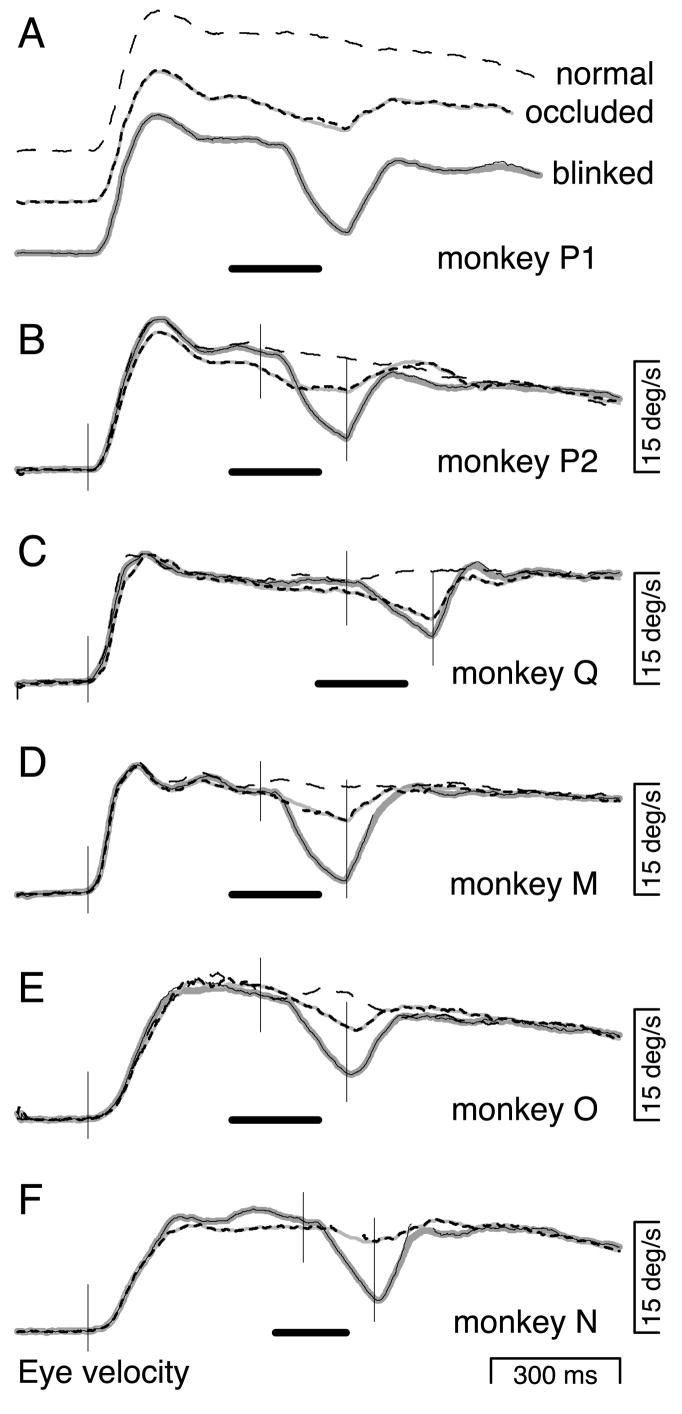
We recorded the smooth-pursuit eye movements of monkeys in response to targets that were extinguished (blinked) for 200 ms in mid-trajectory. Eye velocity declined considerably during the target blinks, even when the blinks were completely predictable in time and space. Eye velocity declined whether blinks were presented during steady-state pursuit of a constant-velocity target, during initiation of pursuit before target velocity was reached, or during eye accelerations induced by a change in target velocity. When a physical occluder covered the trajectory of the target during blinks, creating the impression that the target moved behind it, the decline in eye velocity was reduced or abolished. If the target was occluded once the eye had reached target velocity, pursuit was only slightly poorer than normal, uninterrupted pursuit. In contrast, if the target was occluded during the initiation of pursuit, while the eye was accelerating toward target velocity, pursuit during occlusion was very different from normal pursuit. Eye velocity remained relatively stable during target occlusion, showing much less acceleration than normal pursuit and much less of a decline than was produced by a target blink. Anticipatory or predictive eye acceleration was typically observed just prior to the reappearance of the target. Computer simulations show that these results are best understood by assuming that a mechanism of eye-velocity memory remains engaged during target occlusion but is disengaged during target blinks.
Figures
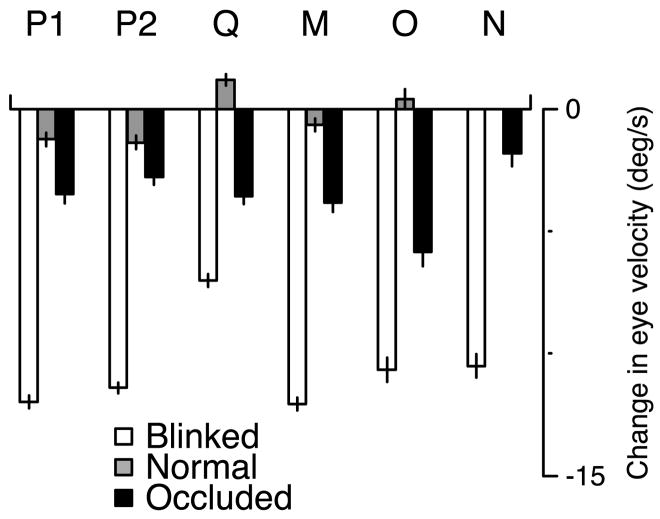
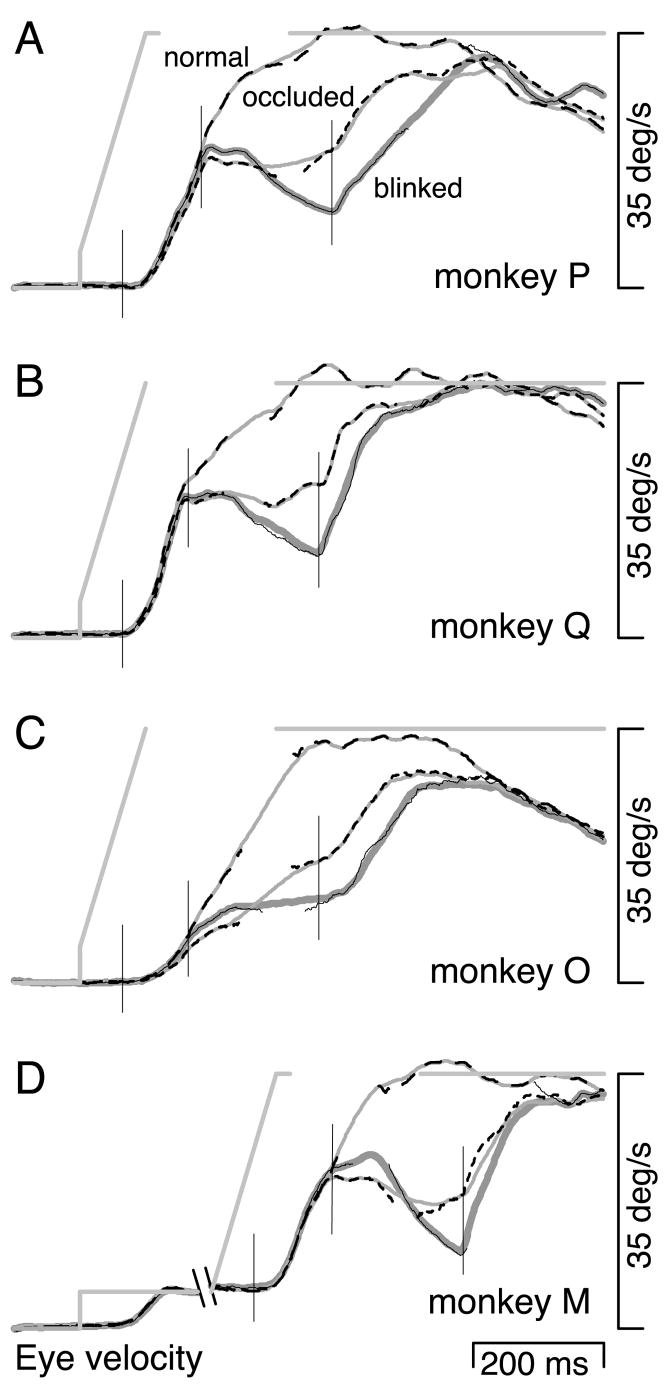
 , and ▪, measurements made from the blinked-, normal-, and occluded-maintenance conditions. Decreases in eye velocity are graphed downward. The letter at the top of each set of bars indicates the monkey for whom the measures were made. Monkey P performed the experiment twice, yielding the measurements labeled “P1” and “P2.” The change in eye velocity for the blinked- and occluded-maintenance conditions was computed as the difference between eye velocity 80 ms after the disappearance of the target and the minimum eye velocity in the subsequent 300 ms. The change in eye velocity for the normal-maintenance condition was computed over the same interval as that for the blinked-maintenance condition (as there was typically no clear “minimum”). The error bars show SE, computed from the individual SEs of the 2 means. Monkey N was the 1st monkey tested and was not shown the normal-maintenance condition.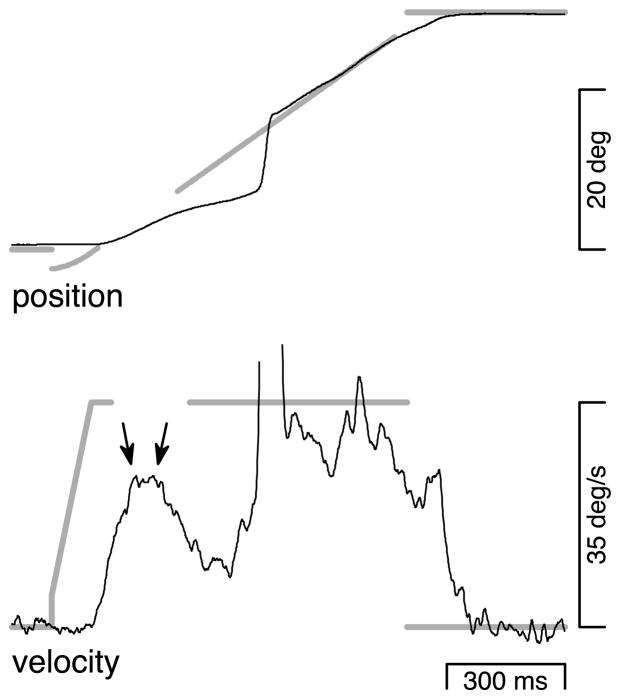
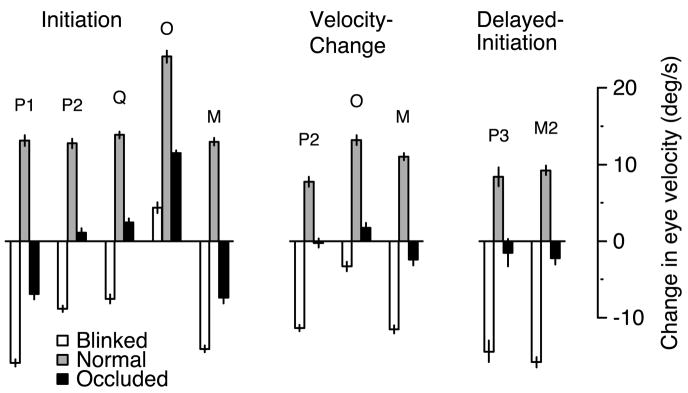 , and ▪, data from the blinked, normal, and occluded conditions, respectively. The letter at the top of each set of bars indicates the monkey for which the measures were made. When monkeys performed the experiment more than once (e.g., monkey P), this is indicated by the accompanying number. From left to right, the bars grouped along each x axis show data from 3 experimental paradigms: initiation, velocity-change, and delayed-initiation. The velocity-change conditions were presented in the same experimental sessions as the initiation conditions but were not presented to all monkeys. The delayed-initiation conditions were presented later in their own experimental sessions. Changes in eye velocity were computed as follows. First, the change in eye velocity was computed for the blinked condition as the difference between eye velocity 80 ms after the disappearance of the target (this time was always before the decline in eye velocity began) and the minimum eye velocity in the subsequent 300 ms. For the occluded and normal conditions, we then measured the change in eye velocity over the same interval, by making measurements from the same time points. Monkey O showed no dip in eye velocity during the blinked-initiation condition. We therefore measured the change in eye velocity from 80 ms after the disappearance of the target until 80 ms after the reappearance of the target (approximately the location of the minimum in eye velocity for the other monkeys). SEs were computed from the individual SEs of the 2 means. Measurements were made from the saccade-interpolated averages but were virtually identical if made from the saccade-excluded averages.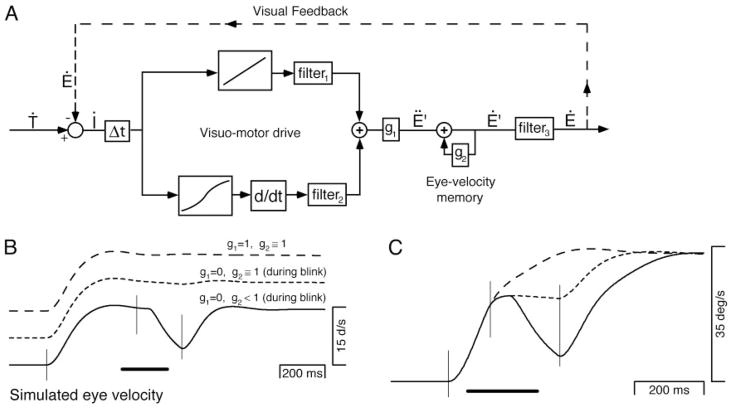
References
-
- Barborica A, Ferrera VP. Estimating invisible target speed from neuronal activity in monkey frontal eye field. Nat Neurosci. 2003;6:66–74. - PubMed
-
- Barnes GR, Barnes DM, Chakraborti SR. Ocular pursuit responses to repeated, single-cycle sinusoids reveal behavior compatible with predictive pursuit. J Neurophysiol. 2000;84:2340–2355. - PubMed
-
- Barnes G, Grealy M, Collins S. Volitional control of anticipatory ocular smooth pursuit after viewing, but not pursuing, a moving target: evidence for a re-afferent velocity store. Exp Brain Res. 1997;116:445–455. - PubMed
-
- Becker W, Fuchs AF. Prediction in the oculomotor system: smooth pursuit during transient disappearance of a visual target. Exp Brain Res. 1985;57:562–575. - PubMed
Publication types
MeSH terms
Grants and funding
LinkOut - more resources
Full Text Sources
