doi: 10.1101/gad.256603.
MAX4 and RMS1 are orthologous dioxygenase-like genes that regulate shoot branching in Arabidopsis and pea
Affiliations
- PMID: 12815068
- PMCID: PMC196077
- DOI: 10.1101/gad.256603
Item in Clipboard
MAX4 and RMS1 are orthologous dioxygenase-like genes that regulate shoot branching in Arabidopsis and pea
Genes Dev.
.
Abstract
Shoot branching is inhibited by auxin transported down the stem from the shoot apex. Auxin does not accumulate in inhibited buds and so must act indirectly. We show that mutations in the MAX4 gene of Arabidopsis result in increased and auxin-resistant bud growth. Increased branching in max4 shoots is restored to wild type by grafting to wild-type rootstocks, suggesting that MAX4 is required to produce a mobile branch-inhibiting signal, acting downstream of auxin. A similar role has been proposed for the pea gene, RMS1. Accordingly, MAX4 and RMS1 were found to encode orthologous, auxin-inducible members of the polyene dioxygenase family.
Figures

Shoot phenotype of max4-1 mutant plants. (A) Wild-type (WT) and max4-1 plants were grown under a 16-h long-day photoperiod for 3 wk. Bar, 1 cm. (B) Lateral bud and inflorescence lengths of WT (closed circles) and max4-1 (open circles). Lateral lengths were measured when the primary shoot apex had ceased activity. Cauline nodes are numbered positively (5 youngest, 1 oldest) and rosette nodes are numbered negatively (-1 youngest, -20 oldest). Node number is aligned so that node 1 is the oldest cauline node. Error bars represent the standard errors of the mean; n = 10. (C) Mean branch numbers originating from the rosette of plants at maturity produced by hypocotyl grafting between WT and max4-1 plants (shoot genotype/root genotype). Error bars represent the standard errors of the mean; n = 4–11.
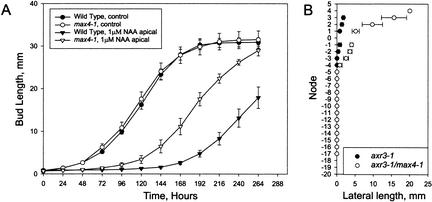
Altered auxin responses in max4-1 mutants. (A) Lateral inflorescence outgrowth of excised max4-1 and WT nodes in response to the synthetic auxin 1-NAA. The oldest cauline node was excised from WT (closed symbols) or max4-1 (open symbols), and inserted between two agar blocks. The apical agar block contained either no 1-NAA (circles) or 1 μM 1-NAA (triangles). Bud outgrowth was measured every 24 h. Error bars represent standard error of the mean; n = 11 to 19. (B) Lateral bud and inflorescence lengths of axr3—1 (closed circles) and axr3-1, max4-1 double-mutant plants (open circles). Lateral lengths were measured 55 d after sowing, and the mean primary inflorescence height of the axr3-1 and the axr3-1, max4-1 double-mutant plants were not significantly different. Cauline nodes are numbered positively and rosette nodes are numbered negatively. Node number increases with proximity to the shoot apex. Node number is aligned so that node 1 is the oldest cauline node. Error bars represent standard error of the mean; n = 7.
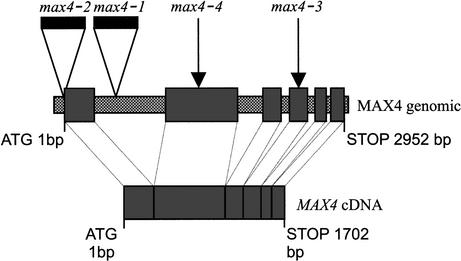
Diagram of MAX4 genomic and MAX4 cDNA showing the relative positions of the transposon-induced mutations. The MAX4 cDNA consists of six exons (larger gray bars) separated by five introns in the genomic DNA (smaller hatched bars). The max4-1 and max4-2 mutations are caused by transposon insertions (black bars) and the max4-3 and max4-4 mutations (arrows) are caused by transposon footprints.

(A) Phylogenetic analysis of polyene chain dioxygenases. The unrooted phylogenetic tree was generated from multiple sequence alignments, using ClustalX and modified by eye. Positions with gaps were excluded. Numbers at branch forks represent bootstrap values as a percentage of 10,000 bootstraps, and give a confidence limit for grouping together the sequences. Proteins are labeled with a prefix that represents the species origin of the sequence: At, Arabidopsis thaliana; Ps, Pisum sativum, pea; Os, Oryza sativa, rice; Sp, Sphingomonas paucimobilis; h, human; Mm, Mus musculus, mouse. (B) Southern blot analysis of the PsMAX4 gene in WT and isogenic rms1 pea lines. Lanes 2—5 contain EcoR1-digested genomic DNA from rms1-2, Weitor, rms1-3, and Raman, respectively. Lane 1 contains a 1-kb ladder.

Root tip expression of the GUS reporter protein driven by 2.7 kb of DNA upstream of the MAX4 gene. (A) Untreated 5-day-old seedlings. (B) Seedlings transferred to 1 μM 1-NAA for 24 h. (C) Nodal section showing expression close to a young bud, but not in the bud. (D, top panel) RMS1 gene expression in internode 4 of 14-day-old plants, with 5 leaves expanded, that were intact (I) or 6 h after decapitation (D), treated with 0, 500, or 3000 mg/L-1 IAA to the decapitated stump. (Bottom panel) Actin gene expression was monitored as a control.
References
-
- Altschul S.F., Gish, W., Miller, W., Myers, E.W., and Lipman, D.J. 1990. Basic local alignment search tool. J. Mol. Biol. 215: 403–410. - PubMed
-
- Bangerth F. 1994. Response of cytokinin concentration in the xylem exudate of bean (Phaseolus vulgaris L.) plants to decapitation and auxin treatment, and relationship to apical dominance. Planta 194: 439–442.
-
- Beveridge C.A. 2000. Long-distance signaling and a mutational analysis of branching in pea. Plant Growth Regul. 32: 193–203.
-
- Beveridge C.A., Symons, G.M., Murfet, I.C., Ross, J.J., and Rameau, C. 1997. The rms1 mutant of pea has elevated indole-3-acetic acid levels and reduced root-sap zeatin riboside content but increased branching controlled by graft-transmissible signals. Plant Physiol. 115: 1251–1258.
Publication types
MeSH terms
Substances
LinkOut - more resources
Full Text Sources
Other Literature Sources
Molecular Biology Databases
Miscellaneous