


Suppression of skeletal muscle lipoprotein lipase activity during physical inactivity: a molecular reason to maintain daily low-intensity activity
- PMID: 12815182
- PMCID: PMC2343229
- DOI: 10.1113/jphysiol.2003.045591
Suppression of skeletal muscle lipoprotein lipase activity during physical inactivity: a molecular reason to maintain daily low-intensity activity
Abstract
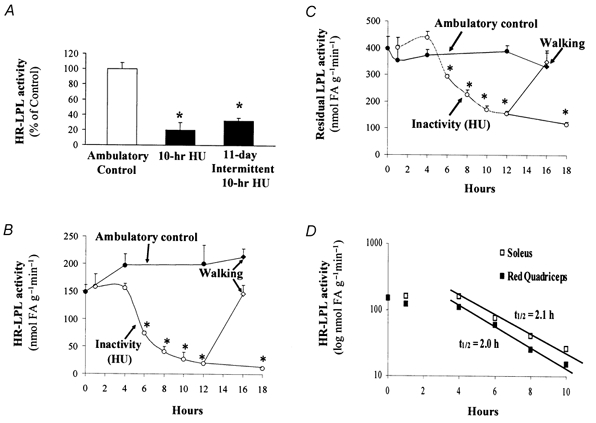
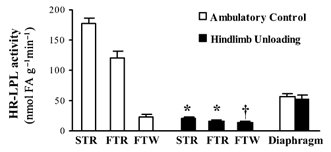
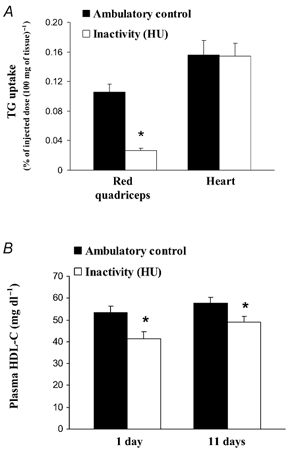
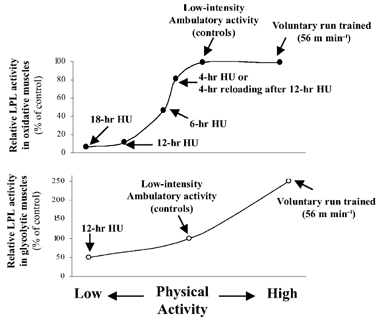
We have examined the regulation of lipoprotein lipase (LPL) activity in skeletal muscle during physical inactivity in comparison to low-intensity contractile activity of ambulatory controls. From studies acutely preventing ambulatory activity of one or both the hindlimbs in rats, it was shown that approximately 90-95 % of the heparin-releasable (HR) LPL activity normally present in rat muscle with ambulatory activity is lost, and thus dependent on local contractile activity. Similarly, approximately 95 % of the differences in LPL activity between muscles of different fibre types was dependent on ambulatory activity. The robustness of the finding that physical inactivity significantly decreases muscle LPL activity was evident from confirmatory studies with different models of inactivity, in many rats and mice, both sexes, three muscle types and during both acute and chronic (11 days) treatment. Inactivity caused a local reduction of plasma [3H]triglyceride uptake into muscle and a decrease in high density lipoprotein cholesterol concentration. LPL mRNA was not differentially expressed between ambulatory controls and either the acutely or chronically inactive groups. Instead, the process involved a rapid loss of the HR-LPL protein mass (the portion of LPL largely associated with the vascular endothelium) by an actinomycin D-sensitive signalling mechanism (i.e. transcriptionally dependent process). Significant decreases of intracellular LPL protein content lagged behind the loss of HR-LPL protein. Treadmill walking raised LPL activity approximately 8-fold (P < 0.01) within 4 h after inactivity. The striking sensitivity of muscle LPL to inactivity and low-intensity contractile activity may provide one piece of the puzzle for why inactivity is a risk factor for metabolic diseases and why even non-vigorous activity provides marked protection against disorders involving poor lipid metabolism.
Figures
References
-
- Aldred HE, Perry IC, Hardman AE. The effect of a single bout of brisk walking on postprandial lipemia in normolipidemic young adults. Metabolism. 1994;43:836–841. - PubMed
-
- Alford EK, Roy RR, Hodgson JA, Ergerton VR. Electromyography of rat soleus, medial gastrocnemius, and tibialis anterior during hindlimb suspension. Exp Neur. 1987;96:635–649. - PubMed
-
- Augustus AS, Kako Y, Yagyu H, Goldberg IJ. Routes of FA delivery to cardiac muscle: modulation of lipoprotein lipolysis alters uptake of TG-derived FA. Am J Physiol. 2003;284:E331–339. - PubMed
-
- Bergo M, Wu G, Ruge T, Olivecrona T. Down-regulation of adipose tissue lipoprotein lipase during fasting requires that a gene, separate from the lipase gene, is switched on. J Biol Chem. 2002;277:11927–11932. - PubMed
-
- Bey L, Akunuri N, Hoffman PE, Zhao P, Hamilton DG, Hamilton MT. Patterns in global gene expression in rat skeletal muscle during unloading and low-intensity ambulatory activity. Physiol Genomics. 2003;13:157–167. - PubMed
Publication types
MeSH terms
Substances
Grants and funding
LinkOut - more resources
Full Text Sources
Medical
