. 2003 Jul;71(7):3730-9.
doi: 10.1128/IAI.71.7.3730-3739.2003.

Staphylococcus aureus susceptibility to innate antimicrobial peptides, beta-defensins and CAP18, expressed by human keratinocytes

Affiliations

Staphylococcus aureus susceptibility to innate antimicrobial peptides, beta-defensins and CAP18, expressed by human keratinocytes

Kazushige Midorikawa et al. Infect Immun. 2003 Jul.

Abstract

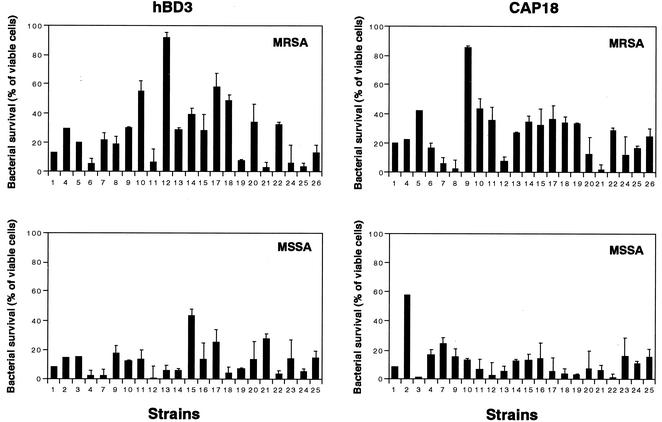
The antimicrobial peptides human beta-defensin-1 (hBD1), hBD2, hBD3, and CAP18 expressed by keratinocytes have been implicated in mediation of the innate defense against bacterial infection. To gain insight into Staphylococcus aureus infection, the susceptibility of S. aureus, including methicillin-resistant S. aureus (MRSA), to these antimicrobial peptides was examined. Based on quantitative PCR, expression of hBD2 mRNA by human keratinocytes was significantly induced by contact with S. aureus, and expression of hBD3 and CAP18 mRNA was slightly induced, while hBD1 mRNA was constitutively expressed irrespective of the presence of S. aureus. Ten clinical S. aureus isolates, including five MRSA isolates, induced various levels of expression of hBD2, hBD3, and CAP18 mRNA by human kertinocytes. The activities of hBD3 and CAP18 against S. aureus were found to be greater than those of hBD1 and hBD2. A total of 44 S. aureus clinical isolates, including 22 MRSA strains, were tested for susceptibility to hBD3 and CAP18. Twelve (55%) and 13 (59%) of the MRSA strains exhibited more than 20% survival in the presence of hBD3 (1 microg/ml) and CAP18 (0.5 microg/ml), respectively. However, only three (13%) and two (9%) of the methicillin-sensitive S. aureus isolates exhibited more than 20% survival with hBD3 and CAP18, respectively, suggesting that MRSA is more resistant to these peptides. A synergistic antimicrobial effect between suboptimal doses of methicillin and either hBD3 or CAP18 was observed with 10 MRSA strains. Furthermore, of several genes associated with methicillin resistance, inactivation of the fmtC gene in MRSA strain COL increased susceptibility to the antimicrobial effect mediated by hBD3 or CAP18.


Figures
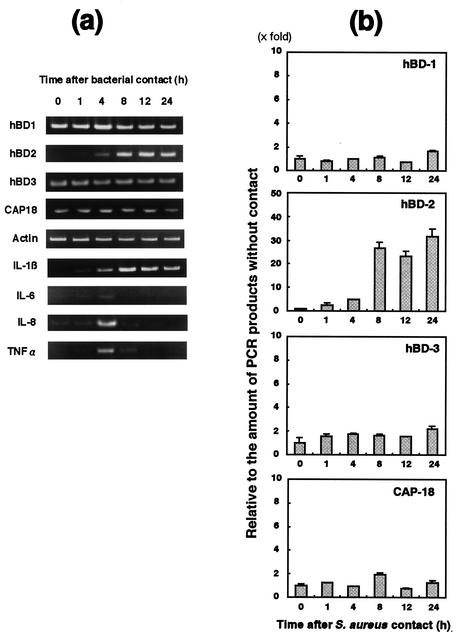
FIG. 1.
FIG. 1.
Expression of β-defensins, CAP18, and cytokine mRNA by human keratinocytes in contact with heat-inactivated S. aureus 209P cells. Total RNA was extracted from cells after contact with S. aureus for various times and then used for RT-PCR (a) and real-time PCR (b) performed by using the methods described in Materials and Methods. The results of the real-time PCR are expressed as a ratio in comparison to the value at zero time and are means ± standard deviations from three independent experiments.
FIG. 2.
FIG. 2.
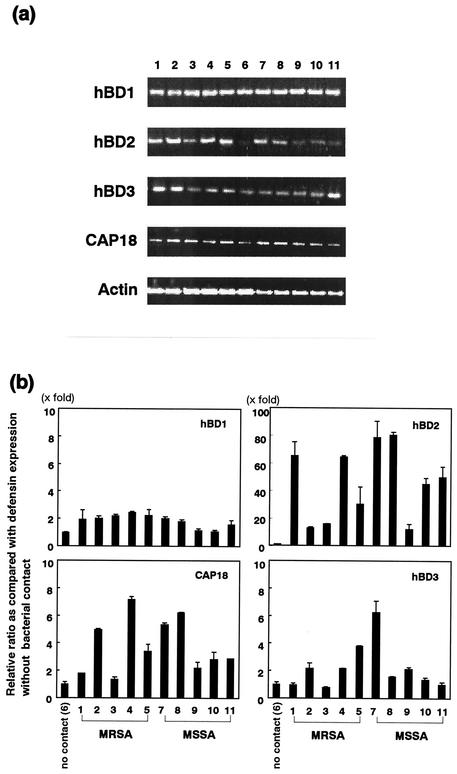
Expression of hBD1, hBD2, hBD3, and CAP18 mRNA by human keratinocytes in contact with heat-inactivated clinically isolated S. aureus cells. Total RNA was extracted from cells in contact with S. aureus for 8 h and used for RT-PCR (a) and real-time PCR (b) performed by using the methods described in Materials and Methods. (a) Lanes 1 to 5, MRSA strains; lane 6, no bacterial contact; lanes 7 to 11, MSSA strains. (b) Ratio of defensin expression in comparison to the value obtained when there was no contact with S. aureus cells. Bars 1 to 5, MRSA strains; bar 6, no bacterial contact; bars 7 to 11, MSSA strains. The results of the real-time PCR are means ± standard deviations from three independent experiments.
FIG. 3.
FIG. 3.
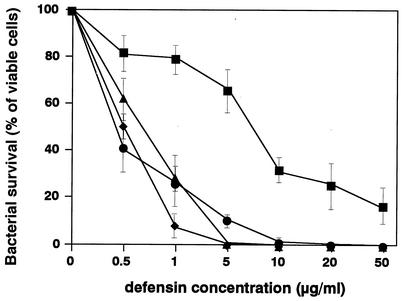
Antibacterial activities of β-defensins and CAP18. Each peptide was incubated for 4 h at 37°C in 200 μl of 10 mM NaPi (pH 6.8) containing 105 bacterial cells. Then serial dilutions were plated on Trypticase soy agar, and colony counts were obtained after 24 h of incubation at 37°C. Bacterial survival is expressed as a percentage (number of cells that survived in the presence of peptides compared to the number of cells that survived without peptide). The data are means ± standard deviations from three independent experiments. Symbols: ▪, hBD1; •, hBD2; ▴, hBD3; ⧫, CAP18.
FIG. 4.
FIG. 4.
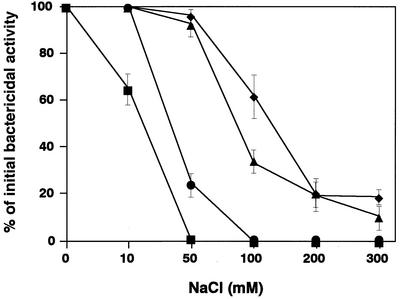
Salt sensitivity of antimicrobial peptides. Various concentrations of NaCl (0 to 300 mM) were added to 10 mM NaPi (pH 6.8), and each peptide (50 μg/ml) was reacted with S. aureus cells by using the method described in Materials and Methods. The data are means ± standard deviations from three independent experiments. Symbols: ▪, hBD1; •, hBD2; ▴, hBD3; ⧫, CAP18.
FIG. 5.
FIG. 5.
Thin sections of S. aureus 2PF-18 exposed to antimicrobial peptides. S. aureus cells were reacted with no peptide (panel 1), with 200 μg of hBD1 per ml (panels 2a and 2b), with 200 μg of hBD2 per ml (panels 3a and 3b), with 200 μg of hBD3 per ml (panels 4a and 4b), or with 200 μg of CAP18 per ml (panels 5a and 5b). Bars, 100 nm.
FIG. 6.
FIG. 6.
Activities of hBD3 and CAP18 against S. aureus clinical isolates. The susceptibilities of 22 MSSA strains and 22 MRSA strains to hBD3 (1 μg/ml) and CAP18 (0.5 μg/ml) were analyzed as described in Materials and Methods. Bacterial survival is expressed as a percentage of the viable cells. The data are means ± standard deviations from three independent experiments.
FIG. 7.
FIG. 7.
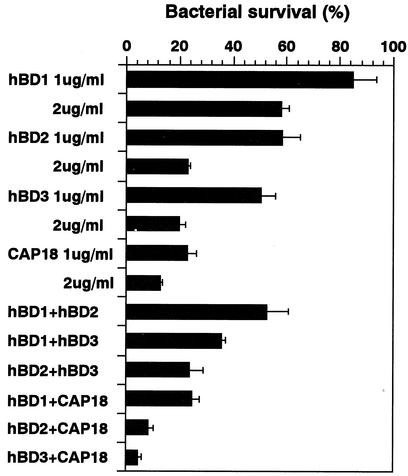
Effects of individual antimicrobial peptides and combinations of antimicrobial peptides on S. aureus survival. Peptides alone (1 or 2 μg/ml) or combinations of two peptides (1 μg/ml each) were used to determine the susceptibilities of the S. aureus COL strain as described in Materials and Methods. The data are means ± standard deviations from three independent experiments.
FIG. 8.
FIG. 8.
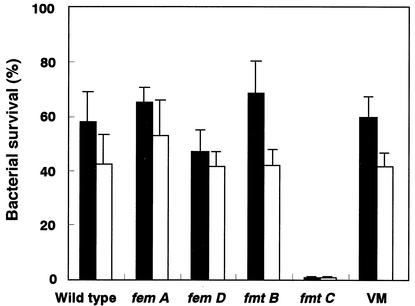
Activities of hBD3 and CAP18 against S. aureus wild type and mutants. The susceptibilities of S. aureus COL, femA, femD, fmtB, and fmtC mutants, and a vancomycin-resistant mutant (VM) to hBD3 (1 μg/ml) and CAP18 (0.5 μg/ml) were determined by the method described in Materials and Methods. Solid bars, hBD3; open bars, CAP18. The data are means ± standard deviations from three independent experiments.

References

    1. Bals, R. 2000. Epithelial antimicrobial peptides in host defense against infection. Respir. Res. 1:141-150. - PMC - PubMed
    1. Bals, R., D. J. Weiner, A. D. Moscioni, R. L. Meegalla, and J. M. Wilson. 1999. Augmentation of innate host defense by expression of a cathelicidin antimicrobial peptide. Infect. Immun. 67:6084-6089. - PMC - PubMed
    1. Becker, M. N., G. Diamond, M. W. Verghese, and S. H. Randell. 2000. CD14-dependent lipopolysaccharide-induced β-defensin-2 expression in human tracheobronchial epithelium. J. Biol. Chem. 275:29731-29736. - PubMed
    1. Berger-Bächi, B., L. Barberis-Maino, A. Strässle, and F. H. Kayser. 1989. femA, a host-mediated factor essential for methicillin resistance in Staphylococcus aureus: molecular cloning and characterization. Mol. Gen. Genet. 219:263-269. - PubMed
    1. Bobin-Dubreux, S., M.-E. Reverdy, C. Nervi, M. Rougier, A. Bolmstrom, F. Vandenesch, and J. Etienne. 2001. Clinical isolate of vancomycin-heterointermediate Staphylococcus aureus susceptible to methicillin and in vitro selection of a vancomycin-resistant derivative. Antimicrob. Agents Chemother. 45:349-352. - PMC - PubMed

Publication types

LinkOut - more resources