. 2003 Jun;13(6B):1402-9.
doi: 10.1101/gr.1055303.

Discovery of imprinted transcripts in the mouse transcriptome using large-scale expression profiling

Affiliations

Discovery of imprinted transcripts in the mouse transcriptome using large-scale expression profiling

Itoshi Nikaido et al. Genome Res. 2003 Jun.

Abstract

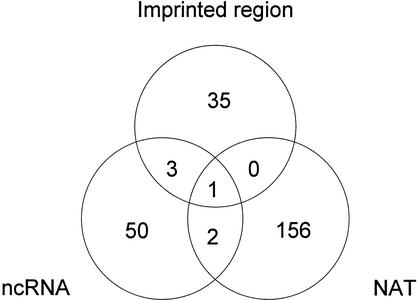
Candidate imprinted transcriptional units in the mouse genome were identified systematically from 27,663 FANTOM2 full-length mouse cDNA clones by expression profiling. Large-scale cDNA microarrays were used to detect differential expression dependent upon chromosomal parent of origin by comparing the mRNA levels in the total tissue of 9.5 dpc parthenogenote and androgenote mouse embryos. Of the FANTOM2 transcripts, 2114 were identified as candidates on the basis of the array data. Of these, 39 mapped to known imprinted regions of the mouse genome, 56 were considered as nonprotein-coding RNAs, and 159 were natural antisense transcripts. The imprinted expression of two transcripts located in the mouse chromosomal region syntenic to the human Prader-Willi syndrome region was confirmed experimentally. We further mapped all candidate imprinted transcripts to the mouse and human genome and were shown in correlation with the imprinting disease loci. These data provide a major resource for understanding the role of imprinting in mammalian inherited traits.


Figures
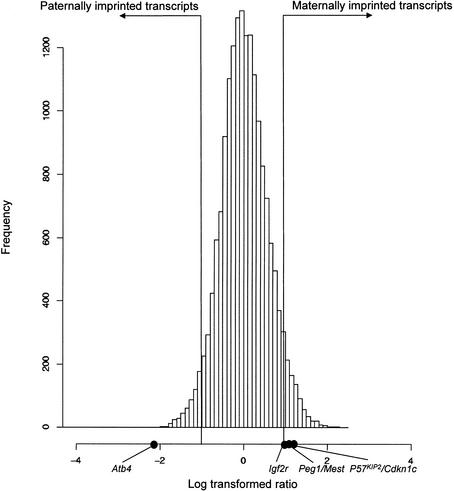
Figure 1
Figure 1
Differential expression using RIKEN cDNAmicroarray 2nd release Histogram of expression ratio Cy3 (andorogenetic embryo) and Cy5 (parthenogenetic embryo). Black dots show ratio of known imprinted genes.
Figure 2
Figure 2
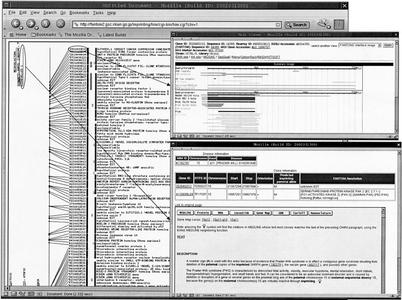
Predicted imprinted transcript map of human chromosome 1 A snap shot from the predicted imprinted transcript map (http://fantom2.gsc.riken.go.jp/imprinting/) is shown. (Left) The chromosome 15 and the mapped transcripts. On the left side of the chromosome, human imprinted gene region was shown. There is a link to the disease information (bottom, right). RIKEN clone ID that has been mapped to the chromosome has a link to the FANTOM2 viewer (top, right). There are six color boxes in between the RIKEN clone ID and the annotation as shown at left. The first color box shows whether the transcript is maternally expressed (red) or paternally expressed (blue). The second box shows whether the transcript is mapped to the human imprinted disease loci (yellow). If yes, the color box is painted in yellow. The third-fifth boxes show whether the transcript overlaps with the mouse imprint region (orange), natural antisense transcript (green), or ncRNA(blue) as shown in Figure 1(Venn diagram). The sixth box shows whether the position on human genome is confirmed by mouse human homology map (Gregory et al. 2002) (fuchsia).
Figure 3
Figure 3
Classification of imprinted candidate transcripts. The total candidate imprinted transcripts listed from the FANTOM2 set were 2108. The overlap between antisense transcripts (Kiyosawa et al. 2003), ncRNA(Numata et al. 2003), and transcripts that map to previously reported imprinted loci (third wheel) listed from the FANTOM 2 clone set were shown.
Figure 4
Figure 4
Ndn antisene. PX00010K13 overlapped Ndn on mouse chromosome 7 by 957 bp. PX00010K13 had three SNPs (white triangle) between C57BL/6J and JF1 strain mouse. PX00010K13 overlapped Ndn including its CDS (slanting line) and promoter region (white box). Three SNPs do not overlap Ndn.
Figure 5
Figure 5
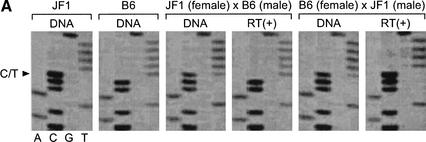
Confirmation of maternal silencing of two candidate imprinted transcripts from the Prader-Willi region. PX00010K13 and PX00113D24, which are the novel transcripts on Prader-Willi syndrome syntenic region were imprinted maternally. (A) The C/T SNP on PX00010K13 was analyzed for the transcripts derived from reciprocal cross F1 mouse between C57BL/6 and JF1 The paternal expression of the transcripts were shown in the reciprocal crosses.
Figure 5
Figure 5
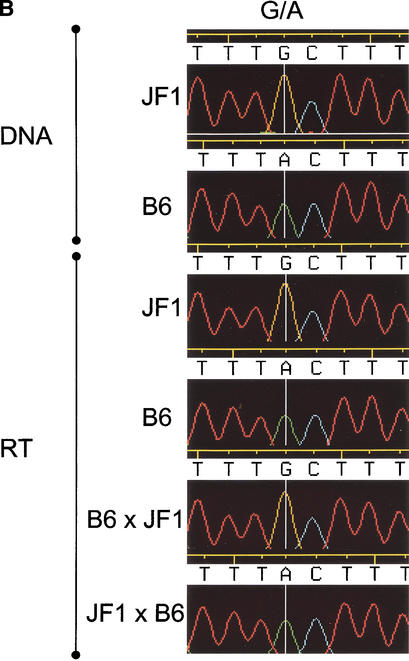
Confirmation of maternal silencing of two candidate imprinted transcripts from the Prader-Willi region. PX00010K13 and PX00113D24, which are the novel transcripts on Prader-Willi syndrome syntenic region were imprinted maternally. (B) The G/ASNP on PX00113D24 were analyzed for the transcripts derived from reciprocal cross F1 mouse between C57BL/6 and JF1. The paternal expression of the transcripts was shown in the reciprocal crosses.
Figure 6
Figure 6
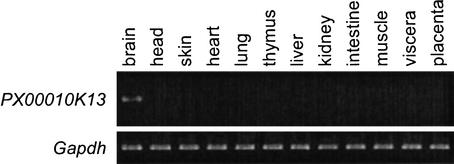
Tissue specific expression of PX00010K13.Northblot hybridization of PX00010K13. PX00010K13 is specifically expressed in the brain.

References

    1. Bielinska, B., Blaydes, S.M., Buiting, K., Yang, T., Krajewska-Walasek, M., Horsthemke, B., and Brannan, C.I. 2000. De novo deletions of SNRPN exon 1 in early human and mouse embryos result in a paternal to maternal imprint switch. Nat. Genet. 25: 74-78. - PubMed
    1. Brockdorff, N. 2002. X-chromosome inactivation: Closing in on proteins that bind Xist RNA. Trends Genet. 18: 352-358. - PubMed
    1. Carninci, P., Kvam, C., Kitamura, A., Ohsumi, T., Okazaki, Y., Itoh, M., Kamiya, M., Shibata, K., Sasaki, N., Izawa, M., et al. 1996. High-efficiency full-length cDNA cloning by biotinylated CAP trapper. Genomics 37: 327-336. - PubMed
    1. Collins, F.S. 1995. Positional cloning moves from perditional to traditional. Nat. Genet. 9: 347-350. - PubMed
    1. Deltour, L., Montagutelli, X., Guenet, J.L., Jami, J., and Paldi, A. 1995. Tissue- and developmental stage-specific imprinting of the mouse proinsulin gene, Ins2. Dev. Biol. 168: 686-688. - PubMed

WEB SITE REFERENCES

    1. http://www.mgu.har.mrc.ac.uk/imprinting/all_impmaps.html; Imprinting maps, Medical Research Council, Mammalian Genetics Unit, Harwell, UK.
    1. http://fantom2.gsc.riken.go.jp/imprinting/; Candidate imprinted transcripts by expression (CITE) database.

Publication types

LinkOut - more resources