


Speed of visual processing increases with eccentricity
- PMID: 12819786
- PMCID: PMC3077107
- DOI: 10.1038/nn1079
Speed of visual processing increases with eccentricity
Erratum in
- Nat Neurosci. 2003 Aug;6(8):899
Abstract
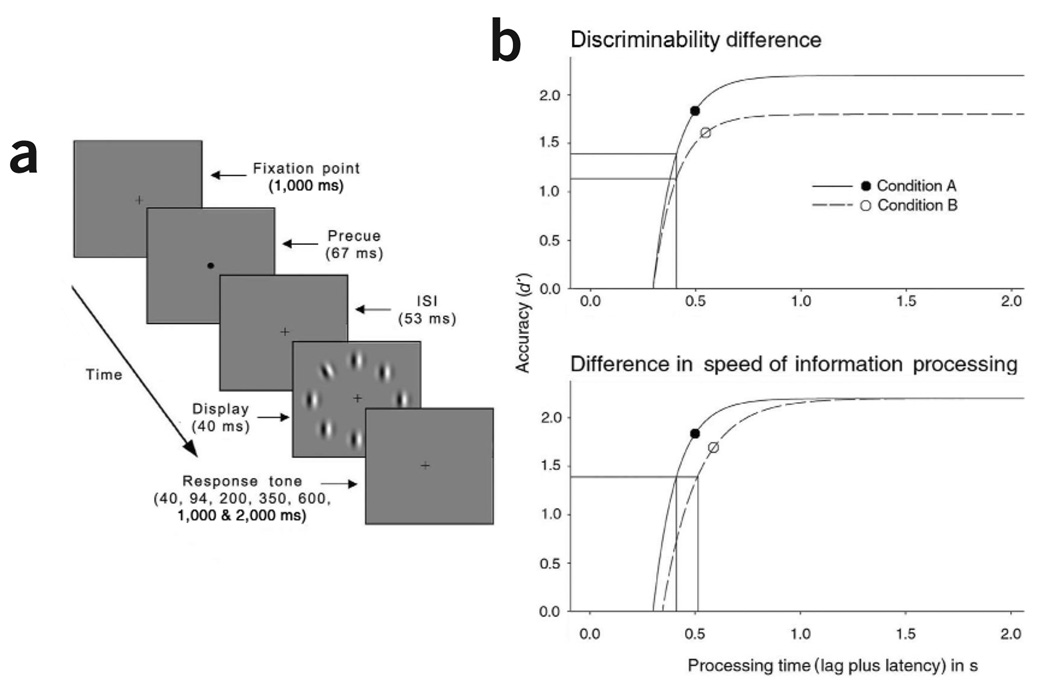
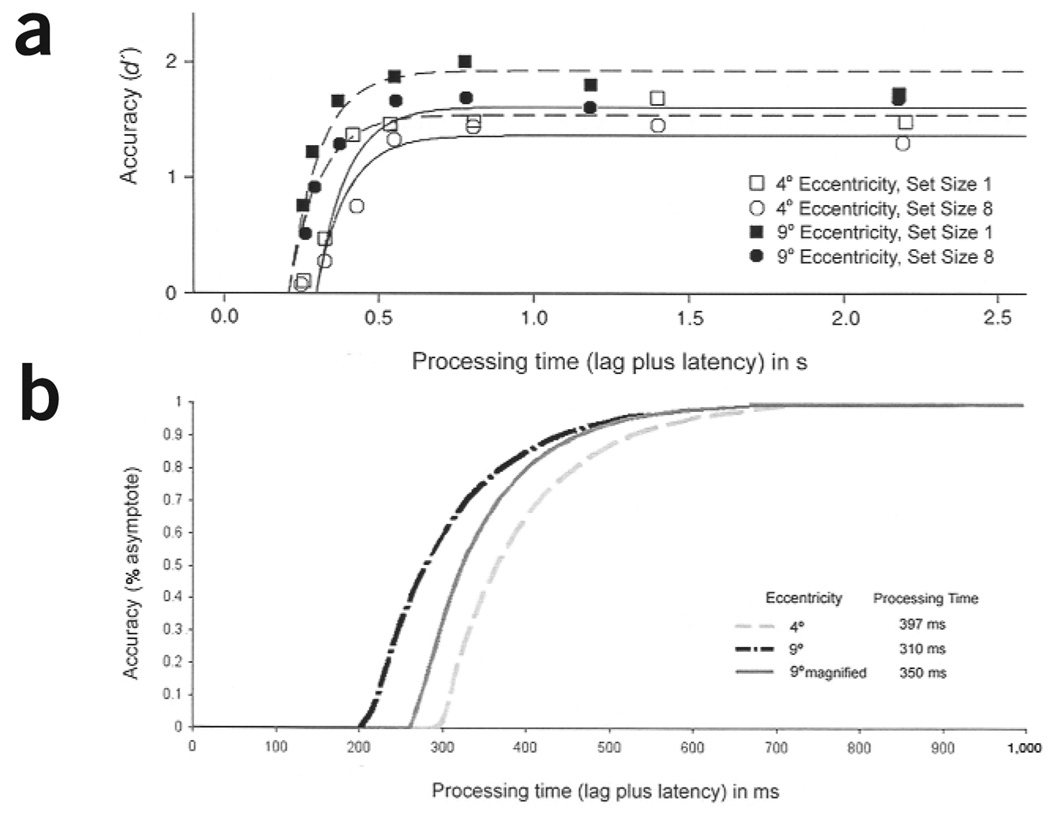
The visual system has a duplex design to meet conflicting environmental demands: the fovea has the resolution required to process fine spatial information, but the periphery is more sensitive to temporal properties. To investigate whether the periphery's sensitivity is partly due to the speed with which information is processed, we measured the full timecourse of visual information processing by deriving joint measures of discriminability and speed, and found that speed of information processing varies with eccentricity: processing was faster when same-size stimuli appeared at 9 degrees than 4 degrees eccentricity, and this difference was attenuated when the 9 degrees stimuli were magnified to equate cortical representation size. At the same eccentricity, larger stimuli are processed more slowly. These temporal differences are greater than expected from neurophysiological constraints.
Figures
References
-
- DeValois RL, DeValois KK. Spatial Vision. New York: Oxford Univ. Press; 1988.
-
- Hartmann E, Lachenmayr B, Brettel H. Vision Res. 1979;19:1019–1023. - PubMed
-
- McKee SP, Nakayama K. Vision Res. 1984;24:25–32. - PubMed
-
- Lennie P. Perception. 1998;27:889–935. - PubMed
-
- Schmolesky MT, et al. Neurophysiology. 1998;79:3272–3278. - PubMed
Publication types
MeSH terms
Grants and funding
LinkOut - more resources
Full Text Sources
