. 2003 Jul;133(1):67-77.
doi: 10.1046/j.1365-2249.2003.02189.x.

Up-regulation of ICAM-1, CD11a/CD18 and CD11c/CD18 on human THP-1 monocytes stimulated by Streptococcus suis serotype 2

Affiliations

Up-regulation of ICAM-1, CD11a/CD18 and CD11c/CD18 on human THP-1 monocytes stimulated by Streptococcus suis serotype 2

D Al-Numani et al. Clin Exp Immunol. 2003 Jul.

Abstract

Streptococcus suis serotype 2 is known to be a major pathogen of swine, causing mainly meningitis. It is also a zoonotic agent leading predominantly to meningitis in humans working in close contact with pigs. In this study, we investigated the ability of S. suis to up-regulate the expression of adhesion molecules involved in inflammation, using an enzyme-linked immunosorbent assay. S. suis serotype 2 stimulated the up-regulation of the expression of intercellular adhesion molecule-1 (ICAM-1, CD54), CD11a/CD18 and CD11c/CD18 on human THP-1 monocytes, but did not change that of ICAM-1, vascular cell adhesion molecule-1 (VCAM-1, CD106) and E-selectin (CD62E) on human endothelial cells. The up-regulation of adhesion molecules was time- and bacterial concentration-dependent, and cell wall components were largely responsible for such stimulation. To a lesser extent, purified haemolysin of S. suis also stimulated adhesion molecule expression. Stimulation of monocytes with strains of different origin showed that there was no clear tendency for human strains to induce a higher expression of adhesion molecules than strains from diseased pigs. Finally, monocytes stimulated with S. suis also showed an increase in adherence to endothelial cells. Hence, S. suis is capable of up-regulating important adhesion molecules involved in inflammation, which may result in an increased leucocyte recruitment into sites of infection, thus providing a possible mechanism for some of the inflammatory features of meningitis caused by this pathogen.


Figures

Fig. 1
Fig. 1
Kinetics of the up-regulated expression of ICAM-1(⋄), VCAM-1(▪) and E-selectin (▴) on HUVEC stimulated by LPS. Results obtained after stimulation with heat-killed (109 cfu/ml) or live (108−104 cfu/ml) S. suis strains of porcine and human origin included in this study (Table 1) are represented by (•) for all three adhesion molecules. Basal expression of adhesion molecules measured on non-stimulated cells was subtracted from all results. Data are expressed as mean ± standard deviation and represent at least three separate experiments.
Fig. 2
Fig. 2
Kinetics of the expression of ICAM-1 (a), CD11a/CD18 (b) and CD11c/CD18 (c) on THP-1 monocytes stimulated by heat-killed bacteria of S. suis serotype 2 strain 31533 (109 cfu/ml) (•) and by LPS (1 µg/ml) (▴) measured at different times of incubation. Basal expression of adhesion molecules measured on non-stimulated cells was subtracted from all results. Data are expressed as means ± standard deviations from at least three separate experiments.
Fig. 3
Fig. 3
Effect of different concentrations of bacteria of heat-killed S. suis serotype 2 strain 31533 on the expression of ICAM-1 (•), CD11a/CD18 (▪) and CD11c/CD18 (▴) on THP-1 monocytes, measured following 48 h of stimulation. Basal expression of the appropriate adhesion molecule measured on non-stimulated cells was subtracted from each result. Data are expressed as mean ± standard deviation and represent at least three separate experiments.
Fig. 4
Fig. 4
Comparison of the expression of ICAM-1, CD11a/CD18 and CD11c/CD18 on THP-1 monocytes stimulated for 24 h with heat-killed (H, □) bacteria of S. suis serotype 2 (109 cfu/ml) strain 31533 versus live (L, ▪) bacteria of the same strain (105 cfu/ml). Basal expression of adhesion molecules measured on non-stimulated cells was subtracted from all results. Data are expressed as mean ± standard deviation and represent at least three separate experiments.
Fig. 5
Fig. 5
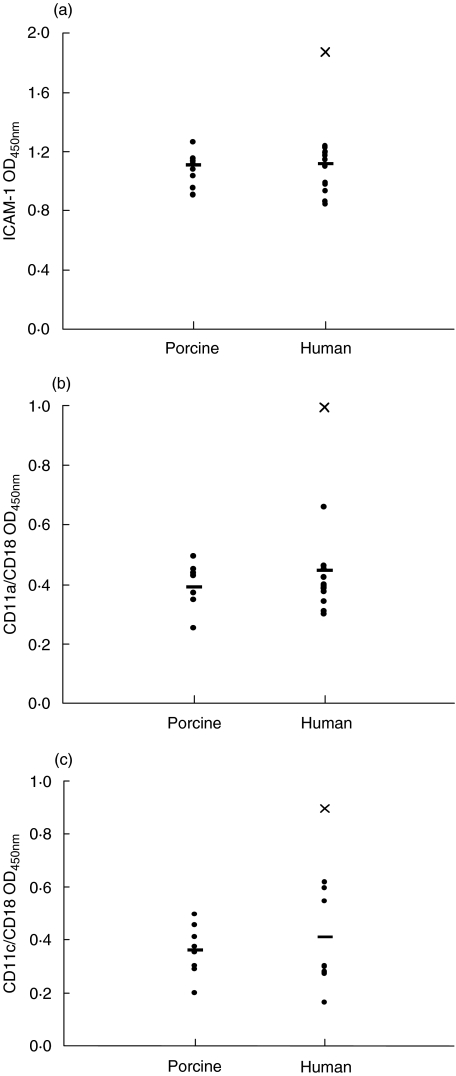
Expression of ICAM-1 (a), CD11a/CD18 (b) and CD11c/CD18 (c) on THP-1 monocytes stimulated with heat-killed bacteria of porcine and human strains of S. suis serotype 2 (109 cfu/ml) for 48 h (see Table 1). The average of each group (porcine or human) is indicated (–). Each point represents one strain and is the average of at least three separate experiments. Human strain ‘Reims’ is indicated in all three graphs as (X). Basal expression of adhesion molecules measured on non-stimulated cells was subtracted from all results.
Fig. 6
Fig. 6
The effect of different concentrations of purified cell wall (checkered bars) and haemolysin (empty bars) of S. suis serotype 2 on the expression of ICAM-1 (a), CD11a/CD18 (b) and CD11c/CD18 (c) on THP-1 monocytes, following 48 h of stimulation, compared to the stimulation observed with whole bacteria (solid bar) (heat-killed strain 31533, 109 cfu/ml). Basal expression of adhesion molecules measured on non-stimulated cells was subtracted from all results. Data are expressed as mean ± standard deviation and represent at least three separate experiments.
Fig. 7
Fig. 7
Adherence of THP-1 monocytes to endothelial cells following stimulation with LPS (1 µg/ml) or heat-killed bacteria of S. suis (109 cfu/ml) strain 31533. Monocyte stimulation: THP-1 monocytes that have been stimulated for 48 h by LPS or S. suis were incubated for 40 min with non-stimulated HUVEC. HUVEC stimulation: non-stimulated THP-1 monocytes were incubated for 40 min with LPS- or S. suis-stimulated HUVEC. Co-culture: THP-1 monocytes and HUVEC were co-incubated for 24 h in the presence of S. suis. Wells were washed, fixed and stained with methylene blue. HCL was added to solubilize the stain and the OD was read at 650 nm. Results were compared to the value representing basal adhesion of non-stimulated THP-1 monocytes on non-stimulated HUVEC. Increase in monocyte adherence upon stimulation, in comparison to non-stimulated cells, is represented by vertical bars. *P < 0·05. Data are expressed as mean ± standard deviation and represent three separate experiments.

References

    1. Higgins R, Gottschalk M. Streptococcal diseases. In: Straw BE, D'Allaire S, Mengeling WL, Taylor DJ, editors. Diseases of swine. Ames: Iowa State University Press; 1999.
    1. Arends JP, Zanen HC. Meningitis caused by Streptococcus suis in humans. Rev Infect Dis. 1988;10:131–7. - PubMed
    1. Higgins R, Gottschalk M. Distribution of Streptococcus suis capsular types in 1997. Can Vet J. 1998;39:299–300. - PMC - PubMed
    1. Charland N, Harel J, Kobish M, Lacasse S, Gottschalk M. Streptococcus suis serotype 2 mutants deficient in capsular expression. Microbiology. 1998;144:325–32. - PubMed
    1. Gottschalk M, Lebrun A, Wisselink H, Dubreuil JD, Smith H, Vecht U. Production of virulence-related proteins by Canadian strains of Streptococcus suis capsular type 2. Can J Vet Res. 1998;62:75–9. - PMC - PubMed

Publication types

MeSH terms