. 2003;5(4):R226-33.
doi: 10.1186/ar774. Epub 2003 May 23.

DEK binding to class II MHC Y-box sequences is gene- and allele-specific

Affiliations

DEK binding to class II MHC Y-box sequences is gene- and allele-specific

Barbara S Adams et al. Arthritis Res Ther. 2003.

Abstract

Using electrophoretic mobility shift assays, we examined sequence-specific binding of DEK, a potential autoantigen in juvenile rheumatoid arthritis, to conserved Y-box regulatory sequences in class II MHC gene promoters. Nuclear extracts from several cell lines of different phenotypes contained sequence-specific binding activity recognizing DRA, DQA1*0101, and DQA1*0501 Y-box sequences. Participation of both DEK and NF-Y in the DQA1 Y-box binding complex was confirmed by 'supershifting' with anti-DEK and anti-NF-Y antibodies. Recombinant DEK also bound specifically to the DQA1*0101 Y box and to the polymorphic DQA1*0501 Y box, but not to the consensus DRA Y box. Measurement of the apparent dissociation constants demonstrated a two- to fivefold difference in DEK binding to the DQA1 Y-box sequence in comparison with other class II MHC Y-box sequences. Residues that are crucial for DEK binding to the DQA1*0101 Y box were identified by DNase I footprinting. The specific characteristics of DEK binding to these related sequences suggests a potential role for DEK in differential regulation of class II MHC expression, and thus in the pathogenesis of juvenile rheumatoid arthritis and other autoimmune diseases.


Figures
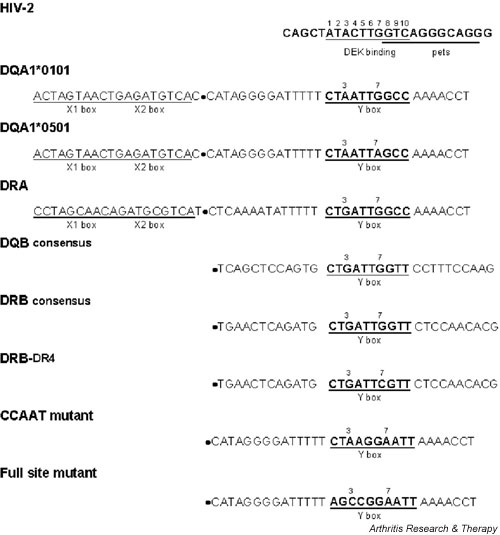
Figure 1
Figure 1
EMSA probes and competitors: HIV-2 DEK-binding site, class II MHC Y-box motifs (DQA1, DRA, DQB, and DRB), and related sequences. Probes and competitors include only sequences 3' of the ● symbol. X boxes are shown to provide a broader context for the Y-box regulatory element. EMSA = electrophoretic mobility shift assay.
Figure 2
Figure 2
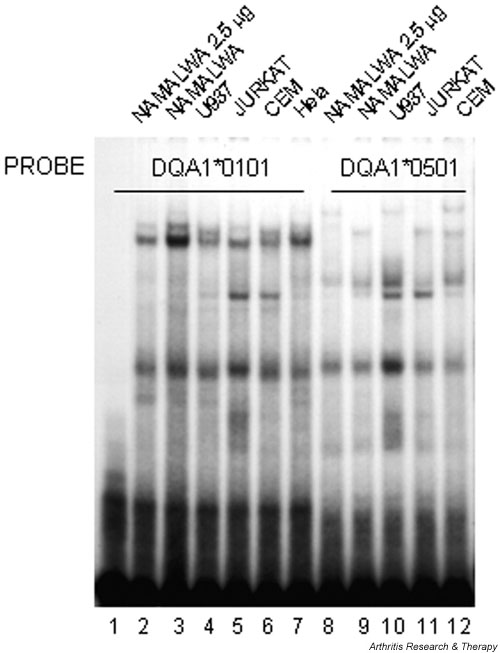
Nuclear extracts from several cultured cell lines show DQA1 Y-box-specific binding activity. Oligonucleotide probes containing the DQA1*0101 Y-box sequence (lanes 1–7) or DQA1*0501 polymorphic Y-box sequence (lanes 8–12) bind protein in nuclear extracts prepared from resting cells of the indicated cultured cell lines. Lane 1, control without nuclear extract; lanes 2 and 8, 2.5 μg of protein; lanes 3–7 and 9–12, 5 μg of protein.
Figure 3
Figure 3
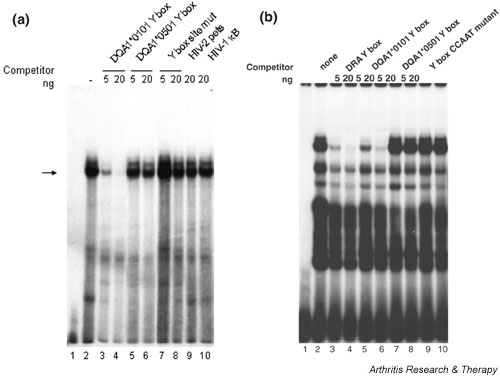
Namalwa cell nuclear protein(s) bind to DQA1 and DRA Y-box elements. 5 μg of Namalwa cell nuclear extract (lanes 2–10) and unlabeled oligonucleotide competitors were added to the binding reaction before addition of the radiolabeled DQA1*0101 probe (a) or the radiolabeled DRA probe (b) to define the sequence specificity of nuclear protein binding. In both (a) and (b), lane 1 contains no protein. See Figure 1 for site mutant and CCAAT mutant sequences. pets = peri-ets.
Figure 4
Figure 4
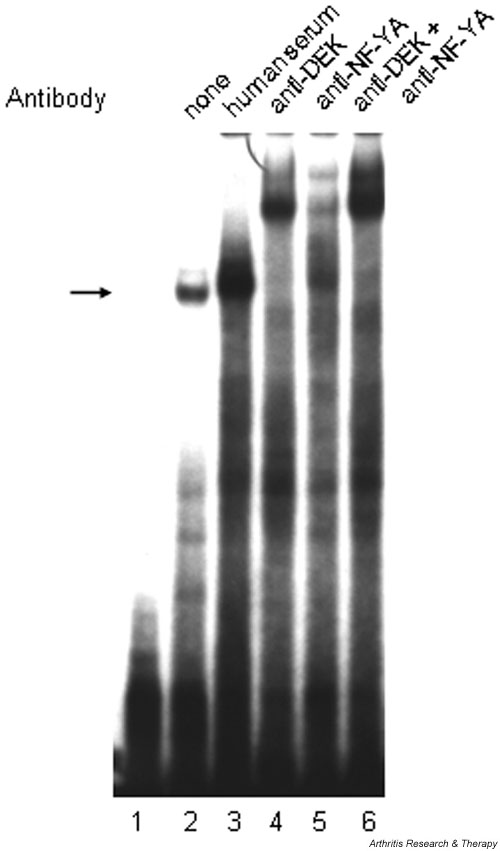
DEK and NF-Y participation in the DQA1*0101 Y-box binding complex demonstrated by 'supershift' assay. Namalwa nuclear extract (5 μg) was preincubated with the following antibody reagents before addition of radiolabeled probe containing DQA1*0101 Y-box sequence: lane 2, no antibody reagent; lane 3, 2 μl normal human serum; lane 4, 1 μl high-titer anti-DEK human antiserum; lane 5, 1 μl anti-NF-YA (subunit) monoclonal antibody; lane 6, 1 μl of anti-DEK plus 1 μl of anti-NF-YA monoclonal antibody. Lane 1 contains probe without nuclear extract or antibody reagent.
Figure 5
Figure 5
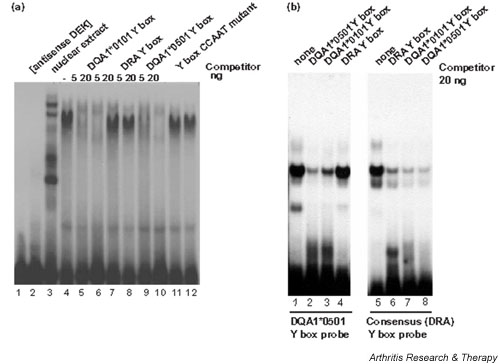
Recombinant DEK protein (rDEK) binds in a sequence-specific manner to the DQA1*0101 Y box, but not to the DRA (consensus) Y box. (a) 5 μl of antisense rDEK (lane 2), 5 μg of Namalwa cell nuclear extract (lane 3), or 5 μl of partially purified recombinant DEK protein (rDEK) (lanes 4–12) was used in each EMSA binding reaction; rDEK was preincubated with the indicated unlabelled competitor before addition of the DQA1*0101 Y-box probe. Lane 1 contains no protein. (b) The indicated unlabelled oligonucleotide competitors (20 ng) were added to the binding reaction containing 5 μl of partially purified rDEK before addition of radiolabeled DQA1*0501 probe (lanes 1–4), or radiolabeled DRA probe (lanes 5–8). PolyD(I-C) (10 ng) was added to each binding reaction as nonspecific competitor. EMSA = electrophoretic mobility shift assay.
Figure 6
Figure 6
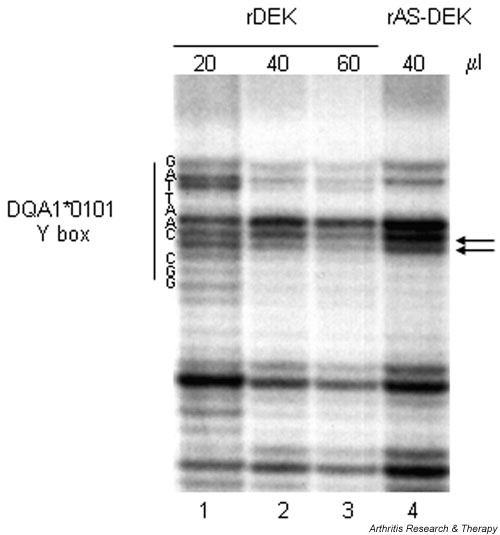
DNase I footprinting localizes rDEK binding to the HLA-DQA1*0101 Y box. Partially purified rDEK (20–60 μl) was incubated with DQA1*0101 probe (antisense strand). Antisense rDEK (40 μl) (prepared simultaneously with the rDEK protein) was used as a control. The Y-box sequence is shown on the left. Arrows denote consistent protection against DNase I digestion in multiple assays. rAS-DEK = recombinant anti-sense DEK protein; rDEK = recombinant DEK protein.

References

    1. Southwood TR, Malleson PH. Antinuclear antibodies and juvenile chronic arthritis (JCA): search for a specific autoantibody associated with JCA. Ann Rheum Dis. 1991;50:595–598. - PMC - PubMed
    1. Szer W, Sierakowska H, Szer IS. Antinuclear antibody profile in juvenile rheumatoid arthritis. J Rheumatol. 1991;18:401–408. - PubMed
    1. Moore TL, Osborn TG, Weiss TD. Autoantibodies in juvenile arthritis. Semin Arthritis Rheum. 1984;13:329–336. - PubMed
    1. Pauls JD, Silverman E, Laxer R, Fritzler MJ. Antibodies to histones H1 and H5 in sera of patients with juvenile rheumatoid arthritis. Arthritis Rheum. 1989;32:877–883. - PubMed
    1. Burlingame RW, Rubin RL, Rosenberg AM. Autoantibodies to chromatin components in juvenile rheumatoid arthritis. Arthritis Rheum. 1993;36:836–841. - PubMed

Publication types

MeSH terms