


WebFEATURE: An interactive web tool for identifying and visualizing functional sites on macromolecular structures
- PMID: 12824318
- PMCID: PMC168960
- DOI: 10.1093/nar/gkg553
WebFEATURE: An interactive web tool for identifying and visualizing functional sites on macromolecular structures
Abstract
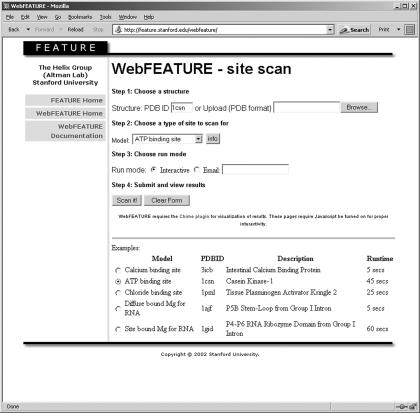
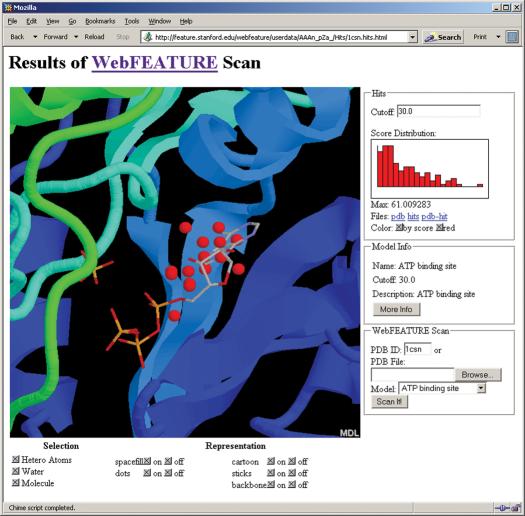
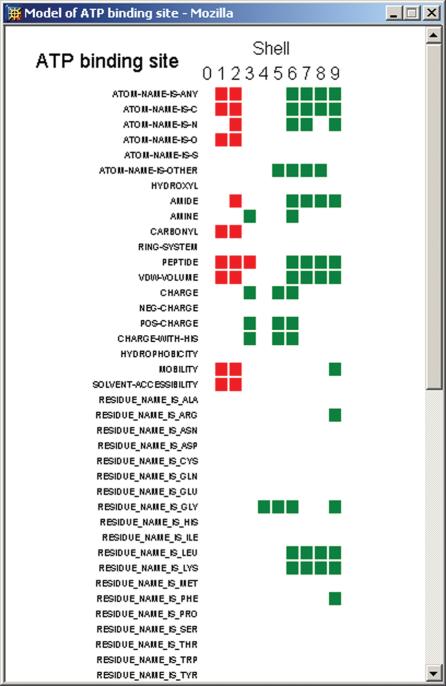
WebFEATURE (http://feature.stanford.edu/webfeature/) is a web-accessible structural analysis tool that allows users to scan query structures for functional sites in both proteins and nucleic acids. WebFEATURE is the public interface to the scanning algorithm of the FEATURE package, a supervised learning algorithm for creating and identifying 3D, physicochemical motifs in molecular structures. Given an input structure or Protein Data Bank identifier (PDB ID), and a statistical model of a functional site, WebFEATURE will return rank-scored 'hits' in 3D space that identify regions in the structure where similar distributions of physicochemical properties occur relative to the site model. Users can visualize and interactively manipulate scored hits and the query structure in web browsers that support the Chime plug-in. Alternatively, results can be downloaded and visualized through other freely available molecular modeling tools, like RasMol, PyMOL and Chimera. A major application of WebFEATURE is in rapid annotation of function to structures in the context of structural genomics.
Figures
References
-
- Burley S.K. and Bonanno,J.B. (2002) Structuring the universe of proteins. Annu. Rev. Genom. Hum. Genet., 3, 243–262. - PubMed
-
- Fetrow J.S. and Skolnick,J. (1998) Method for prediction of protein function from sequence using the sequence-to-structure-to-function paradigm with application to glutaredoxins/thioredoxins and T1 ribonucleases. J. Mol. Biol., 281, 949–968. - PubMed
-
- Waugh A., Williams,G.A., Wei,L. and Altman,R.B. (2001) Using meta computing tools to facilitate large-scale analyses of biological databases. Pac. Symp. Biocomput., 6, 360–371. - PubMed
Publication types
MeSH terms
Substances
Grants and funding
LinkOut - more resources
Full Text Sources
Other Literature Sources
