


POPS: A fast algorithm for solvent accessible surface areas at atomic and residue level
- PMID: 12824328
- PMCID: PMC169007
- DOI: 10.1093/nar/gkg601
POPS: A fast algorithm for solvent accessible surface areas at atomic and residue level
Abstract
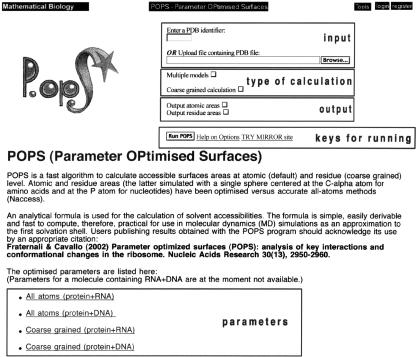
POPS (Parameter OPtimsed Surfaces) is a new method to calculate solvent accessible surface areas, which is based on an empirically parameterisable analytical formula and fast to compute. Atomic and residue areas (the latter represented by a single sphere centered on the C(alpha) atom of amino acids and at the P atom of nucleotides) have been optimised versus accurate all-atom methods. The parameterisation has been derived from a selected dataset of proteins and nucleic acids of different sizes and topologies. The residue based approach POPS-R, has been devised as a useful tool for the analysis of large macromolecular assemblies like the ribosome and it is specially suited for the refinement of low resolution structures. POPS-R also allows for estimates of the loss of free energy of solvation upon complex formation, which should be particularly useful for the design of new protein-protein and protein-nucleic acid complexes. The program POPS is available at http://mathbio.nimr.mrc.ac.uk/~ffranca/POPS and at the mirror site http://www.cs.vu.nl/~ibivu/programs/popswww.
Figures
References
-
- Kauzmann W. (1959) Some factors in the interpretation of protein denaturation. Adv. Prot. Chem., 14, 1–64. - PubMed
-
- Lee B. and Richards,F.M. (1971) The interpretation of protein structures: estimation of static accessibility. J. Mol. Biol., 55, 379–400. - PubMed
-
- Richmond T.J. (1984) Solvent accessible surface area and excluded volume in proteins. Analytical equations for overlapping spheres and implications for the hydrophobic effect. J. Mol. Biol., 178, 63–89. - PubMed
MeSH terms
Substances
LinkOut - more resources
Full Text Sources
Other Literature Sources
