


SSEP: Secondary structural elements of proteins
- PMID: 12824336
- PMCID: PMC168914
- DOI: 10.1093/nar/gkg507
SSEP: Secondary structural elements of proteins
Abstract
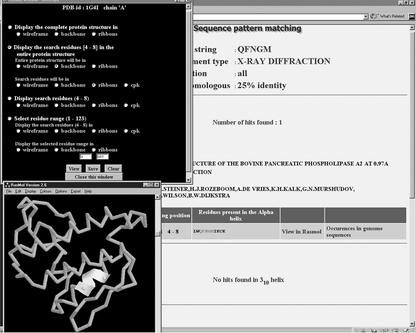
SSEP is a comprehensive resource for accessing information related to the secondary structural elements present in the 25 and 90% non-redundant protein chains. The database contains 1771 protein chains from 1670 protein structures and 6182 protein chains from 5425 protein structures in 25 and 90% non-redundant protein chains, respectively. The current version provides information about the alpha-helical segments and beta-strand fragments of varying lengths. In addition, it also contains the information about 3(10)-helix, beta- and nu-turns and hairpin loops. The free graphics program RASMOL has been interfaced with the search engine to visualize the three-dimensional structures of the user queried secondary structural fragment. The database is updated regularly and is available through Bioinformatics web server at http://cluster.physics.iisc.ernet.in/ssep/ or http://144.16.71.148/ssep/.
Figures
Similar articles
-
SSEP-2.0: Secondary Structural Elements of Proteins.Acta Crystallogr D Biol Crystallogr. 2005 May;61(Pt 5):634-6. doi: 10.1107/S0907444905005883. Epub 2005 Apr 20. Acta Crystallogr D Biol Crystallogr. 2005. PMID: 15858275
-
LySDB - Lysozyme Structural DataBase.Acta Crystallogr D Biol Crystallogr. 2004 Mar;60(Pt 3):597-600. doi: 10.1107/S0907444903029202. Epub 2004 Feb 25. Acta Crystallogr D Biol Crystallogr. 2004. PMID: 14993706
-
BSDD: Biomolecules Segment Display Device--a web-based interactive display tool.Nucleic Acids Res. 2004 Jul 1;32(Web Server issue):W645-8. doi: 10.1093/nar/gkh420. Nucleic Acids Res. 2004. PMID: 15215468 Free PMC article.
-
3dSS: 3D structural superposition.Nucleic Acids Res. 2006 Jul 1;34(Web Server issue):W128-32. doi: 10.1093/nar/gkl036. Nucleic Acids Res. 2006. PMID: 16844975 Free PMC article.
-
SEM (Symmetry Equivalent Molecules): A web-based GUI to generate and visualize the macromolecules.Nucleic Acids Res. 2003 Jul 1;31(13):3356-8. doi: 10.1093/nar/gkg587. Nucleic Acids Res. 2003. PMID: 12824326 Free PMC article.
Cited by
-
Ion pairs in non-redundant protein structures.J Biosci. 2007 Jun;32(4):693-704. doi: 10.1007/s12038-007-0069-1. J Biosci. 2007. PMID: 17762142
References
-
- Bernstein F.C., Koetzle,T.F., Williams,G.J.B., Meyer,E.F.,Jr, Brice,M.D., Rogers,J.R., Kennard,O., Shimanouchi,T. and Tasumi,M.J. (1977) The Protein Data Bank: a computer based archival file for macromolecular structures. J. Mol. Biol., 112, 535–542. - PubMed
-
- Islam S.A. and Sternberg,M.J.E. (1989) A relational database of protein structures designed for flexible enquiries about conformation. Protein Eng., 2, 431–442. - PubMed
-
- Guruprasad K., Prasad,M.S. and Kumar,G.R. (2000) Database of structural motifs in proteins. Bioinformatics, 16, 372–375. - PubMed
Publication types
MeSH terms
Substances
LinkOut - more resources
Full Text Sources
Research Materials
