


doi: 10.1093/nar/gkg598.
ChipInfo: Software for extracting gene annotation and gene ontology information for microarray analysis
Affiliations
- PMID: 12824349
- PMCID: PMC169004
- DOI: 10.1093/nar/gkg598
Item in Clipboard
ChipInfo: Software for extracting gene annotation and gene ontology information for microarray analysis
Nucleic Acids Res.
.
Abstract
To date, assembling comprehensive annotation information for all probe sets of any Affymetrix microarrays remains a time-consuming, error-prone and challenging task. ChipInfo is designed for retrieving annotation information from online databases such as NetAffx and Gene Ontology and organizing such information into easily interpretable tabular format outputs. As companion software to dChip and GoSurfer, ChipInfo enables users to independently update the information resource files of these software packages. It also has functions for computing related summary statistics of probe sets and Gene Ontology terms. ChipInfo is available at http://biosun1.harvard.edu/complab/chipinfo/.
Figures

Making Gene Information Files with ChipInfo. When the ‘Annotation→Gene Information File’ menu is clicked, a ‘Make gene information file’ dialog shows up. Designate a NetAffx file and a Gene Ontology file in the dialog as ChipInfo's inputs. The preparation method for these two files is described in the Accessing Web Databases section. The user can change the name and format of the output file.
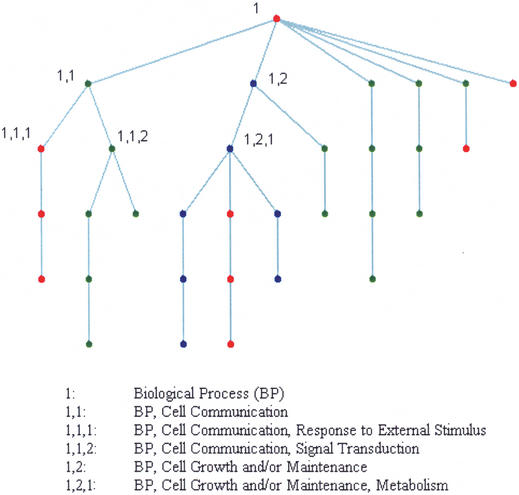
Example of GO path code. A GO term ‘Cell Growth and/or Maintenance’ is denoted by path code ‘1,2’ and its position in the GO graph is uniquely determined. This idea was originated by Ming-Chih Kao and first used by Storch et al. (11).
References
Publication types
MeSH terms
Substances
Grants and funding
LinkOut - more resources
Full Text Sources
Other Literature Sources
